
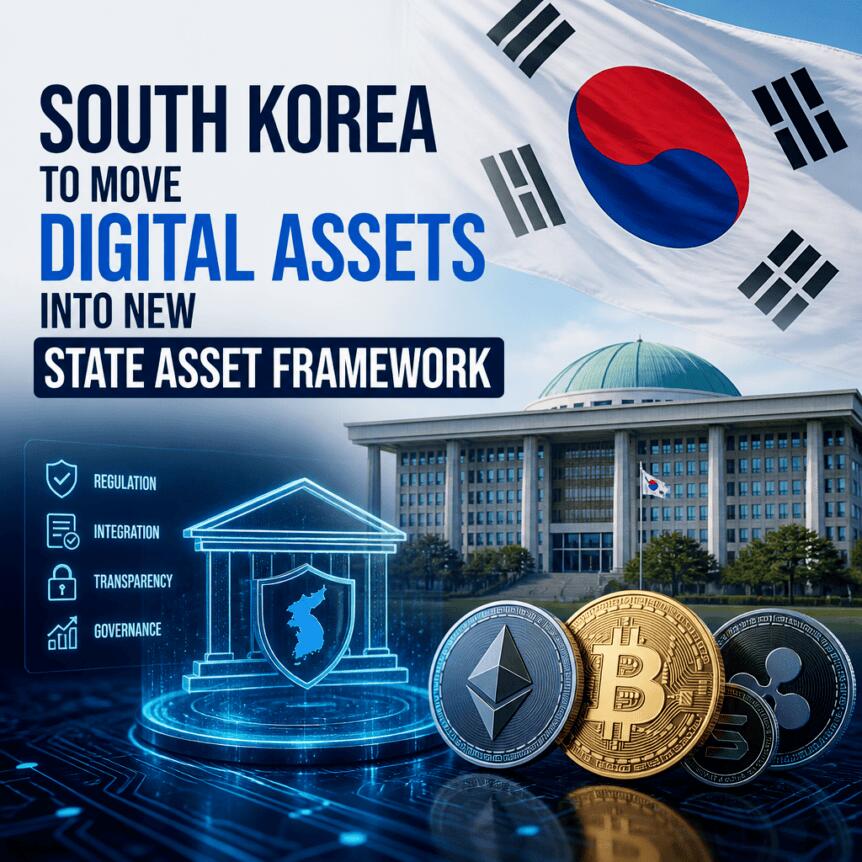
South Korea is preparing a major overhaul of how the government manages “state assets,” including digital assets and intellectual property, as part of efforts to modernize public-sector finance. The Ministry of Economy and Finance (MOEF) says it plans to replace the State Property Act—dating back to 1950—with a new National Asset Basic Act, using a broader definition of what qualifies as state-owned value.
Officials also reiterated plans to test the tokenization of government bonds on a blockchain as early as a 2027 pilot, with an eye toward reducing transaction friction. Beyond securities, the ministry said it will examine tokenizing state-owned real estate to widen retail participation and share a portion of the generated returns with the public.
Key takeaways
- MOEF is moving toward a new National Asset Basic Act to modernize public asset management and expand the legal definition to cover digital assets and intellectual property.
- The government bond tokenization plan is targeted for a 2027 pilot, framed as a way to streamline transactions.
- South Korea is also considering tokenized real-estate models designed to attract retail users and share returns.
- Separately, Seoul’s 2026 growth strategy includes a study period aimed at connecting tokenized government bonds with the Bank of Korea’s CBDC infrastructure.
- Upcoming legal changes to tokenized securities frameworks are scheduled to take full effect in early 2027, with blockchain-ledgers recognized as valid securities registries.
Replacing a decades-old asset framework
MOEF’s proposal centers on updating the legal structure for state asset management. According to the ministry, the National Asset Basic Act is intended to shift policy from a legacy approach—historically focused on tangible, real-estate-heavy state property—toward a framework centered on value creation.
The MOEF briefing held at the President’s Blue House on Wednesday emphasized that the reform would explicitly bring digital assets and intellectual property into the umbrella of state assets. The ministry linked this to a broader modernization goal: aligning the governance of government-held resources with how value is increasingly stored, transferred, and monetized in digital form.
For market participants, the significance is twofold. First, clearer legal coverage can reduce uncertainty around how non-traditional assets may be handled in government programs or public investment strategies. Second, it sets a policy foundation that can support later pilot initiatives—such as bond and real-estate tokenization—without relying on narrow interpretations of older statutes.
Tokenized government bonds and the push toward a “blockchain economy”
Regulatory and infrastructure plans are converging around tokenized government debt. Earlier coverage noted that South Korea’s government unveiled a 2026 Economic Growth Strategy for the second half, which includes a 2027 pilot intended to link tokenized government bonds to central bank digital currency (CBDC) infrastructure. As described in the government strategy, authorities plan to study how to make the Bank of Korea’s (BOK) CBDC system interoperable with other blockchains.
The interoperability concept was first publicly discussed on July 1, when BOK Governor Hyun Song Shin outlined the idea at the European Central Bank Forum on Central Banking. Building on that, the latest strategy positions the research and pilot work as part of a broader effort to develop a “blockchain economy.”
In practice, this matters because interoperability between a CBDC infrastructure layer and public or permissioned blockchain networks can affect how tokenized instruments are issued, transferred, and settled. A pilot that tests that connection in the context of government bonds—an asset class that is typically central to liquidity and price discovery—could serve as a benchmark for future tokenized issuance across other sectors.
From pilots to legal recognition for tokenized securities
South Korea’s push for tokenization is not only about infrastructure; it is also about legal status. The MOEF previously announced a pilot using tokenized deposits to execute government operational spending, with a full rollout planned for the fourth quarter of 2026. That initiative reflects a wider pattern: tokenized rails are being tested in day-to-day state functions before scaling.
Separately, changes to South Korea’s Capital Markets Act and Electronic Securities Act—designed to support the country’s early tokenized securities framework—are scheduled to take full effect on Feb. 4, 2027. The reforms aim to legally recognize blockchain-ledgers as valid securities registries.
Officials say this would bring tokenized assets under the Financial Services Commission’s jurisdiction, moving them out of a purely experimental stage. For investors, that shift is particularly important: securities registration is a core component of custody, ownership tracking, and compliance. Legal recognition of blockchain-ledgers as registries can improve clarity around operational responsibilities and investor protections, although the practical impact will depend on how regulators implement standards and supervision.
Tokenizing state real estate for retail access
Alongside the bond and CBDC-related work, MOEF is exploring tokenization of state-owned real estate. The stated goal is to encourage retail participation and share part of the returns generated from these assets with the public.
While the proposal is framed as an area for further exploration rather than a fully specified rollout, it fits the broader theme of shifting government asset management toward models that can potentially broaden access and reduce barriers to entry. Real estate has historically been difficult for retail investors to access at scale due to high capital requirements and complex transaction processes. Tokenization, at least in theory, could address parts of that problem by enabling smaller ownership units and faster transfer mechanisms.
Still, major details typically determine whether tokenized real estate becomes commercially viable—such as custody arrangements, investor suitability rules, valuation practices, and the regulatory treatment of tokenized property rights. Until those elements are clarified, the move should be viewed as a policy direction that may shape future pilots and rulemaking.
Looking ahead, investors and builders should watch for how MOEF’s National Asset Basic Act language translates into implementation, particularly regarding digital asset classification and governance. The 2026 strategy’s 2027 CBDC interoperability and the Feb. 4, 2027 legal changes to securities registries are likely to be the clearest near-term signals of how quickly tokenization can move from pilots into regulated, scalable markets.
https://www.cryptobreaking.com/south-korea-to-move-digital/?utm_source=blogger%20&utm_medium=social_auto&utm_campaign=South%20Korea%20to%20Move%20Digital%20Assets%20Into%20New%20State%20Asset%20Framework%20
Comments
Post a Comment