
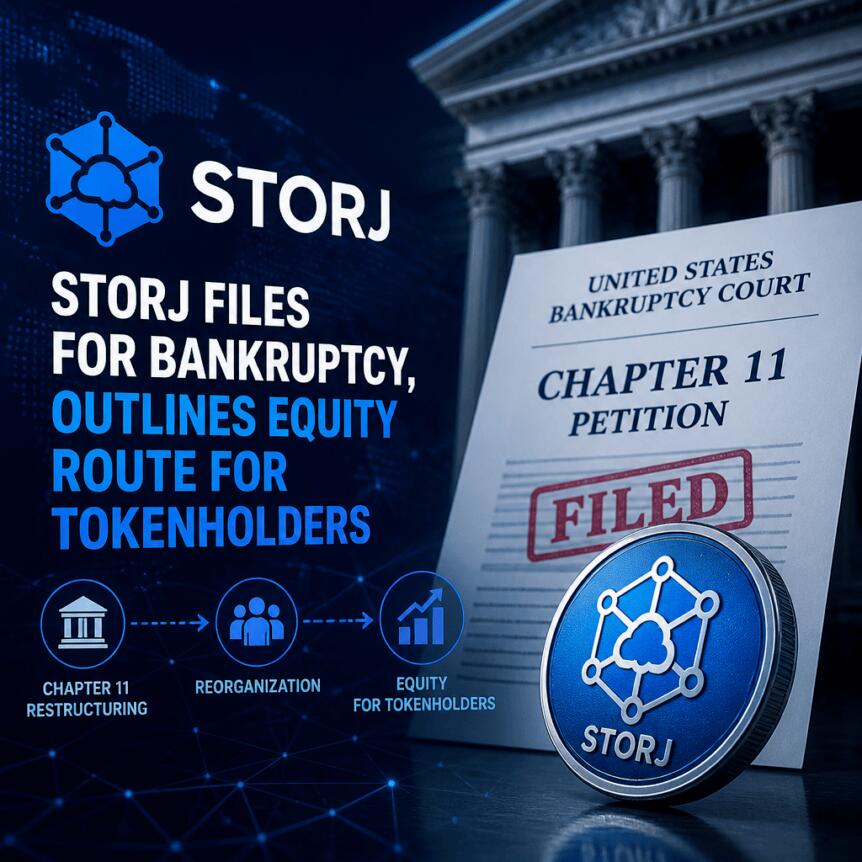
Decentralized cloud storage provider Storj Labs has filed for voluntary Chapter 11 bankruptcy protection in the United States, opening a restructuring process that could test how—if at all—utility-token holders might participate in the equity of a company that emerges from bankruptcy. The filing was made in the US Bankruptcy Court for the Northern District of West Virginia, according to a statement published by Storj.
Storj says the restructuring is aimed at addressing legacy liabilities that it argues can’t be resolved through growth alone, while keeping its network running and preserving the token’s core utility. At the time of writing, STORJ appeared to have reacted mutedly to the news, trading around $0.072 based on CoinGecko data.
Key takeaways
- Storj Labs entered voluntary Chapter 11 in the Northern District of West Virginia while stating that ordinary operations and customer services will continue under court oversight.
- The company says its liabilities largely predate its current strategy and are too large to clear solely through business expansion.
- Storj management plans to propose a pathway for STORJ token holders to participate in the equity of a reorganized company, subject to bankruptcy priorities and court approval.
- Storj has not yet detailed how tokenholder eligibility would work, including whether a token snapshot, lockup, or other criteria would be used.
- STORJ’s market reaction to the filing was limited in the immediate term, with CoinGecko showing trading near $0.072 at publication time.
Chapter 11 filing framed as a legacy-liability fix
On Sunday, Storj announced that it filed for voluntary Chapter 11 “to resolve legacy liabilities and position the business for growth,” according to a post on its own website. The company indicated that day-to-day operations would not stop, and that customer services would continue during the process, but under supervision by the bankruptcy court.
Storj also said its parent company, Inveniam, would continue to support the business throughout the restructuring. That support, along with Storj’s insistence that the underlying network remains functional, is central to the company’s message to token holders: the technology and the token’s intended role should not be treated as collateral to be sidelined while legal obligations are worked through.
A proposal for tokenholder equity—without the mechanics yet
Storj’s open letter to its community argues that the restructuring need is driven by obligations from earlier stages of the company, rather than issues stemming from the present network model. The letter also states that the network is operating normally and that the token’s utility is unchanged.
Crucially, Storj said management intends to submit a plan that would create a mechanism for token holders to participate in the reorganized company’s equity. However, the company has not disclosed essential details, including how eligibility would be determined (for example, whether participation would depend on token ownership at a particular time), whether any tokens would be locked up, or what portion of equity might be offered.
Storj acknowledged that any proposal must align with bankruptcy requirements—meaning the reorganization plan has to follow established priority rules and receive court approval. That constraint matters because Chapter 11 restructurings typically involve complex treatment of different classes of creditors, equity holders, and other stakeholders. In this case, token holders are not automatically treated as equity holders, so Storj’s approach will likely hinge on how the court-approved plan defines who receives value and under what conditions.
Cointelegraph contacted Storj for additional comment but did not receive a response before publication.
Why the Storj case is a test for utility-token ownership
Storj’s bankruptcy filing is likely to draw attention beyond its community because it sits at the intersection of two unresolved questions in crypto: how regulators and courts may interpret token-related claims in insolvency, and whether “utility” token holders can convert their economic exposure into equity-like rights during a restructuring.
The company described the restructuring as a potential “ownership pathway” for STORJ token holders, which—if it moves from proposal to approved plan—could become a reference point for other projects with token distributions and decentralized networks. At the same time, uncertainties remain. Storj has not provided a framework for how a tokenholder-to-equity mechanism would be structured, and bankruptcy priorities could limit what any token holder pathway ultimately looks like.
For market participants and builders, this is also a reminder that decentralized infrastructure tokens can still carry company-level legal and financial risk. Even when networks continue operating, restructuring plans can reshape governance expectations, economic arrangements, and the distribution of future upside.
Part of a broader Chapter 11 wave in crypto
Storj’s filing comes amid a month in which multiple crypto-related businesses sought Chapter 11 protection. Earlier coverage highlighted Movement Labs filing under Subchapter V on July 15 after turmoil connected to its MOVE token, and a separate filing by Bitcoin mining pool Poolin on July 22 as it pursued a court-supervised sale of two Texas mining sites.
Meanwhile, other exchanges faced operational endpoints without filing for bankruptcy. BitMEX announced in July that it would shut down after 11 years, following announcements connected to legal action, while BitMart said it would end trading on Aug. 26 before fully ceasing operations on Jan. 31, 2027. Storj’s case differs in that it is explicitly pursuing a court-supervised reorganization with potential equity-related outcomes for token holders.
Storj itself traces its origins to 2014, when it began as an open-source peer-to-peer cloud storage concept designed to let users rent storage from network participants rather than rely on centralized providers, according to earlier reporting. That longer history may help explain why the company emphasizes continuity: the network has market credibility and operational history, and Storj is positioning Chapter 11 as a legal course-correction rather than a shutdown.
As the bankruptcy process develops, investors and token holders will be watching for what Storj’s eventual reorganization plan actually proposes—particularly the eligibility criteria for tokenholder participation and how (or whether) any proposed equity allocation can comply with Chapter 11 priorities and court approval. The next phase will also reveal whether the network’s stated “normal operation” stance can be maintained through the litigation and settlement decisions that typically follow a major restructuring filing.
https://www.cryptobreaking.com/storj-files-for-bankruptcy-outlines/?utm_source=blogger%20&utm_medium=social_auto&utm_campaign=Storj%20Files%20for%20Bankruptcy,%20Outlines%20Equity%20Route%20for%20Tokenholders%20
Comments
Post a Comment