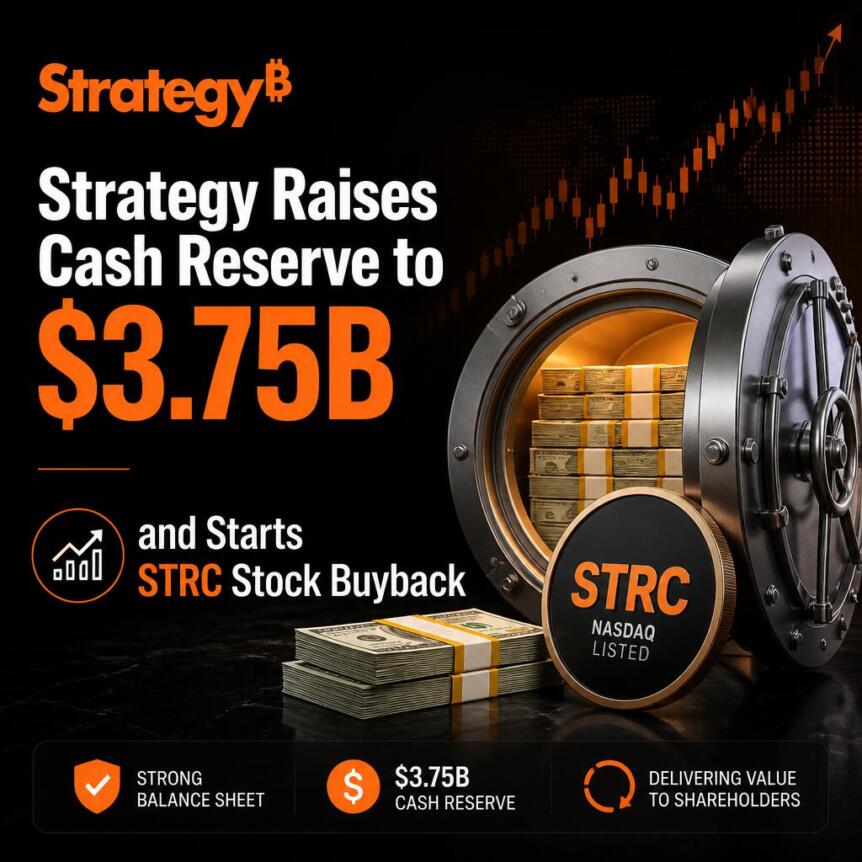
Strategy Raises Cash Reserve to $3.75B and Starts STRC Stock Buyback


Strategy expanded its cash reserve to a record $3.75 billion after selling additional MSTR shares last week. The company also completed its first STRC preferred stock buyback under its repurchase program. Meanwhile, Strategy kept its Bitcoin holdings unchanged as MSTR shares gained during premarket trading and Bitcoin remained above $65,000.


Strategy Expands Cash Reserve and Completes First STRC Buyback


Strategy increased its USD reserve by $525 million after raising about $544.5 million through MSTR stock sales. The latest filing with the U.S. Securities and Exchange Commission confirmed the updated reserve position. As a result, the company now holds $3.75 billion in cash reserves.


The larger reserve gives Strategy about 2.1 years of dividend coverage under current estimates. At the same time, the company executed its first STRC preferred stock repurchase. Strategy bought back 288,930 STRC preferred shares for approximately $25 million.


The repurchase formed part of the Digital Credit Securities Repurchase Program announced last month. After the transaction, Strategy retained $975 million for additional preferred stock repurchases. Meanwhile, the MSTR share repurchase program still has about $1 million available for future purchases.


Bitcoin Holdings Stay Unchanged as Capital Strategy Continues


Strategy did not purchase additional Bitcoin during the latest reporting period. Instead, the company continued raising capital through MSTR share sales. The company still holds 843,775 BTC valued at approximately $58.47 billion.


Strategy acquired those Bitcoin holdings for about $63.68 billion over several years. Consequently, the company currently carries more than $5.21 billion in unrealized losses. However, the company has maintained its long-term Bitcoin treasury approach despite recent market fluctuations.


Strategy remains the largest corporate holder of Bitcoin among publicly traded companies. The company has regularly financed Bitcoin acquisitions through equity offerings and preferred stock issuance. However, the latest filing focused on strengthening liquidity instead of expanding Bitcoin holdings.


MSTR Shares Rise as Bitcoin Holds Above $65,000


MSTR shares closed 2.09% lower at $91.67 during Friday's regular trading session. The stock traded between $89.76 and $93.68 before finishing below the previous close. Trading volume also remained below the stock's 20 million share average.


Premarket trading showed renewed buying activity after the latest corporate filing became public. MSTR gained 2.21% and traded near $93.70 before the opening bell. Even so, the stock remains down about 10% over the past month and nearly 50% this year.


Meanwhile, STRC shares advanced 1.66% to $88.33 but remained below the preferred stock's $100 target price. Several brokerage firms have maintained buy ratings on MSTR with an average 12-month target of $275. At the same time, Bitcoin traded above $65,000 after developments in Iran-Oman discussions supported broader market sentiment, while trading volume increased 86% during the past 24 hours.


https://www.cryptobreaking.com/strategy-raises-cash-reserve-to/?utm_source=blogger%20&utm_medium=social_auto&utm_campaign=Strategy%20Raises%20Cash%20Reserve%20to%20$3.75B%20and%20Starts%20STRC%20Stock%20Buyback%20

Comments

Popular posts from this blog

Mastercard Launches AI Agent Pay System With Ripple and Solana Help

Mastercard has launched Agent Pay for Machines, a payments system built for autonomous software agents. The service allows AI agents to send and receive payments without direct human action. It brings Ripple, Coinbase, and Solana Foundation into Mastercard’s push for automated digital commerce. Ripple Brings XRPL and RLUSD to Mastercard’s Agent Pay System Mastercard introduced Agent Pay for Machines on June 10 as a tool for machine-led payments. The system targets high-volume and low-value transactions across business and consumer use cases. It also supports automated settlement between software agents and connected machines. Ripple will support the system through the XRP Ledger and its RLUSD stablecoin. The company said that settlement will become more important as automated commerce grows. It also sees blockchain rails as useful for fast and rule-based payments. RippleX senior vice president Markus Infanger said XRPL and RLUSD support enterprise-grade agent payments. He said the tool...

Coinbase's x402 launches AI agents app store for payments

Coinbase-backed x402 has unveiled Agentic.market, a dedicated marketplace aimed at increasing the usefulness of AI agents by aggregating thousands of apps and services that agents can access without any API keys. The rollout positions the platform as a central hub for agents to discover, evaluate, and deploy capabilities across a standardized payments layer. Coinbase product lead Nick Prince described Agentic.market in a video posted on X as a storefront for discovering, comparing, and using x402 services. The marketplace is designed to give both humans and their AI agents access to a wide range of tools—from data feeds to consumer apps—without the friction of managing API credentials. A storefront for discovering, comparing, and using x402 services. Thousands of services. Zero API keys. Powered by x402. Prince added that the market offers a web interface for humans to browse and assess services, alongside a programming layer that lets AI agents autonomously search, filter, and integra...

Solana Policy Institute Calls on SEC to Safeguard DeFi Developers from Overly Strict Regulations

US Crypto Policy Innovation: Advocates Push for Clear Regulations and Developer Protections The Solana Policy Institute has urged the U.S. Securities and Exchange Commission (SEC) to differentiate between centralized crypto exchanges and non-custodial decentralized finance (DeFi) software. The nonprofit emphasizes that developers creating and publishing non-custodial code should not be classified as intermediaries, advocating for balanced regulation that fosters innovation without compromising security or legality. Key Takeaways Advocates call for regulatory clarity distinguishing between non-custodial DeFi protocols and centralized exchanges. The Institute argues that applying traditional securities laws to DeFi code risks stifling innovation and pushing activity offshore. Authorities are encouraged to adopt a custody-and-control-based framework to clarify legal liabilities. Legislation proposals aim to shield developers from legal liabilities associated with blockchain code and activ...