
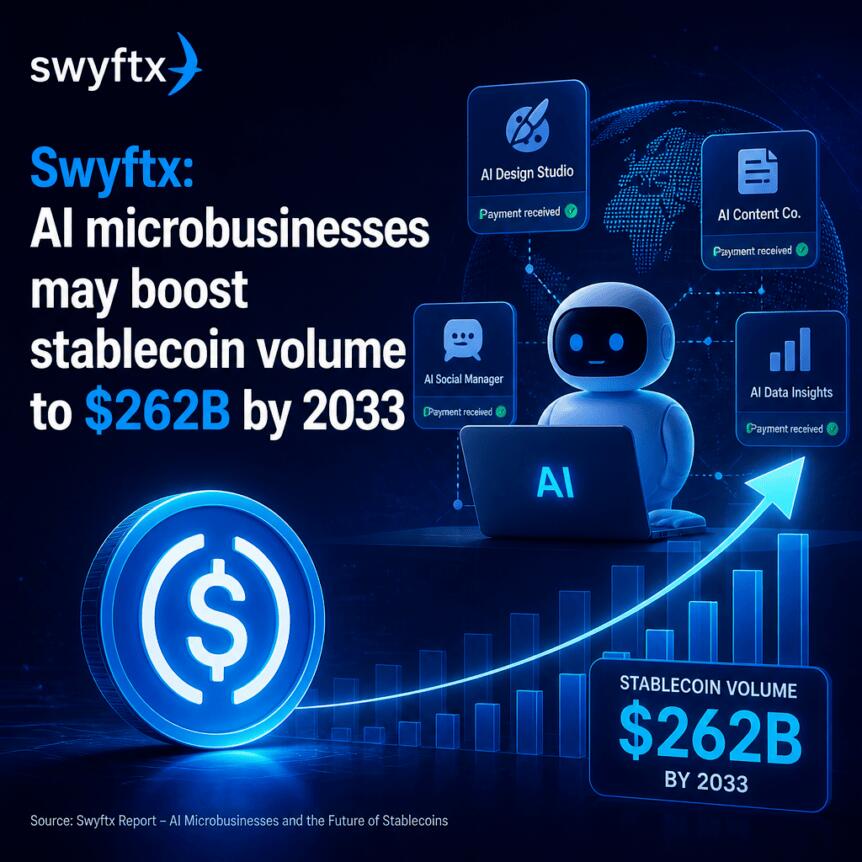
Australia-based crypto exchange Swyftx says the next wave of stablecoin usage may come from the people and businesses already pushing against the limits of traditional payments: gig workers, freelancers, and AI-enabled solo operators. In a second-quarter industry report, the exchange links the expanding gig economy—particularly cross-border freelance work—to a potential jump in stablecoin settlement.
The report models a global gig and freelance payments market that could grow to $2.1 trillion by 2033, with AI-native workers representing a $775 billion portion of that total. Under Swyftx’s base-case assumptions, about $262 billion of that AI-native payment volume could be settled using stablecoins, implying adoption of roughly 33% for the modeled cohort.
Key takeaways
- Swyftx projects gig and freelance payments could reach $2.1 trillion by 2033, with AI-native workers accounting for $775 billion.
- In its base case, Swyftx estimates $262 billion of AI-native payment volume could be settled in stablecoins at an assumed ~33% adoption rate.
- The exchange points to solo entrepreneurs and small businesses as among the fastest-moving in AI adoption, creating a new customer segment sensitive to fees.
- Swyftx cites stablecoin transaction volumes rising to a record $1.79 trillion in June, reinforcing the idea that payment utility demand is real.
- It argues stablecoins can outperform cross-border rails on cost and speed, particularly for frequent, cross-border invoices.
Why gig work and AI-native labor are central to stablecoin demand
Swyftx’s thesis starts with who is paying and how often. The exchange argues that the smallest employers—firms with fewer than five employees—are adopting AI at a faster pace than larger organizations. That shift, it says, contributes to a rise in solo entrepreneurs who operate across borders and invoice frequently.
Because these workers often face payment amounts and settlement rhythms that standard banking and payment infrastructure are not optimized for, Swyftx frames stablecoins as a natural fit. It estimates there are currently about 6 million to 10 million solo workers globally, projecting growth to 17 million over the next decade.
Lead market analyst Pav Hundal told Cointelegraph that the appeal of stablecoins is increasingly tied to economics rather than just technology. “Adoption doesn’t happen just because the technology exists. It happens when the economics are compelling, and the rules are clear,” Hundal said, adding that both conditions are “falling into place.”
Stablecoin volumes are already signaling payment utility
The exchange’s predictions build on recent usage trends. Swyftx notes stablecoins have doubled in market capitalization over the past two years and reached a record $1.79 trillion in volume in June—figures Swyftx presents as evidence of growing payment demand.
The report also emphasizes that stablecoin activity is not only about end users; it can extend to the “settlement layer beneath” the payment routes. Swyftx suggests that if its modeled scenario develops, the infrastructure supporting settlements—such as over-the-counter liquidity, custody, and yield services used by platforms—could capture a new revenue stream.
In that framework, Swyftx estimates this could reach as much as $1.3 billion by 2033, assuming total transaction, liquidity, and custody costs of 0.5% across the relevant payments.
For context, earlier coverage from Cointelegraph highlighted the June record by noting stablecoin transaction volume at $1.79 trillion and linking it to broader payment-oriented narratives. Stablecoin transaction volume hits record $1.79T in June
Lower fees, faster settlement, and a more global customer base
In Swyftx’s account, traditional cross-border payment rails tend to impose three frictions that matter most to frequent freelancers: high fees, multi-day settlement windows, and uneven availability across jurisdictions. The exchange also asserts that many rails exclude users in more than 50 countries, which can limit the addressable freelance base.
To illustrate the potential advantage, Swyftx points to stablecoin transfers using Ethereum layer-2 networks as an example of how costs and time can improve. It claims such transfers can cut fees by 80% to 90%, saying an average freelancer could save about 86% per year in transfer fees under the cited example.
The report also ties the stablecoin payments outlook to the broader “agentic AI” narrative. Swyftx argues that AI agents—unlike human users—cannot easily obtain bank accounts. As a result, it says they will likely rely on crypto-based assets to execute payments.
That point aligns with earlier Cointelegraph reporting on the idea that autonomous AI agents with crypto access could become a meaningful payments driver. Autonomous AI agents with crypto access could become unstoppable
What investors should watch next
Swyftx’s projections are directionally clear—stablecoins may benefit as AI-native work increases and small operators demand cheaper, faster international settlement. The key uncertainty is adoption: the exchange’s base case assumes roughly one-third adoption of stablecoins within its modeled AI-native payment cohort by 2033. Traders and builders should watch whether stablecoin use keeps rising in real payment flows at the same pace suggested by recent volume records, and whether regulatory and on-ramps/off-ramps continue to make the “economics and rules” Hundal references more consistent across jurisdictions.
https://www.cryptobreaking.com/swyftx-ai-microbusinesses-may-boost/?utm_source=blogger%20&utm_medium=social_auto&utm_campaign=Swyftx:%20AI%20microbusinesses%20may%20boost%20stablecoin%20volume%20to%20$262B%20by%202033%20
Comments
Post a Comment