
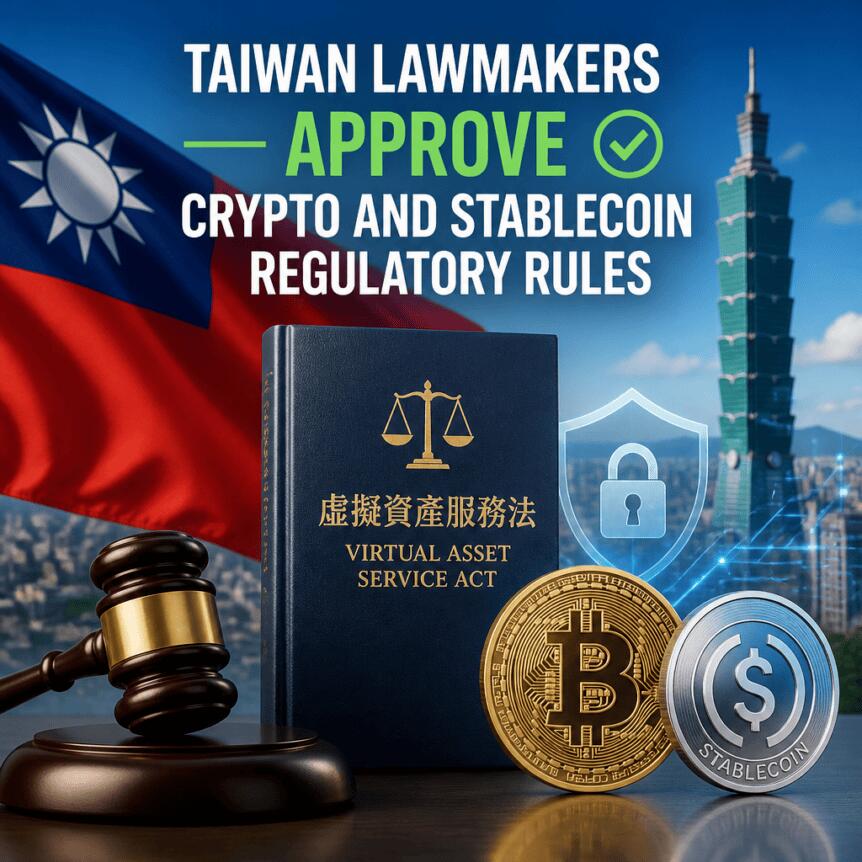
Taiwan has taken a major step toward formalizing the country’s crypto market, with lawmakers passing a new law that sets out a regulatory framework for virtual assets and stablecoins. The package establishes a licensing regime for virtual asset service providers (VASPs) and introduces specific approval, reserve, and audit requirements for stablecoin issuers.
According to Taiwan’s Financial Supervisory Commission (FSC), the Legislative Yuan passed the bill on Tuesday, requiring VASPs to obtain regulatory approval before operating. The FSC said the move is designed to strengthen protections for traders’ rights while helping Taiwan integrate with international financial markets.
Key takeaways
- Taiwan’s new law creates a licensing regime for virtual asset service providers, overseen by the FSC.
- Stablecoins issued in Taiwan must receive approval from both the central bank and the FSC, with reserve and audit requirements.
- The framework covers multiple VASP categories, including exchanges, trading platforms, custodians, and lenders.
- The law criminalizes crypto-related fraud and price manipulation, with penalties including prison time and substantial fines.
- Implementation timing depends on publication by the executive branch, with a post-implementation license application window for firms that already completed AML registration.
Licensing and oversight for VASPs
The FSC said all VASPs in Taiwan must be authorized by the regulator before they can legally operate. The law is described as Taiwan’s first comprehensive regime specifically addressing crypto and stablecoins, aligning the jurisdiction with other major Asian markets in the region—such as Japan, Singapore, and Hong Kong—that have already moved ahead with crypto legislation to encourage industry participation.
Under the rules, Taiwan defines seven types of VASPs, including exchanges and trading platforms, as well as custodians and lenders. Regardless of category, the law requires regulated firms to maintain robust internal controls and undergo audits. It also sets expectations around cybersecurity systems, listing and delisting standards for crypto assets, customer-asset segregation, and financial reporting.
Stablecoin approval, reserves, and audits
Stablecoins receive their own regulatory structure within the bill. The law states that any stablecoin issued in Taiwan must obtain approval from both the central bank and the FSC. Issuers are required to maintain sufficient reserves, with those reserves held with a trustee.
In addition, stablecoin issuers must undergo regular audits. By combining multi-agency approval with reserve custody and recurring review, the framework aims to reduce the risk of under-collateralization and improve transparency for token holders.
The FSC argued that stablecoin issuance can help Taiwan connect more effectively to international markets and strengthen its position in the global crypto sector.
Enforcement: fraud and unlicensed operation carry prison and fines
The bill also lays out enforcement measures aimed at preventing misconduct in the crypto sector. The law prohibits crypto-based fraud and price manipulation, and it sets penalties that range from three to 10 years in prison, along with fines estimated at roughly 10 million New Taiwan dollars (about $300,000) to 200 million New Taiwan dollars (about $6.3 million).
For individuals or entities that operate a VASP or issue a stablecoin without the required license, the law increases the stakes: CNA reported that unauthorized activity can result in up to seven years in prison and fines of up to 100 million New Taiwan dollars (about $3.1 million).
These figures signal that Taiwan intends to treat compliance as a central condition for market access, rather than a purely administrative requirement.
What happens next: publication, timing, and a follow-on derivatives proposal
While the legislative step is complete, the law’s timeline is not yet fully operational. The implementation date remains undecided, and the framework will only take effect after it is published by the government’s executive branch.
In the meantime, the FSC said VASPs that have already completed anti-money laundering (AML) registration before implementation can apply for a license within 12 months after the bill becomes effective. Institutions providing related services under the FSC also fall within the same general post-implementation window, according to the regulator’s comments.
Separately, CNA reported that lawmakers passed a resolution asking the FSC to propose a plan within a year detailing how the crypto industry could offer derivative crypto commodity services. The resolution frames the effort as a way to provide diversified investment options while improving the overall health of the sector—but it does not change the fact that the new law’s immediate focus is licensing, stablecoin rules, and market conduct.
Regional implications for traders and industry participants
For market participants, the practical effect of the bill will hinge on the licensing process that follows implementation—especially for platforms handling customer assets, custody, or market operations. The stablecoin provisions are likely to be particularly consequential for issuers and reserve holders, since the framework explicitly requires approvals from both Taiwan’s central bank and the FSC, along with trustee-held reserves and regular audits.
Readers should watch next for the executive-branch publication date and any subsequent guidance from the FSC on how it will evaluate VASPs across the seven defined categories, including cybersecurity expectations, customer-asset segregation practices, and listing/delisting rules. Until those details land, firms can prepare for compliance work, but the final operational path will depend on how regulators translate the law into enforceable procedures.
Sources: FSC statement (as reported in the provided material); CNA report on penalties and timelines; Cointelegraph link referenced for context.
https://www.cryptobreaking.com/taiwan-lawmakers-approve-crypto-and/?utm_source=blogger%20&utm_medium=social_auto&utm_campaign=Taiwan%20Lawmakers%20Approve%20Crypto%20and%20Stablecoin%20Regulatory%20Rules%20
Comments
Post a Comment