
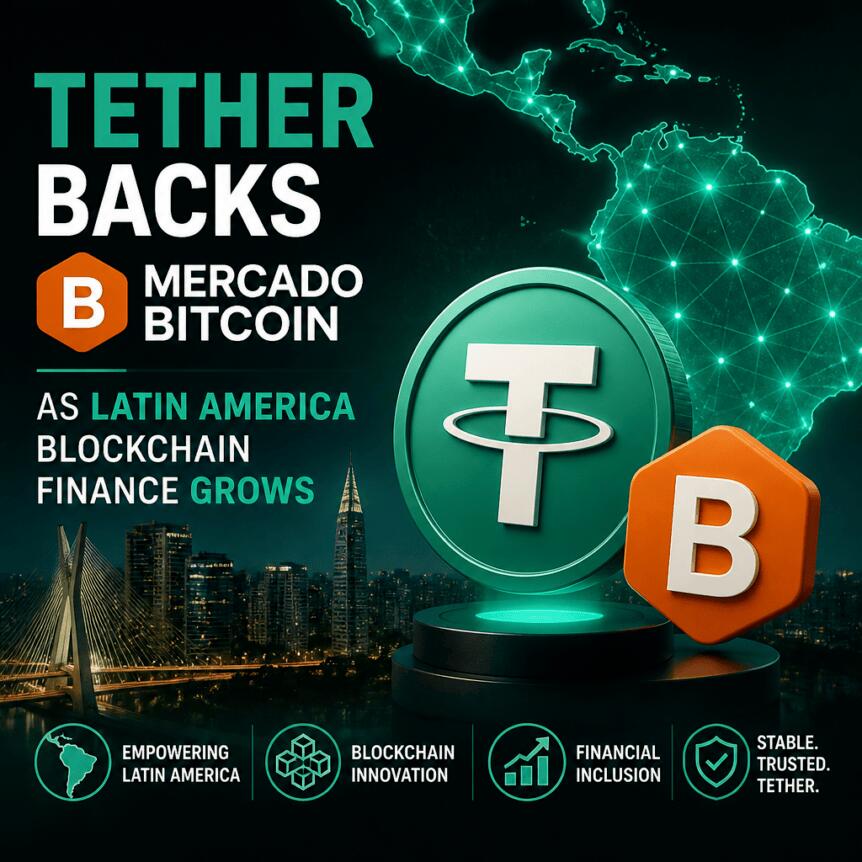
Tether has taken a $20 million stake in Brazil’s Mercado Bitcoin as it pushes further into tokenized financial products and stablecoin-powered payments across Latin America. The investment is intended to back the company’s expansion into tokenized assets, lending and other blockchain-based services throughout the region.
Mercado Bitcoin, originally launched in 2013 as a crypto trading venue, has since broadened into regulated financial offerings. The platform says it now serves more than 4.5 million users and has issued over 2 billion Brazilian reais (about $370 million) in tokenized assets, while operating under nearly a dozen licenses in Brazil and Europe, including a payment institution authorization from Brazil’s central bank.
Key takeaways
- Tether’s $20 million investment targets Mercado Bitcoin’s expansion into tokenized assets, lending and stablecoin payments in Latin America.
- Mercado Bitcoin positions its business model as “onchain” financial infrastructure supported by multiple licenses, including Brazil’s payment institution framework.
- Tether says it is using profits from its stablecoin business (including USDT) to fund strategic investments in blockchain financial services.
- The deal builds on Mercado Bitcoin’s earlier tokenization deployments, including a $20 million private credit rollout on Bitcoin’s Rootstock sidechain.
Tether backs Mercado Bitcoin’s regulated onchain push
The partnership highlights how stablecoin issuers are increasingly funding regulated platforms rather than focusing solely on token supply. Tether Investments’ stated approach is to support companies building blockchain-based financial infrastructure, and Mercado Bitcoin is positioned as one of Latin America’s most developed “regulated onchain” ecosystems—according to Tether CEO Paolo Ardoino.
Ardoino said Mercado Bitcoin has established a comprehensive platform by combining licensing, tokenization capabilities, and integrated financial services. For investors and users, the practical takeaway is that the project is aiming to connect tokenization and payments to mainstream financial rails under oversight, rather than treating blockchain services as purely standalone experiments.
While the statement emphasizes regulatory breadth, the investment also implicitly addresses a core challenge facing tokenized finance: making tokenized products easier to deploy within existing legal and payment frameworks. Mercado Bitcoin’s cited license footprint—spanning Brazil and Europe, and including a Brazilian central bank payment institution license—suggests the company intends to keep expanding within compliance constraints as it adds more stablecoin and tokenized offerings.
Tokenization momentum: from private credit to wider asset services
Mercado Bitcoin’s broader tokenization strategy appears to be accelerating. In February, the platform announced it had deployed more than $20 million in tokenized private credit, describing this as part of its expanding real-world asset (RWA) activity. That deployment was carried out on Bitcoin’s sidechain Rootstock, according to earlier reporting from Cointelegraph: Mercado Bitcoin expands LatAm RWA push.
Against that backdrop, Tether’s new investment can be read as reinforcement of a direction already underway: scaling tokenization use cases beyond early pilots. The company’s most recent plan explicitly includes stablecoin payments and lending—two segments that typically require not only token issuance and custody capabilities, but also reliable payment processing and settlement infrastructure.
Still, the specific operational details of how the $20 million will be allocated within Mercado Bitcoin’s product stack weren’t provided in the information available here. Readers should watch for updates on whether the funding is earmarked for token issuance infrastructure, credit origination/servicing, or specific stablecoin settlement integrations.
Where Tether’s money is coming from
For Tether, the Mercado Bitcoin investment fits a broader pattern of deploying capital through its investment arm. The company issues USDT, which it describes as the largest stablecoin by circulation, with about $184 billion in circulation cited in the underlying material.
In its Q1 2026 results, Tether reported approximately $1.04 billion in net profit and said it is using those earnings for strategic investments. The underlying report also notes ongoing emphasis on reserves; the investment announcement ties directly to this broader capital deployment thesis via Tether’s finance strategy.
Beyond Mercado Bitcoin, Tether’s participation in other initiatives—such as a $134 million funding round for the Stablecoin Development Corporation—has also been framed as part of expanding the “stablecoin economy” and the infrastructure around it. In April, Tether backed that financing round, and later invested in remittance platform LemFi with the aim of supporting USDT settlement for cross-border payments across Africa and Asia.
Tether also outlined plans to work with the Government of Georgia to launch a stablecoin pegged to the Georgian lari under the country’s digital asset framework. Separately, Tether has said it invests in sectors including artificial intelligence, energy, biotechnology and digital media through its investment arm.
Signals for stablecoin adoption and regulated finance in LatAm
The Mercado Bitcoin deal matters because it sits at the intersection of three trends: tokenization of real-world assets, stablecoin payments, and regulatory-driven rollout. Stablecoins can reduce settlement friction, while tokenized credit and other RWAs aim to bring traditional financial products onto blockchain rails. Mercado Bitcoin’s licensing and reported track record are positioned as the bridge between those worlds.
For users in Brazil and across Latin America, the most meaningful question is whether stablecoin payments and lending will become integrated into Mercado Bitcoin’s regulated financial stack in a way that supports scale—especially for remittances, merchant payments, and other high-frequency use cases. For builders and institutional participants, the investment suggests continued demand for compliant infrastructure that can connect tokenized assets to payment systems.
There’s also an important context point: Tether leadership has previously addressed speculation about going public. Paolo Ardoino said the company has no plans to go public, according to a social post linked in the underlying material.
That clarification doesn’t change the Mercado Bitcoin story directly, but it underscores that the investment strategy is being presented as an ongoing part of Tether’s operating approach rather than a short-term funding maneuver tied to corporate restructuring.
Next, the market will likely look for concrete milestones from Mercado Bitcoin: how quickly stablecoin payments and lending roll out under its licensing framework, and whether additional tokenized credit or other RWAs expand beyond the earlier Rootstock-based deployment. The $20 million investment is a clear signal of intent, but execution details will determine how much of Latin America’s tokenized-finance promise turns into sustained, usable products.
https://www.cryptobreaking.com/tether-backs-mercado-bitcoin-as/?utm_source=blogger%20&utm_medium=social_auto&utm_campaign=Tether%20Backs%20Mercado%20Bitcoin%20as%20Latin%20America%20Blockchain%20Finance%20Grows%20
Comments
Post a Comment