
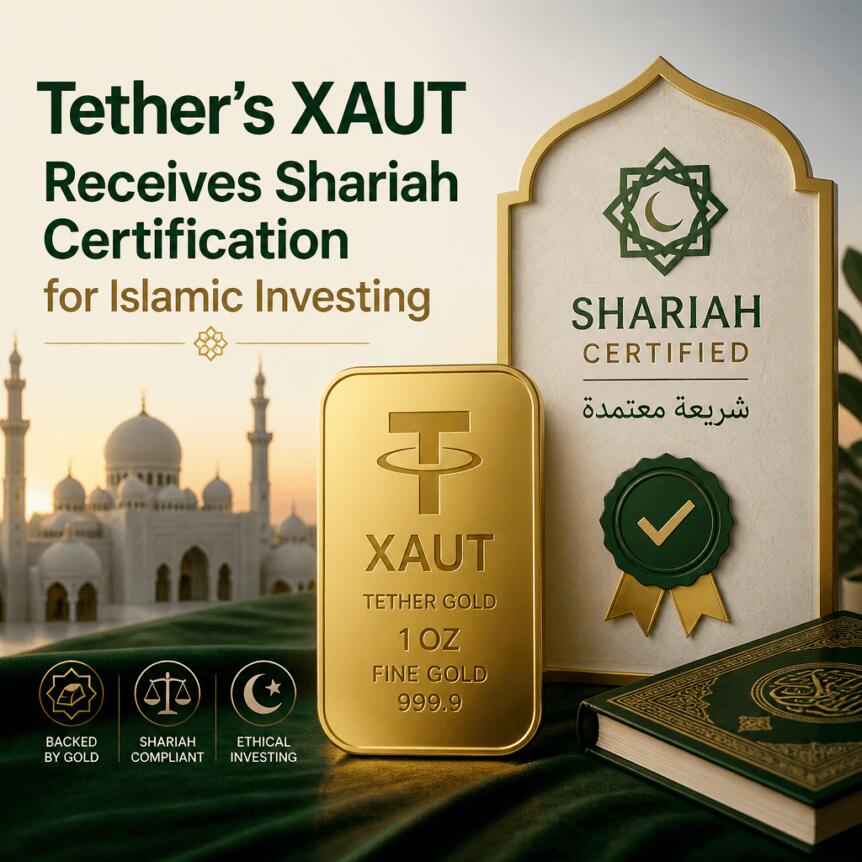
Tether’s gold-backed token XAUt has secured Shariah certification from Amanah Advisors, positioning the product for wider use among Islamic financial institutions and investors seeking Shariah-compliant exposure to physical bullion. The move focuses on whether the token’s underlying design aligns with Islamic finance principles, particularly around how value is held and whether income-generation features introduce interest-related concerns.
According to Tether, the certification concluded that XAUt’s structure complies with key Shariah requirements, including full backing by physical gold, the absence of interest and leverage, and transparent reserves. Tether says each XAUt token corresponds to one troy ounce of physical gold held in Swiss vaults.
Key takeaways
- XAUt received Shariah certification from Amanah Advisors, strengthening its suitability for Islamic financial institutions and investors.
- Tether says the token is fully backed by physical gold, with reserves designed to be transparent and structured without interest or leverage.
- As of March 31, Tether reported XAUt reserves exceeding 707,000 troy ounces worth more than $3.3 billion.
- Onchain data cited by RWA.xyz indicates XAUt’s asset value has risen from about $700 million in July 2025 to roughly $2.5 billion.
Why Shariah certification matters for tokenized gold
For many investors, the question is not simply whether an asset is pegged to a real-world commodity, but whether the product’s mechanics fit within Shariah guidelines. Islamic finance frameworks generally restrict practices considered to involve excessive uncertainty, speculative dynamics, or interest. Those constraints have historically created a barrier for broader adoption of mainstream crypto and tokenized offerings.
By obtaining certification, Tether has effectively reduced one of the main due-diligence hurdles for compliance-focused stakeholders. Tether said the certification gives it a clearer path to distribute XAUt to Islamic banks and institutions, as well as individual investors across regions where Islamic finance is widely practiced, including the Gulf Cooperation Council, South Asia, and parts of Africa.
In addition, Tether highlighted reserve transparency and physical custody as central to the compliance narrative. Tether’s position is that each token represents one troy ounce of gold stored in Swiss vaults, and that the token is not engineered with leverage or interest-bearing features.
Reserve coverage and growth in tokenized gold exposure
XAUt is described by Tether as one of the largest tokenized gold products in the crypto market. The company’s latest reserves reporting (available via Tether’s gold reserve reports page) showed that the token was backed by more than 707,000 troy ounces of physical gold as of March 31, representing a value above $3.3 billion.
Beyond reserve size, demand signals also matter. Data cited by RWA.xyz suggests XAUt’s onchain asset value has expanded significantly over the past year. The article notes that the figure rose from approximately $700 million in July 2025 to around $2.5 billion, indicating growing interest in gold exposure delivered through token infrastructure.
While tokenized commodities are often discussed through the lens of liquidity and accessibility, the key point for investors is how Shariah certification and physical backing can intersect with market demand. If institutions in Shariah-compliant finance ecosystems can evaluate the product with fewer structural objections, it may help unlock new distribution channels—particularly where regulators and compliance departments scrutinize whether a product’s income or risk characteristics violate established principles.
Broader trend: more Shariah-compliant crypto products
Debate over cryptocurrency’s compatibility with Islamic finance has been ongoing. As discussed in earlier coverage referenced by the source, scholars have differed on whether digital assets meet Shariah expectations due to concerns such as speculation and uncertainty. Over time, however, efforts to design compliant products have started to gain traction.
One example highlighted in the source dates back to 2025, when a Bahrain-based group, AlAbraaj Restaurants Group, said it adopted a Bitcoin treasury strategy and intended to develop Shariah-compliant financial instruments to broaden access to Bitcoin within the Islamic world.
More recently, the source points to developments in stablecoin infrastructure. In April, Palm Azgar Finance expanded its Shariah-compliant PUSD stablecoin to ADI Chain, positioning it around the scale of the global Islamic finance market. The source notes that PUSD became the second stablecoin available on that network, enabling institutions to settle transactions using either a dollar-linked asset or a dirham-denominated token on the same infrastructure.
Taken together, these examples frame a shift from theoretical compliance debate toward product engineering—attempts to structure crypto exposure in a way that can pass institutional review. Tether’s XAUt certification fits that broader pattern by targeting a concrete barrier: certification by a recognized advisor that can assess whether a tokenized gold product is consistent with Shariah guidelines.
Middle East momentum and the regulatory backdrop
Distribution is not just about product design; it also depends on how regional regulators handle digital asset services. The source describes Dubai as an increasingly prominent crypto hub and notes that the emirate’s Virtual Assets Regulatory Authority (VARA) issued its 50th virtual asset service provider license earlier this month. The article adds that this puts Dubai ahead of Hong Kong and Singapore in the number of licensed crypto firms, underscoring the pace of regulated market development in the region.
For tokenized assets like XAUt, regulatory clarity can influence whether institutions consider adoption—especially when they need to align token distribution, custody, and settlement practices with local compliance requirements. Shariah certification addresses a religious/contractual suitability question, while licensing and regulatory frameworks address operational and legal concerns. Together, the two can determine how quickly eligible products can move from niche demand to broader institutional access.
Looking ahead, the key variable will be how fast Shariah-compliant finance players incorporate XAUt into their offerings after certification. Investors and institutions should watch for indications of new partnerships, clearer market access strategies by Tether, and evidence that demand growth continues in step with the asset’s reserve reporting and onchain uptake.
https://www.cryptobreaking.com/tethers-xaut-receives-shariah-certification/?utm_source=blogger%20&utm_medium=social_auto&utm_campaign=Tether’s%20XAUT%20Receives%20Shariah%20Certification%20for%20Islamic%20Investing%20
Comments
Post a Comment