
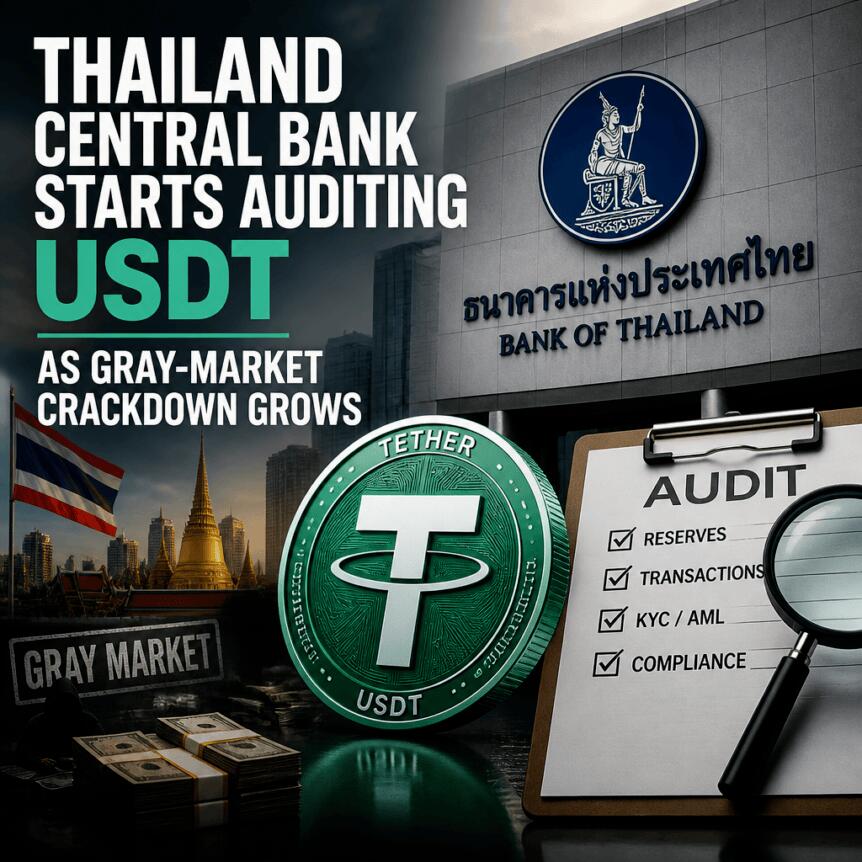
Thailand’s central bank is intensifying oversight of stablecoin activity, aiming to reduce the use of digital assets in money laundering, illicit finance, and cash-linked “gray money.” The Bank of Thailand said it is working alongside the country’s Securities and Exchange Commission to audit high-volume stablecoin transfers, with a particular focus on USDT (USDT), cash movements, and currency exchange flows.
The effort is part of a broader anti-financial-crime push that targets suspicious funds that may originate from scams and other criminal operations. Bank of Thailand Governor Vitai Ratanakorn told local media outlet The Nation that the changes are not meant to be a quick fix, but rather a continuous program requiring multiple parallel approaches.
Key takeaways
- The Bank of Thailand and the SEC will audit high-volume stablecoin transactions, prioritizing USDT-related activity alongside cash and foreign exchange behavior.
- New compliance expectations will extend beyond crypto—covering cash networks, currency exchanges, and gold bullion trading—where suspicious patterns may be linked to illicit flows.
- Thailand plans tighter reporting rules for large cash transactions, including source-of-funds declarations and scrutiny of suspicious banknote exchanges.
- Regulators are also seeking to address “gray money,” a category closely associated in the reporting with scam-linked proceeds.
- The crackdown arrives after prior steps that reportedly affected a wider set of bank customers than intended, highlighting execution risks.
Why the stablecoin spotlight is widening
Stablecoins have become a common bridge for moving value quickly across borders, and Thai authorities are now treating that speed as a potential vulnerability when paired with illicit funding sources. According to the report, the central bank’s focus includes high-volume stablecoin transactions and the routes they may connect to—including exchanges between cash and different currencies.
Thailand is also emphasizing “gray economy” activity. While the article notes there are no reliable figures for the size of the gray economy, it cites a reported $3.4 billion in 2025 scam losses alongside 173 million scam calls and texts. Against that backdrop, regulators appear to be building out monitoring capabilities designed to detect suspicious transaction structures rather than relying solely on post-incident enforcement.
What regulators plan to monitor in practice
In addition to stablecoin transfers, the proposed surveillance program is described as expanding commercial bank compliance responsibilities across several channels. These include cash networks, currency exchanges, and gold bullion trading, alongside “suspicious stablecoin transactions.” The objective, as presented in the reporting, is to reduce the likelihood that regulated intermediaries help facilitate corruption or shadow-economy behavior.
The measures also include reporting requirements for cash activity. For example, the article says high-value cash transactions will require a source-of-funds declaration. It also notes that exchanging large volumes of big banknotes for smaller denominations without a clear business purpose will be monitored, suggesting authorities want to identify patterns consistent with laundering workflows.
The report further states that cash deposits above 5 million baht (about $150,000) will require full disclosure. For market participants, that signals a compliance posture that treats large cash movements as higher-risk, even when those funds never touch an on-chain wallet—an important point for Thai businesses operating between traditional finance and crypto-linked payment rails.
Crypto rules remain layered: legal trading, tighter stablecoin scrutiny
Thailand is often portrayed as relatively open to digital assets, but the central bank’s stance on payment uses remains restrictive. The article reiterates that stablecoin and digital asset payments are outlawed by the central bank, while crypto trading remains legal in the country. That creates a policy tension: while trading is permitted, authorities are still trying to prevent certain transaction uses that can support illicit behavior.
According to the report, Thailand’s largest exchange, Bitkub, handles roughly $26 million in daily volume. CoinGecko data cited in the article indicates that nearly 40% of that activity is tied to forex, with the USDT/THB pair noted as the most popular. This matters because stablecoins can function as a practical liquidity tool for currency-related trading—meaning monitoring efforts could intersect with everyday market operations even if the underlying business is legitimate.
Thailand’s regulatory tightening has not been a one-off. The article points to ongoing rule changes around crypto funding and compliance expectations for crypto businesses, suggesting the stablecoin surveillance push is part of a longer shift toward stronger enforcement rather than a sudden reversal.
Past enforcement backlash is shaping the risk calculus
The stablecoin monitoring initiative comes after a broader banking crackdown on suspicious accounts. The article says Thai banks restricted or froze accounts in 2025 as part of efforts to target mule accounts, gray capital, and other forms of suspicious activity, with reporting that three million bank accounts were frozen.
However, the same reporting notes that thousands of individuals and legitimate businesses were reportedly caught in the dragnet. Local coverage described the earlier campaign as a “scammer crackdown gone wrong,” indicating that the challenge for regulators is not only identifying illicit activity, but doing so without overreach that harms lawful users.
That context is important for investors and businesses because it raises the question of how authorities will balance enforcement intensity with precision. When surveillance expands across cash, forex, and stablecoin rails, false positives can become a recurring operational risk—particularly for firms and customers that frequently move between cash and digital currency due to normal commercial activity.
Thailand’s next signals will likely come from how the audit process is implemented in practice—especially whether regulators publish clearer thresholds, how they define “suspicious” stablecoin transactions, and what remedies are available when compliance actions mistakenly affect legitimate customers. For market participants, the key watch item is how USDT-related flows, cash reporting requirements, and banking compliance obligations converge during enforcement and audits.
https://www.cryptobreaking.com/thailand-central-bank-starts-auditing/?utm_source=blogger%20&utm_medium=social_auto&utm_campaign=Thailand%20Central%20Bank%20Starts%20Auditing%20USDT%20as%20Gray-Market%20Crackdown%20Grows%20
Comments
Post a Comment