
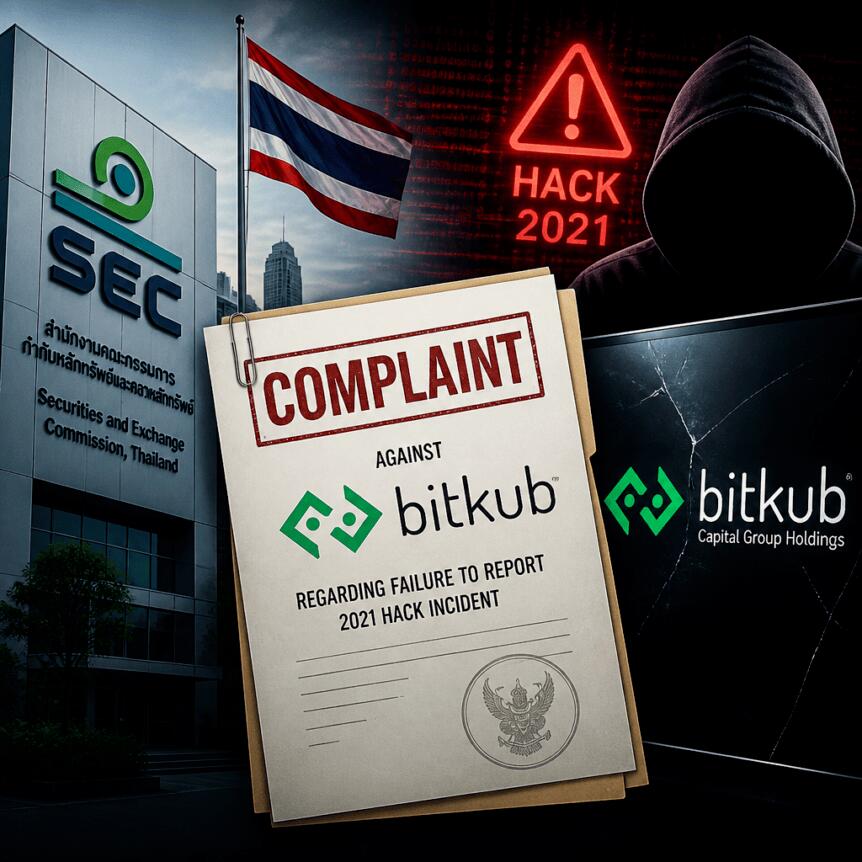
Thailand’s crypto market is facing renewed regulatory pressure after the country’s Securities and Exchange Commission (SEC) filed a criminal complaint against Bitkub and two former directors over allegations of inaccurate disclosures tied to a 2021 cyberattack.
In a report released Thursday, the Thai SEC said it has brought the case against Bitkub Online along with former executives Sakolkorn Sakavee and Thaweesap Rawan, accusing them of submitting company reports that misrepresented the impact of the hack during the period under investigation. The matter comes at a sensitive time for Bitkub, as its parent company has been weighing a potential public listing—an issue that typically brings stricter expectations around transparency and governance.
Key takeaways
- The Thai SEC filed a criminal complaint against Bitkub Online and two former directors for alleged false reporting connected to a May 2021 cyberattack.
- The SEC claims Bitkub failed to reflect the full impact of the theft in daily net liquid capital reports between May 10 and Oct. 30, 2021.
- The regulator estimates the stolen crypto assets at 16 types worth about 1.7 billion baht (around $50 million).
- Bitkub disputes the SEC’s allegations, saying disclosures were delayed to avoid a bank-run and that it later covered the stolen assets with equivalent holdings.
- The case will proceed through Thailand’s investigation and possible prosecution process, while Bitkub’s broader corporate plans remain in focus.
SEC alleges Bitkub understated losses in capital reporting
At the center of the complaint is the SEC’s contention that Bitkub did not accurately disclose the consequences of the May 2021 hack. According to the SEC, the incident led to the theft of 16 categories of digital assets from the exchange, with a stated value of approximately 1.7 billion baht (about $50 million).
The SEC further alleged that Bitkub replaced the stolen assets by Oct. 31, 2021. However, it said the exchange’s daily net liquid capital reports did not show a significant reduction in assets during the period from May 10 through Oct. 30, 2021.
In the SEC’s view, this reporting gap could have created the impression that customer assets remained effectively unchanged and that the exchange had not suffered meaningful losses from the attack.
The complaint accuses Bitkub and the former directors of violating multiple provisions of Thailand’s digital asset regulations in connection with the alleged false disclosures. The SEC said the matter will move forward through investigation and, if warranted, prosecution and court proceedings.
Bitkub counters: disclosure timing aimed to prevent a bank run
Bitkub rejected the SEC’s claims in a post on X, describing the complaint as stemming from disclosure decisions made after the May 2021 cyberattack rather than from fraudulent intent.
The exchange said it delayed disclosing the wallet compromise to help prevent a bank run while it worked to address the loss. Bitkub also stated that its co-founders later purchased digital assets equivalent to the stolen funds, arguing that neither the company nor its customers ultimately experienced financial losses.
Alongside the rebuttal, Bitkub said it has since strengthened governance, compliance, and security systems. The exchange did not indicate that it will change or reverse its position, but its response frames the controversy as a risk-management dispute over timing and communication rather than a concealment of ongoing damage.
Why this case matters as Bitkub eyes a listing
Beyond the immediate legal process, the SEC complaint arrives as Bitkub’s ownership group considers a potential public listing. In December 2025, Bitkub confirmed to Cointelegraph that it was considering an initial public offering, with a potential listing in Hong Kong.
That context matters because public-market pathways generally increase pressure on disclosure quality, internal controls, and auditability—particularly for regulated exchanges. Even if Bitkub’s parent company proceeds with fundraising or an IPO plan, regulatory scrutiny of past reporting practices can influence investor sentiment, due-diligence findings, and the scrutiny applied by prospective underwriters or listing authorities.
At the same time, the case highlights an underlying tension that has appeared in crypto regulation across multiple jurisdictions: whether a firm’s attempts to stabilize conditions after an incident justify delayed or incomplete public disclosures, and what regulators consider “accurate” reporting in the interim.
Bitkub’s scale in Thailand and what to watch next
Founded in 2018, Bitkub has become one of Thailand’s best-known crypto exchanges. According to CoinGecko, it ranks first among Thai exchanges by trust score and had about $712 million in daily trading volume at the time of publication for the referenced data.
For market participants, the SEC complaint may affect how counterparties and users evaluate compliance and reporting standards—especially for an exchange that already holds significant market share. While Bitkub disputes the allegations, the next phase will be driven by Thailand’s investigation process and any subsequent prosecution decisions.
Readers should watch for whether regulators can show that the disputed reports materially misled stakeholders, how Bitkub substantiates its claim of later compensation, and whether additional documents surface regarding the timeline of disclosures around the May 2021 hack. As the legal process develops—and with IPO plans still part of the background—clarity around internal controls and incident communications could become a defining factor in how Bitkub is judged by both regulators and investors.
https://www.cryptobreaking.com/thailand-sec-files-complaint-against/?utm_source=blogger%20&utm_medium=social_auto&utm_campaign=Thailand%20SEC%20Files%20Complaint%20Against%20Bitkub%20Over%202021%20Hack%20Reporting%20
Comments
Post a Comment