
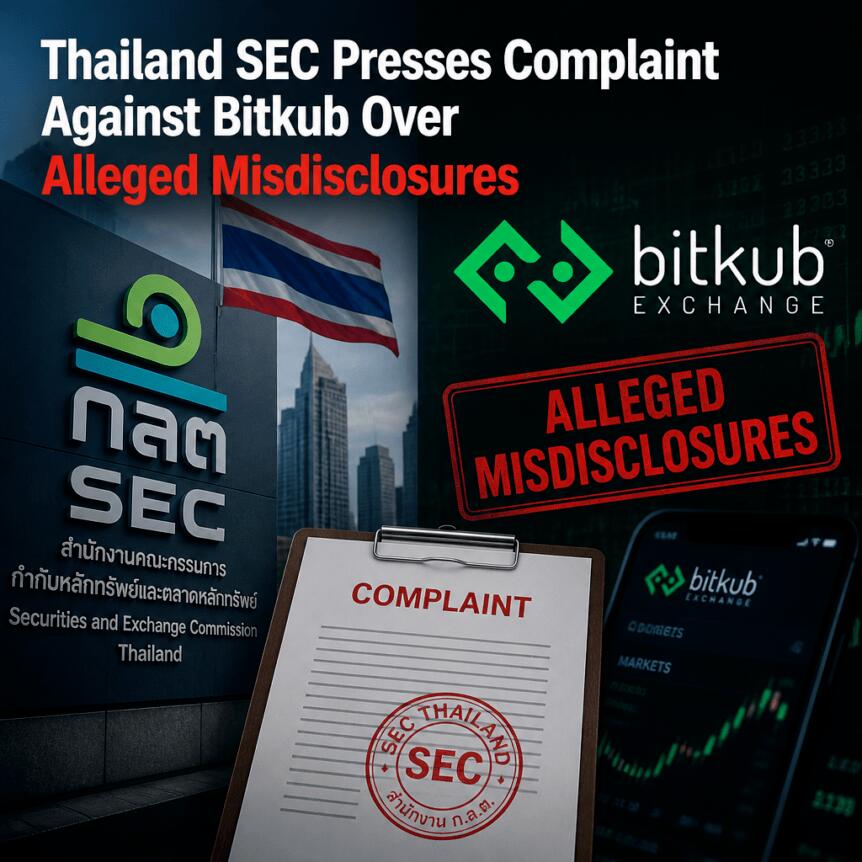
Thailand’s crypto market is facing renewed regulatory pressure after the country’s Securities and Exchange Commission (SEC) filed a criminal complaint against Bitkub Online and two former directors. The case centers on allegations that the exchange submitted misleading information to regulators in connection with a May 2021 cyberattack.
Bitkub is also in the spotlight because its parent company has been exploring a potential public listing, a development that heightens scrutiny around governance, risk controls, and the quality of disclosures for investors and customers alike.
Key takeaways
- The Thai SEC has filed a criminal complaint against Bitkub Online and former directors Sakolkorn Sakavee and Thaweesap Rawan over alleged false reporting tied to a May 2021 hack.
- Regulators say a cyberattack led to the theft of 16 types of digital assets worth about 1.7 billion baht (around $50 million), and that Bitkub’s daily net liquid capital reports failed to reflect the impact.
- Bitkub disputes the SEC’s characterization, arguing that disclosure was delayed to avoid a bank-run and that comparable assets were later purchased to cover the stolen funds.
- The SEC’s complaint could move through investigation, potential prosecution, and ultimately court proceedings.
What the SEC says happened after the 2021 hack
According to the SEC, a cyberattack in May 2021 resulted in the theft of 16 types of digital assets held by Bitkub. The regulator estimated the stolen assets were worth roughly 1.7 billion baht (about $50 million).
The core of the SEC’s allegation is not the hack itself, but the subsequent reporting. The SEC said Bitkub replaced the stolen assets by Oct. 31, 2021. However, the regulator claims that Bitkub did not accurately show the incident’s effects in the exchange’s daily net liquid capital reports.
In particular, the SEC alleged that reports filed between May 10 and Oct. 30, 2021 did not demonstrate a “significant reduction” in the exchange’s assets despite the theft. In the SEC’s view, the omission could have created the impression that customer assets remained unchanged and that the exchange had not suffered losses from the attack.
The complaint states that Bitkub and the former directors allegedly violated multiple provisions of Thailand’s digital asset regulations related to the alleged false disclosures. The matter is expected to progress through the Thai legal process, including investigation and possible prosecution before any court proceedings.
Bitkub’s response: delayed disclosure to prevent a bank run
Bitkub disputed the SEC’s allegations in a post on X. The exchange argued that the dispute stems from disclosure choices made after the May 2021 cyberattack rather than fraudulent conduct.
Bitkub said it delayed disclosing the wallet compromise to prevent a bank run while it worked to address the stolen funds. The company further stated that its co-founders later purchased digital assets equivalent to what was taken, meaning the exchange and its customers did not ultimately bear financial losses.
In addition, Bitkub said it has strengthened governance, compliance, and security systems since the incident.
The dispute effectively turns on competing narratives about timing and reporting accuracy: the SEC frames the documentation as materially misleading during the period when assets had been compromised, while Bitkub argues that the delayed disclosure was a risk-management decision intended to prevent panic among customers.
Why the case matters beyond one exchange
For Thailand’s crypto industry, this complaint underscores how regulators may treat disclosure practices—even where an operator claims losses were later covered. In many financial systems, timing and transparency during periods of operational stress are often as important as end results, because they influence how markets and counterparties assess risk.
From an investor and compliance perspective, the case also illustrates how governance is becoming a central focus for exchanges contemplating broader corporate moves. Bitkub’s public listing discussions—reported earlier by Cointelegraph—have already brought the company’s structure and controls into sharper view. While the SEC’s complaint relates specifically to 2021 reporting, it arrives at a time when corporate transparency is likely to be critical for any future fundraising or listing process.
Bitkub was founded in 2018 and has grown into one of Thailand’s most prominent trading venues. According to CoinGecko, it ranks first among Thai crypto exchanges by trust score and had about $712 million in daily trading volume at the time of publication.
IPO plans raise the stakes for governance and disclosures
In December 2025, Bitkub confirmed to Cointelegraph that it was considering an initial public offering, including a potential listing in Hong Kong. Cointelegraph also reported that it reached out to Bitkub for additional comment on the SEC complaint and its IPO plans, but did not receive a response by publication.
In that context, the SEC’s allegations could become more consequential than a purely legal matter. Even without determining guilt at this stage, criminal complaints can affect perceived risk for counterparties and potential investors, and they tend to intensify demands for internal documentation, auditability, and compliance readiness.
For customers, the practical question is how authorities and the exchange will reconcile the discrepancy between “late coverage” of stolen assets and the regulator’s view that early reporting should have shown a reduction in net liquid capital.
As the SEC’s complaint moves through Thailand’s legal system, readers will likely want to track what evidence is used to substantiate the alleged reporting gaps, how Bitkub supports its “bank run prevention” rationale, and whether the dispute changes the timeline or terms of any future corporate listing plans.
https://www.cryptobreaking.com/thailand-sec-presses-complaint-against/?utm_source=blogger%20&utm_medium=social_auto&utm_campaign=Thailand%20SEC%20Presses%20Complaint%20Against%20Bitkub%20Over%20Alleged%20Misdisclosures%20
Comments
Post a Comment