
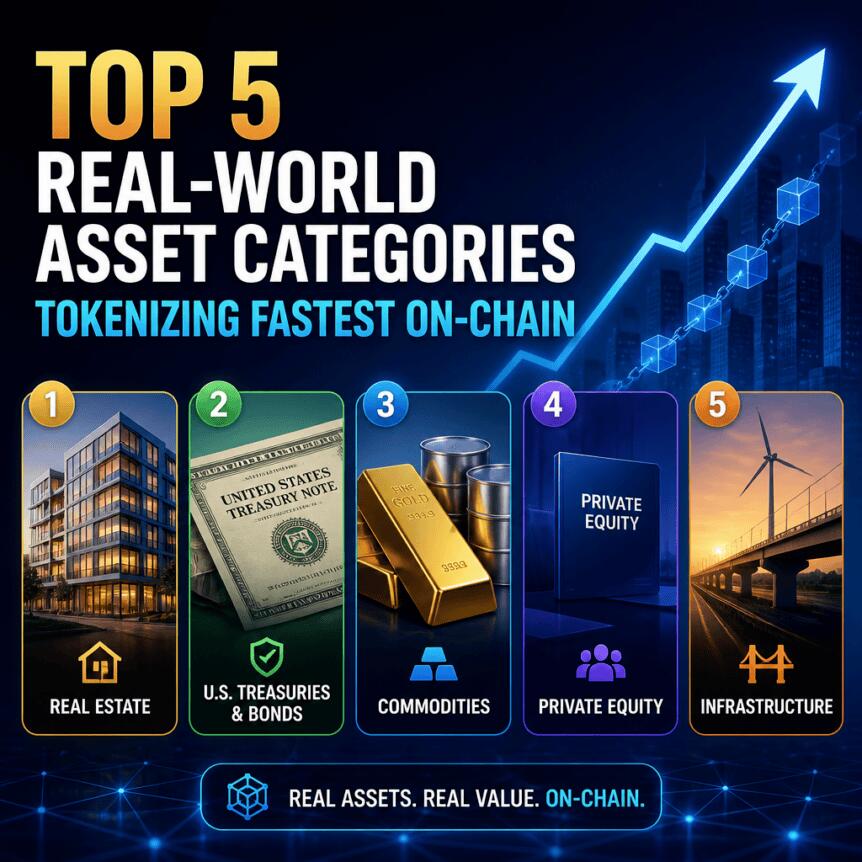
Tokenization of real-world assets (RWAs) is advancing faster than many investors expected, but a major constraint remains: DeFi access and infrastructure. A recent research note by Standard Chartered’s head of digital assets research, Geoff Kendrick, argues that on-chain finance could rapidly absorb tokenized products—provided DeFi ecosystems can actually integrate them.
Kendrick estimates that only about 3% of stablecoins and 10% of tokenized real-world assets are currently used in DeFi. He projects that these shares could rise to 30% by 2030. That would represent a dramatic shift in how tokenized assets flow through decentralized markets, according to the note—though the pace will likely hinge on regulatory clarity and, just as importantly, practical trading and custody plumbing.
Key takeaways
- Standard Chartered expects DeFi’s use of tokenized assets to expand sharply, with Kendrick projecting 30% usage by 2030.
- Tokenized Treasuries remain the largest RWA on-chain category by distributed value, around $15 billion, supported by yield-bearing demand.
- Tokenized private credit is growing but still far smaller than Treasuries, at roughly $6.2 billion across major issuer platforms.
- Tokenized stocks are still a small share overall, yet growth is accelerating alongside broader market-structure pilots.
- Tokenized commodities have shown resilience during market closures, with on-chain perpetuals seeing sharply higher weekend volumes in early 2026.
Why DeFi adoption could be the real bottleneck
Tokenization is not the same as decentralized utility. Kendrick’s research frames the current gap: stablecoins and RWAs do exist on-chain, but only a limited portion is deployed inside DeFi strategies. The difference matters because DeFi liquidity, lending, hedging, and derivative markets typically require robust token standards, reliable custody, and operational integrations with trading venues.
The research note’s optimistic outlook for DeFi usage rests on a broader expansion in tokenized markets. According to data compiled by RWA.xyz, tokenized real-world assets reached $32.22 billion in distributed on-chain value by the end of June, nearly three times the $11.8 billion reported a year earlier. When stablecoins are included—understood here as tokenized representations of fiat—the wider tokenized market stands above $328.8 billion, per the same dataset.
RWA.xyz also reports that RWA asset holders grew to 937,928, up 13% in a single month—an indicator that the ownership layer is widening even if DeFi penetration is not yet where it could be.
Treasuries lead on-chain: yield, familiarity, and expanding access
Within RWAs, US Treasury instruments are currently the standout. Tokenized Treasuries are the largest category by on-chain value at about $15 billion. The appeal is straightforward: investors get familiar assets, low perceived risk, and yield—capabilities that stablecoins do not provide on their own.
BlackRock’s BUIDL fund, launched in March 2024, reached over $2.9 billion in total asset value by June 2025, and it was at $2.23 billion at the time of reporting. The article notes that some funds declined as capital was reallocated, reflecting competition among platforms and shifting allocations rather than a universal withdrawal.
Importantly for DeFi, tokenized funds are beginning to connect to decentralized trading venues. In February 2026, Uniswap Labs and Securitize announced that BUIDL shares were available for trade on UniswapX. The integration is described as restricted—meaning access is not fully open-ended—but it still signals a step toward bringing regulated, institutional-grade tokenized assets into DeFi-style execution.
Elsewhere, Franklin Templeton’s OnChain US Government Money Fund is represented by the BENJI token, which the article says has reached $2.44 billion. It runs across multiple networks, including Avalanche and Arbitrum as well as others listed in the report.
Beyond these flagship products, the piece highlights several additional Treasury offerings including Circle’s USYC (about $3.1 billion), Ondo’s tokenized suite (around $3.7 billion), and WisdomTree’s WTGXX (about $764 million). Together, these illustrate that Treasuries are not just the largest category by distributed value—they’re also where momentum is most visible across platforms.
Private credit and tokenized credit: liquidity where lockups used to dominate
Private credit—loans issued, negotiated, and held by non-bank institutions—has emerged as another growth lane within RWAs. The rationale overlaps with Treasuries but with a different incentive: private credit can offer higher yields than government debt, while tokenization can also address a long-standing pain point. Traditional private credit is often characterized by extended capital lockups; tokenization can make positions more transferable, usable as collateral, and redeemable.
According to RWA.xyz data cited in the article, the largest tokenized private credit platforms are Maple Finance and Stokr, each holding about a 22% market share. The total value of tokenized private credit is reported at approximately $6.2 billion—small relative to Treasuries, but meaningful for a sector that historically lacked liquid secondary markets.
Stocks and ETFs: pilots begin, but scale is still early
Tokenized stocks remain a fraction of the broader RWA ecosystem. RWA.xyz data referenced in the article places tokenized stocks at about $2.19 billion, with growth of nearly 50% in the previous 30 days at the time of writing.
The next potential step-change is market-structure modernization. In May, the Depository Trust & Clearing Corporation (DTCC) announced plans to pilot tokenized securities trading. DTCC clears and settles almost all US stock trades and custodies over $114 trillion in securities, according to the report. The pilots are described as beginning in the current month, with a full commercial launch considered possible by October. The pilot assets include Russell 1000 equities, major index ETFs, and US Treasuries, with participation listed across a wide range of financial firms including BlackRock, Goldman Sachs, JPMorgan, Citigroup, Bank of America, Morgan Stanley, Circle, Ondo Finance, and Ripple Prime.
In the tokenized equities space specifically, the article says Ondo Finance holds roughly 60% of the tokenized equity market through its Global Markets platform. It also points to partnerships Ondo has made to expand tokenization coverage, including a March 2026 partnership with Franklin Templeton to tokenize five ETFs and an April deal with Broadridge Financial Solutions aimed at enabling token holders to submit voting preferences for underlying shares.
Commodities, real resilience: trading around clock gaps
Tokenized commodities have delivered one of the clearest “use it or lose it” demonstrations of why on-chain markets can matter in real time. While tokenized gold and other commodities have existed for years, 2026 introduced a more stressful test.
The article describes a period of heightened US–Iran tensions when traditional markets faced closures, while tokenized oil and gold markets remained available. After US and Israel attacks on Iran earlier in the year, trading desks reportedly turned to on-chain perpetual futures platforms as a pricing venue during off-hours when conventional markets were not operating.
Weekend volumes on on-chain commodity perpetuals are described as increasing ninefold since the beginning of 2026, and commodity perpetuals now represent more than 67% of builder-deployed contracts on DEXs, according to the piece. While volumes have pulled back from March—when tokenized commodities reached $5.8 billion—the article says current figures are about $4.7 billion, with gold still comprising the majority.
On-chain and traditional markets have also started to move together more reliably. The article notes that the correlation between tokenized gold volumes and traditional gold markets crossed a 0.70 threshold in Q1 2026, suggesting that the on-chain commodity market is maturing rather than trading in isolation.
Real estate: still small, but approvals in regulated markets are changing the outlook
Real estate tokenization has historically been more promise than large-scale reality. As a slice of the RWA pie, the article places real estate at about $202.7 million in assets currently, while arguing that expansion could accelerate as tokenized property enters major regulated markets.
Dubai’s Land Department began the second phase of its real estate tokenization project in February 2026, opening tokenized property units for resale. In the same quarter, Hong Kong’s Securities and Futures Commission approved real estate tokenization products from Derlin Holdings, the article states.
For investors, the potential benefit is fractional exposure. The token represents a share of a building, which can translate into proportional rents and, crucially, the ability to trade positions without waiting for a property sale—though the long-term impact will depend on liquidity and secondary-market depth.
Growth is real—but RWAs are still dwarfed by traditional markets
Despite rapid progress, tokenized RWAs remain early-stage by most benchmarks. Tokenized Treasury products, though the largest category at nearly $15 billion, are still far smaller than the traditional US Treasury market, estimated at around $30 trillion by SIFMA research referenced in the article. Tokenized stocks are also described as a rounding error compared with the DTCC’s $114 trillion in securities under custody.
Liquidity is another limiting factor. The article points to thin secondary trading and long holding periods across many RWA segments—conditions that can frustrate DeFi strategies that rely on consistent market access and tight spreads.
Regulation may determine how quickly these frictions ease. In March, the SEC reportedly approved a Nasdaq proposal allowing certain stocks to be traded and settled via tokens, according to Reuters coverage cited in the article. Observers described in the same reporting expect broader approval ahead, with SEC Chair Paul Atkins potentially supporting RWAs through an “innovation exemption.” Either way, the article frames the remaining question as timing: not whether tokenization will expand, but how fast infrastructure and oversight can keep up.
For investors and builders, the next watch items are clear: whether integrations like DeFi-friendly token trading of regulated funds scale beyond restricted access, and whether regulatory pilots for tokenized securities translate into sustainable liquidity. If DeFi penetration rises as Kendrick expects, it will likely be because tokenization finally meets the operational needs of on-chain markets—not just because RWAs exist.
https://www.cryptobreaking.com/top-5-real-world-asset/?utm_source=blogger%20&utm_medium=social_auto&utm_campaign=Top%205%20Real-World%20Asset%20Categories%20Tokenizing%20Fastest%20On-Chain%20
Comments
Post a Comment