
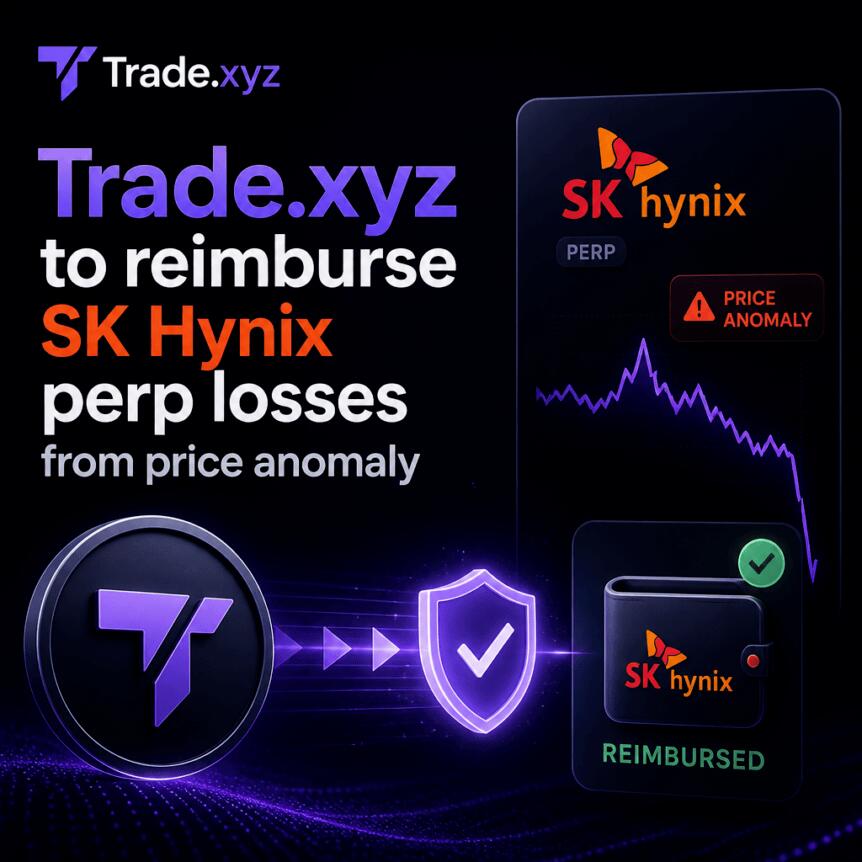
Trade.xyz, the operator of onchain perpetual markets on Hyperliquid, says it will reimburse eligible users for liquidation losses tied to a sudden “price anomaly” affecting its SK Hynix-linked contract. The announcement follows a sharp drop in the contract’s mark price after an off-chain trade was relayed through multiple independent data providers.
In a post on X, Trade.xyz stated that the SKHYNIX contract’s mark price fell to $917.25 from $1,127.90 at 23:01 UTC on Monday. It attributed the move to the way its oracle processes an external venue’s executed transaction, noting that eligibility requirements and details of the reimbursement are expected shortly.
Key takeaways
- Trade.xyz will cover eligible liquidation losses after a mark-price drop in its SK HynIX perpetual contract triggered liquidations.
- Trade.xyz said its oracle was “tracking” an external venue used as the primary South Korean pre-market and that it behaved according to specification.
- The affected contract is among Hyperliquid’s most active, with the platform reporting over $1.5 billion in 24-hour volume and nearly $600 million in open interest at the time of writing.
- Trade.xyz described reimbursement as a one-time discretionary decision and said it will review how prices are formed during extreme events.
- Hyperliquid/Trade.xyz is reportedly considering increasing the weight given to prices derived from its own order books during market stress.
Reimbursement after a mark-price break
The reimbursement plan centers on a specific event: Trade.xyz’s SKHYNIX contract mark price reportedly plunged within minutes, dropping from $1,127.90 to $917.25. According to Trade.xyz, the move was linked to an executed transaction on an external venue rather than a sudden distortion inside Hyperliquid’s own trading order book.
Trade.xyz did not disclose the number of users likely to qualify or the total amount it expects to distribute. It also said it would “announce soon” the eligibility requirements, with distributions expected “in the coming days.”
While the operator acknowledged the frustration traders can feel when liquidations occur during unusual market conditions, it framed the reimbursement as a “one-time discretionary decision.” It also signaled that the company plans to examine how its system handles price formation during extreme market events.
Why Hyperliquid’s mark price matters
On Hyperliquid, the mark price is not just a reference—it is a core input for risk controls. Trade.xyz said Hyperliquid uses mark prices to value positions for margin purposes and to determine when leveraged positions should be liquidated.
That design makes the accuracy and responsiveness of the mark-price mechanism critical. Even if the anomaly originates elsewhere, its impact can propagate quickly to trader margin calculations, particularly in highly leveraged perpetual markets.
Hyperliquid data cited by Trade.xyz indicates the SK Hynix contract is deeply liquid. On Wednesday, Hyperliquid’s interface showed the contract had produced over $1.5 billion in 24-hour volume and held nearly $600 million in open interest at the time of writing—figures that underscore why an oracle-driven disruption can quickly become a large-scale trader event.
How the anomaly appears to have transferred on-chain
Trade.xyz said the sharp move began with an executed transaction on an external market, not with trades on Hyperliquid itself. Its oracle tracks the US dollar value of one SKHX common share. The mechanism, according to Trade.xyz’s documentation, converts the underlying South Korean won price using the prevailing exchange rate.
In this case, Trade.xyz said the external print was processed by the oracle and contributed to the contract’s mark-price shift. It added that the oracle “worked as intended according to its specification,” a detail that helps clarify what the operator believes went wrong: not the system failing technically, but the market-data input producing a sudden reference-price dislocation.
The operator also suggested that Hyperliquid may adapt its approach for future stress periods. Trade.xyz said it is considering giving more weight to prices formed on Hyperliquid’s own order books, arguing that Hyperliquid’s internal liquidity and market signals may better reflect tradable conditions during volatility.
Perpetuals with external feeds under HIP-3
Trade.xyz’s SK Hynix market runs under Hyperliquid’s HIP-3 framework. HIP-3 enables perpetual contracts tied to assets with external price feeds, allowing builders to launch products when the primary pricing reference comes from venues outside the on-chain trading system.
Trade.xyz previously accounted for more than $22 billion of HIP-3’s first $25 billion in cumulative volume, according to coverage referenced in the source material. It has also launched an officially licensed S&P 500 perpetual using S&P Dow Jones Indices data, illustrating how HIP-3 has been used to bring traditional benchmark feeds into onchain perpetual trading.
This case highlights a central trade-off of external-feed perpetuals: while they expand asset coverage, they can also import volatility or idiosyncratic prints from other venues into margin and liquidation machinery. In moments when an off-chain venue’s execution data diverges sharply from the prevailing onchain trading picture, mark-price-based liquidation thresholds can behave abruptly.
What traders should watch next
For now, the key uncertainties are operational: how Trade.xyz will define eligibility for reimbursement and how it will adjust the balance between external feeds and Hyperliquid order-book prices going forward. Traders in external-feed perpetuals may want to pay close attention to any announced changes to oracle weighting and to monitoring around mark-price calculations during extreme events.
https://www.cryptobreaking.com/trade-xyz-to-reimburse-sk/?utm_source=blogger%20&utm_medium=social_auto&utm_campaign=Trade.xyz%20to%20reimburse%20SK%20Hynix%20perp%20losses%20from%20price%20anomaly%20
Comments
Post a Comment