
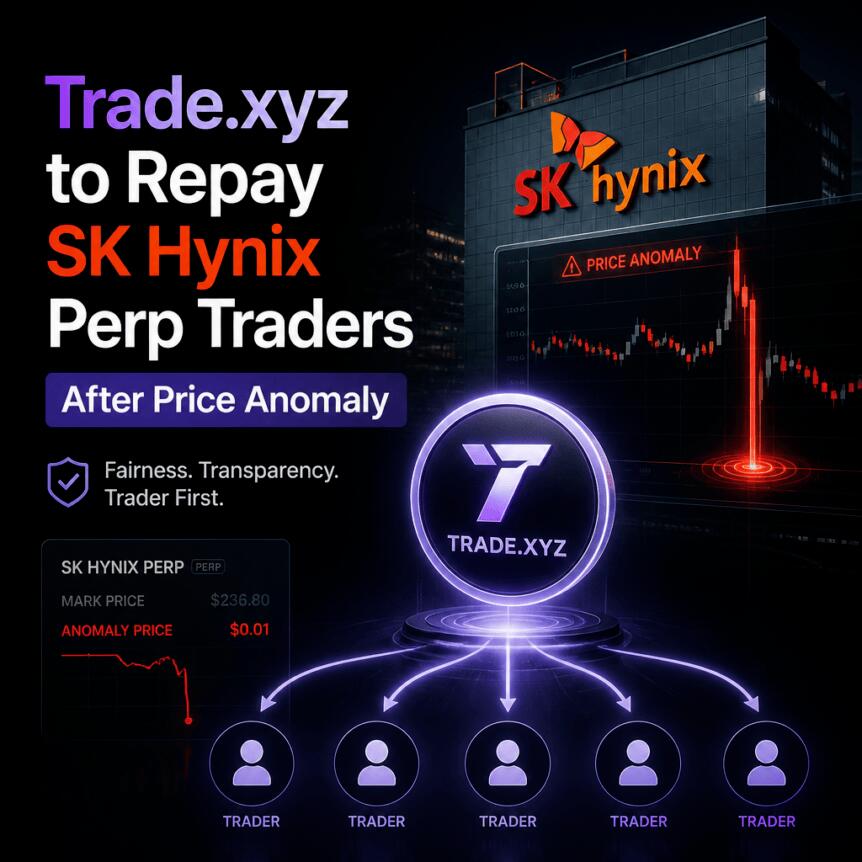
Trade.xyz, the operator behind onchain perpetual markets on Hyperliquid, says it will reimburse eligible liquidation losses after an abrupt price move affected its Hyperliquid-traded SK Hynix (SKHYNIX) contract. In a post on X, the platform linked the incident to an external market trade that its oracle incorporated into the contract’s mark price, triggering liquidation mechanics.
According to Trade.xyz, the SKHYNIX mark price dropped from $1,127.90 to $917.25 at 23:01 UTC on Monday after a trade on a separate venue was relayed through multiple independent data providers. The operator said it will announce eligibility criteria soon, with reimbursement expected over the following days.
Key takeaways
- Trade.xyz plans to cover liquidation losses tied to an SKHYNIX mark-price dislocation on Hyperliquid.
- Trade.xyz attributes the move to an external market print that flowed into its oracle, not to changes in its own order book.
- The affected contract is a high-activity Hyperliquid market, with $1.5B+ in 24-hour volume and about $600M open interest shown by Hyperliquid data.
- Reimbursement is described as a one-time discretionary decision, with eligibility and total amounts yet to be disclosed.
- Trade.xyz is reviewing how it forms prices during extreme events, including whether to weight its own order-book liquidity more heavily.
What happened to the SKHYNIX contract
Trade.xyz said the incident began with an executed transaction on an external market rather than activity directly in Hyperliquid’s SKHYNIX order book. The platform’s oracle tracks the US dollar value of one SKHX common share by translating the underlying Korean won price into USD using the prevailing exchange rate, based on its published documentation.
In this case, Trade.xyz said the oracle received the external print and that the mark price moved sharply as a result. On Hyperliquid, the mark price is used for margin valuation and for determining when leveraged positions should be liquidated—meaning sudden oracle-driven shifts can quickly cascade into liquidation outcomes for traders holding risk on the contract.
Trade.xyz did not specify how many traders will qualify, nor did it disclose the total amount it expects to distribute. It said the market will be eligible only under criteria to be released soon.
Why Hyperliquid mark pricing matters for liquidations
Hyperliquid’s design relies on mark prices to keep leverage risk measurable and liquidation thresholds predictable. While that approach can work smoothly during normal market conditions, it can be exposed to abrupt external price dislocations—especially when oracles pull in values that may not immediately reflect the trading dynamics on the contract’s own venue.
Trade.xyz acknowledged trader frustration and framed its response as a “one-time discretionary decision” to cover eligible liquidation losses. At the same time, it said the oracle “worked as intended according to its specification,” emphasizing that the system performed the task it was built to do—incorporating the external venue pricing feed and converting it via the exchange rate.
Looking ahead, Trade.xyz said it will review how prices are formed during extreme market events. The operator also indicated it is considering adding more weight to prices formed on its own order books, saying those order books now provide meaningful liquidity and market signals.
Scale of exposure: a top Hyperliquid market
The SKHYNIX contract is among the most actively traded offerings on Hyperliquid. Hyperliquid data shared by the platform showed that the contract had produced more than $1.5 billion in 24-hour volume and held nearly $600 million in open interest at the time of writing (Wednesday).
That level of activity matters because it increases the number of traders potentially affected when margin and liquidation thresholds change quickly. It also raises the stakes for oracle and mark-price methodology: even when a disagreement is rooted in external venue pricing, the on-chain mechanics that rely on mark prices can convert the move into immediate forced position closures.
Trade.xyz’s reimbursement plan is therefore aimed at mitigating the downstream consequence of the mark-price shift rather than disputing the oracle’s intended behavior.
Where the price feed fits in Hyperliquid’s ecosystem
Trade.xyz operates under Hyperliquid’s HIP-3 framework, which allows builders to launch perpetual contracts tied to assets using external price feeds. In other words, the contract’s mark price doesn’t come purely from the local order book—it can be driven by an external reference intended to reflect the underlying asset’s value.
Trade.xyz has also been active within the HIP-3 launch phase: Cointelegraph previously reported that the firm accounted for more than $22 billion of HIP-3’s first $25 billion in cumulative volume. It later launched an officially licensed S&P 500 perpetual using S&P Dow Jones Indices data, according to earlier coverage.
In practical terms, the SKHYNIX episode highlights a core tension in this model. External feeds can help anchor derivatives to real-world reference prices, but they can also import sudden prints that may not line up with the contract’s own trading behavior at the moment the print lands.
Trade.xyz’s comments suggest it recognizes that mismatch and is open to adjusting weighting—potentially blending external feed inputs with the signals derived from the order book where liquidity is now deeper than it may have been earlier in the platform’s growth.
Traders watching Hyperliquid next should focus on when Trade.xyz publishes eligibility criteria and how it decides what counts as “eligible liquidation losses.” They should also watch for any technical or policy changes around mark-price formation in extreme events, particularly whether the platform moves toward a higher reliance on local order-book pricing during volatile or anomalous periods.
https://www.cryptobreaking.com/trade-xyz-to-repay-sk/?utm_source=blogger%20&utm_medium=social_auto&utm_campaign=Trade.xyz%20to%20Repay%20SK%20Hynix%20Perp%20Traders%20After%20Price%20Anomaly%20
Comments
Post a Comment