
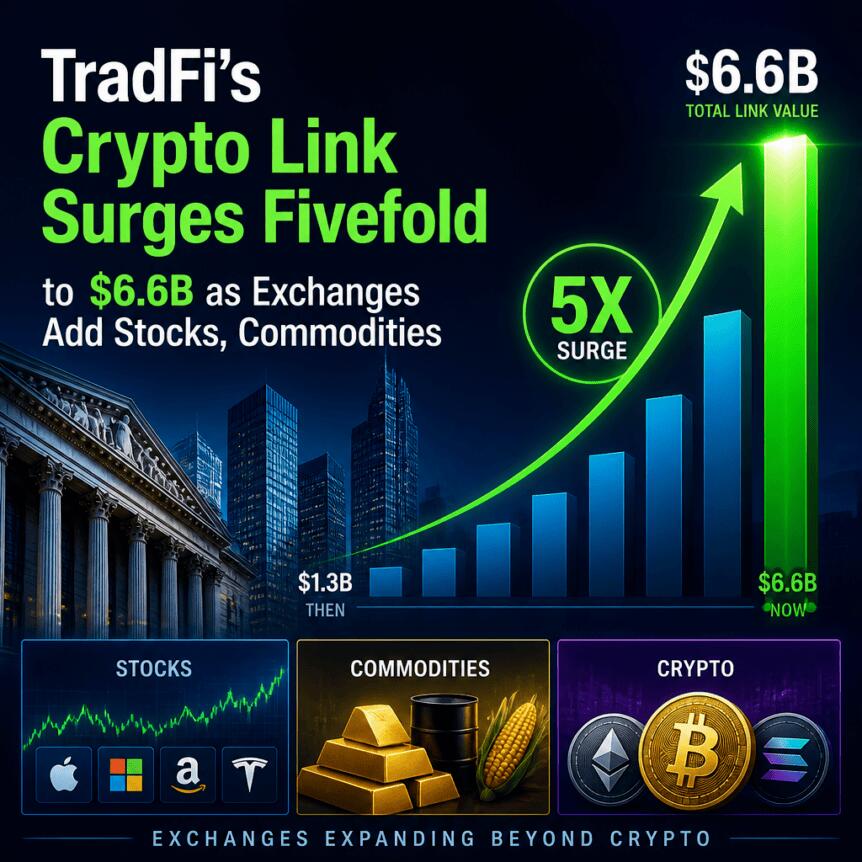
Crypto exchange competition is spilling into tokenized versions of traditional financial assets, according to new research from CoinGecko. A report released Wednesday finds that the market capitalization of tokenized “real-world” assets listed on major crypto trading platforms has climbed sharply, reaching $6.6 billion in June 2026—up from $1.4 billion in January 2025.
CoinGecko’s analysis tracks tokenized exposure across exchanges including Binance, OKX, Bybit, Bitget, Gate and MEXC, spanning categories such as precious metals, US stocks, commodities, global indexes and forex. The data suggests that what began as a metals-led niche has expanded into US equities, with derivatives now playing an outsized role in how these assets are traded.
Key takeaways
- CoinGecko reports tokenized traditional assets on major crypto exchanges grew to $6.6B in June 2026 from $1.4B in January 2025.
- Precious metals drove early momentum, but by mid-2026 US stock perpetual futures became the dominant activity by both volume and open interest.
- Trading is heavily skewed toward derivatives: perpetual futures account for the majority of activity, while spot markets remain smaller.
- Derivatives appear to be easier for exchanges to scale because they can list leveraged products without necessarily issuing, custodying, or holding the underlying tokenized asset.
- Centralized exchanges are expanding beyond crypto to retain users as both decentralized exchanges and traditional brokerages compete for share.
Tokenized “real-world” assets accelerate on major exchanges
CoinGecko frames the growth as a response to pressure across the broader exchange landscape. The study identifies that tokenized traditional assets—ranging from metals to equities—have expanded quickly in market cap terms over roughly 18 months.
Crucially, CoinGecko’s report doesn’t just point to total growth; it also maps how trading preferences are shifting. The market’s initial expansion, the report says, was fueled largely by tokenized precious metals. Over time, that focus broadened into tokenized US equities.
By mid-2026, CoinGecko reports that US stock perpetual futures overtook precious metals across both trading volume and open interest. The report attributes this turn to investor attention on semiconductor stocks and to expectations for upcoming initial public offerings (IPOs). While these drivers are specific to equity demand, the broader takeaway is that exchange-listed tokenization is beginning to follow the same “liquidity gravity” seen in crypto: where leverage and activity concentrate, participation follows.
Derivatives dominate: perpetual futures outpace spot
One of the more actionable elements of CoinGecko’s analysis is its breakdown of trading structure. According to the report, perpetual futures account for “the vast majority” of trading activity, while spot markets are comparatively small.
The reason offered by CoinGecko is practical for exchanges: derivatives are typically the product of choice for traders who prefer leverage, and perpetual contracts can be listed without exchanges needing to issue, custody, or directly hold the underlying tokenized asset.
This helps explain why tokenization can grow even when the broader ecosystem hasn’t fully reached the stage where spot trading of tokenized real-world assets is the main event. In effect, leveraged trading venues can bootstrap demand and liquidity faster than spot markets, because the operational burden of holding and managing the underlying asset is reduced.
Why centralized exchanges are moving beyond crypto
The report positions tokenized traditional assets as an expansion strategy for centralized crypto exchanges. As competition intensifies, exchanges appear to be looking for incremental revenue streams and new user segments rather than relying solely on crypto spot and derivatives.
CoinGecko points to two pressure fronts. First, decentralized exchanges have chipped away at market share. Second, traditional brokerages are broadening their digital asset offerings, increasingly overlapping with crypto trading ecosystems.
A notable example cited by CoinGecko is Robinhood, which Cointelegraph previously reported has significantly expanded its digital asset offerings (see Cointelegraph’s coverage). The broader implication is that users are not only choosing between venues; they are also increasingly choosing between platforms that blend legacy finance and blockchain-based trading experiences.
Institutional tokenization momentum reinforces the trend
CoinGecko’s exchange-focused findings sit within a wider narrative of institutional adoption. Earlier this year, Standard Chartered projected that tokenization could support the expansion of decentralized finance into a $2.7 trillion market by 2030 through real-world asset adoption (as covered by Cointelegraph in a related report). Separately, Bernstein analysts estimated the broader tokenization market could reach $4 trillion by the end of the decade, citing accelerating embrace of blockchain-based assets by financial institutions (see Cointelegraph’s earlier coverage).
These projections matter because they help contextualize why exchanges are investing effort in tokenized products now rather than later. When large institutions begin to treat tokenization as infrastructure—not just experimentation—liquidity, custody arrangements, and regulatory pathways can improve, making it easier for trading venues to scale.
Cointelegraph also previously reported partnerships aimed at expanding access to tokenized securities. For instance, BitGo and OTC Markets Group have partnered to expand access for more than 150 broker-dealers (as described in Cointelegraph’s report). In another example, Tradable teamed with the Stellar network to bring up to $1 billion in private credit assets onchain (see Cointelegraph’s coverage).
Taken together, these developments underline a recurring theme: tokenization is increasingly built across the same rails—blockchain networks and token standards—while distribution is where competition shows up fastest. CoinGecko’s data suggests that on crypto exchanges, distribution is increasingly happening through derivatives, with perpetual futures providing the main on-ramp for traders.
Going forward, the key question for investors and traders is whether the current derivative-led structure will translate into deeper spot liquidity and broader usage of tokenized assets—or whether perpetuals will continue to concentrate most activity. CoinGecko’s findings point to an evolving demand map, with equities now playing a larger role than metals; the next watch item is whether that shift persists as tokenized IPO expectations and sector-specific attention change.
https://www.cryptobreaking.com/tradfis-crypto-link-surges-fivefold/?utm_source=blogger%20&utm_medium=social_auto&utm_campaign=TradFi’s%20Crypto%20Link%20Surges%20Fivefold%20to%20$6.6B%20as%20Exchanges%20Add%20Stocks,%20Commodities%20
Comments
Post a Comment