
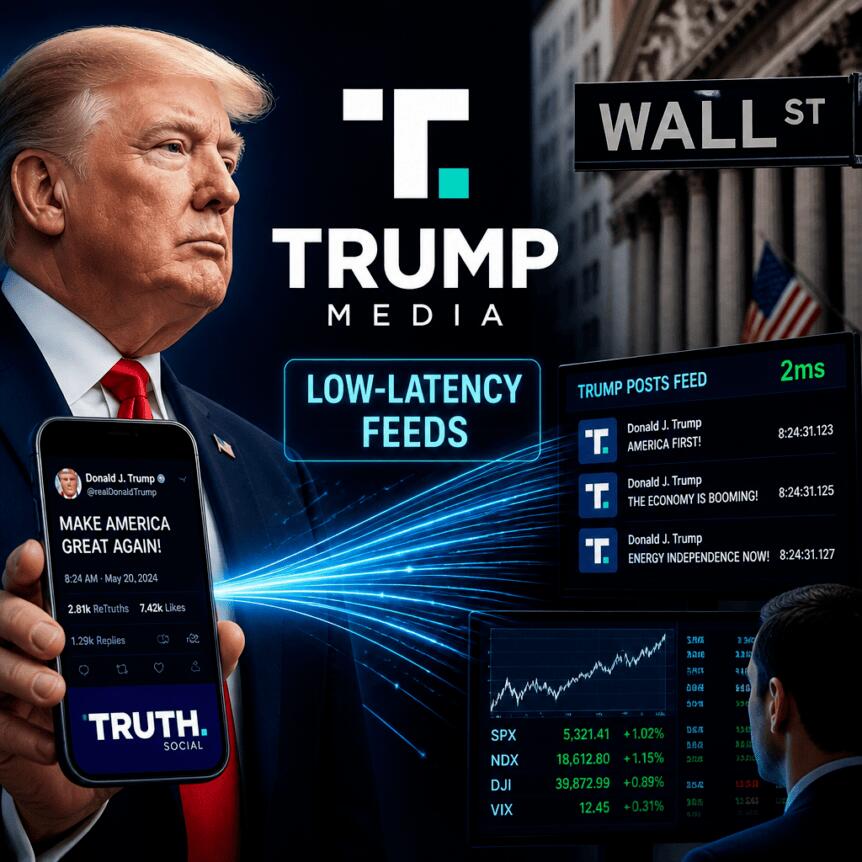
Trump Media & Technology Group (TMTG), the company behind the Truth Social platform, says it is preparing to launch a paid API that will let institutional Wall Street users pull posts from selected high-impact Truth Social accounts in real time.
In a filing with the U.S. Securities and Exchange Commission, TMTG states the “Truth API” is expected to be available to institutional customers starting Aug. 1, 2026. The service is designed for low-latency, machine-readable access—useful for high-frequency and algorithmic trading firms that want faster integration than manual browsing or slower data collection methods.
Key takeaways
- Trump Media is launching a paid Truth Social API aimed at institutional customers and market data workflows.
- Availability is targeted for Aug. 1, 2026, with a focus on real-time, licensed content from influential accounts.
- The API is intended for algorithmic and high-frequency trading that prioritizes low latency and machine readability.
- TMTG says scraping prior approaches violate its terms and that the company wants to increase friction for non-direct data collection.
- Truth Social posts have previously been cited as market-moving, including posts connected to U.S.–Iran developments.
A licensed, real-time feed for institutions
According to TMTG’s SEC filing, the Truth API is positioned as a direct, licensed channel for retrieving posts from Truth Social’s most “market-moving” accounts. The company is explicitly pitching the product to professional trading and market data users that need data in a format that systems can ingest quickly.
The filing emphasizes that the API is meant to deliver a real-time feed, tailored for scenarios where timing matters—especially for automated strategies. That framing matters to investors and market participants because it acknowledges a practical reality: social-media headlines and posts can influence how quickly traders react, and the gap between posting and data availability can affect execution.
Low latency and “friction” for scraping
In comments tied to the rollout, TMTG’s interim CEO Kevin McGurn said that Truth API provides a direct licensed stream of the platform’s “most market-moving Truths,” while also supporting the company’s goal of monetizing proprietary assets through recurring revenue.
The company also drew a line around how data should be obtained. In the filing, McGurn says companies have previously attempted to scrape Truth Social data, which he characterizes as a violation of the platform’s terms of service. He adds that Truth API is expected to “create a lot of friction” for those who do not come to the company directly.
For market participants, this shift is significant. Scraping-based approaches typically come with reliability and compliance risks—such as sudden changes in access patterns, blocking, or disputes over licensing. A formal API, by contrast, signals a more structured data pipeline that may be easier to incorporate into regulated or vendor-driven workflows.
Which accounts are in scope
TMTG’s announcement highlights that the API is intended to deliver posts from influential accounts, including Donald Trump (as President and as the operator of the Truth Social account named in the filing). The SEC documentation also references other major figures on the platform, including Donald Trump Jr, Eric Trump, and FBI Director Kash Patel.
Separately, the company points to prior instances where posts from Trump’s Truth Social account were associated with market attention. The article notes examples tied to the ongoing conflict between Iran and the U.S.—a reminder that Truth Social content is being watched not only as political commentary, but as a potential driver of market narratives.
Even with the API’s focus on “market-moving” accounts, investors should consider a key uncertainty: the SEC filing and the accompanying description do not spell out—within the provided text—exactly how “market-moving” is determined, how frequently the account set could change, or what latency benchmarks will be provided to customers.
Why an API matters for trading workflows
Social-media data has long been used in trading, but the quality of that data pipeline—particularly speed, structure, and licensing—often determines whether it can be reliably used for automation. By targeting low-latency delivery to institutional users, TMTG is effectively positioning Truth Social as a more integration-ready source of information for quantitative systems.
Just as importantly, the company’s approach frames the business model: rather than relying on incidental discovery or indirect data access, TMTG is attempting to convert platform influence into a recurring, licensed data service. The “high-margin, recurring revenue stream” language in McGurn’s statement suggests the API is intended to become a durable line of monetization, not a one-off product experiment.
As Aug. 1, 2026 approaches, market observers will likely watch for more operational details—especially how the API will handle access controls, content eligibility, and real-time performance expectations for institutional customers. Those specifics will determine whether Truth API becomes a practical component of algorithmic strategies or remains largely a compliance-first licensing alternative.
https://www.cryptobreaking.com/trump-media-offers-wall-street/?utm_source=blogger%20&utm_medium=social_auto&utm_campaign=Trump%20Media%20Offers%20Wall%20Street%20Low-Latency%20Feeds%20for%20Trump%20Posts%20
Comments
Post a Comment