
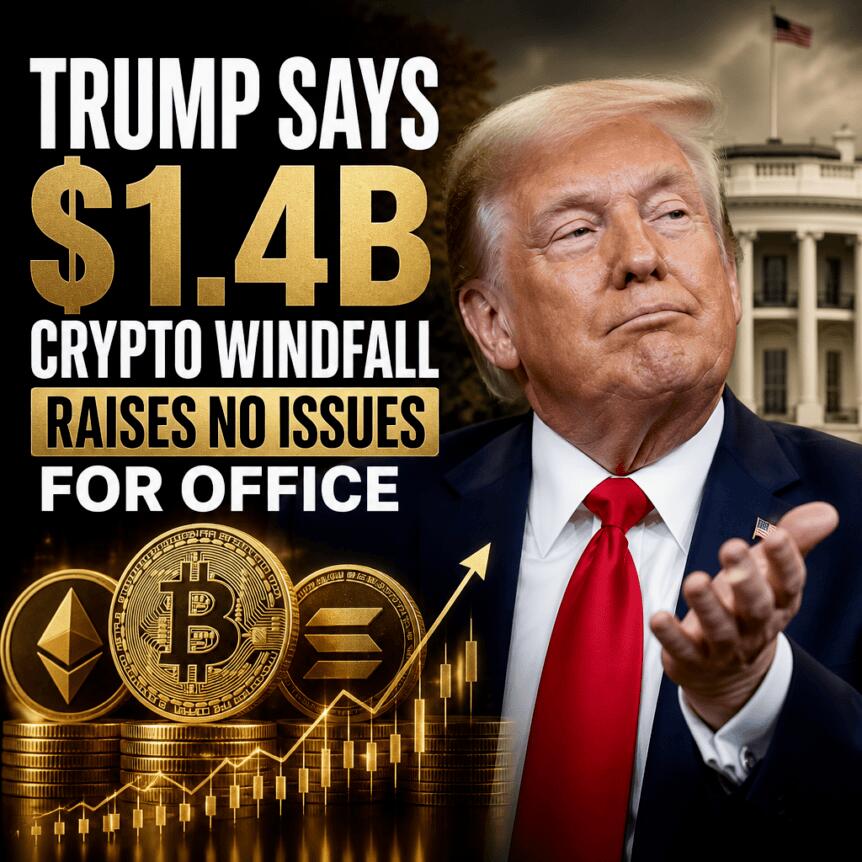
US President Donald Trump has pushed back against criticism of his latest financial disclosures, telling CNBC that there was “nothing illegal” and “nothing wrong” about earning income tied to his crypto investments while in office. The remarks came shortly after the US Office of Government Ethics (OGE) released his 2025 financial disclosure report, which advocacy groups say highlights troubling conflicts of interest.
In a Thursday interview with CNBC’s Joe Kernen, Trump argued that others were responsible for his crypto-related investments and that he did not “even know who they are,” without directly addressing concerns about whether his position could influence policy affecting the digital asset industry. The disclosures reportedly show Trump’s businesses and investments generated more than $2 billion during 2025, with about $1.4 billion linked to crypto ventures.
Key takeaways
- Trump said on CNBC there was “nothing illegal” about profiting from crypto investments while president, following the release of his 2025 OGE financial disclosure.
- The filing reportedly attributes roughly $1.4 billion of Trump’s 2025 income to crypto-related activities, including his memecoin and the family platform World Liberty Financial.
- Trump did not provide specific answers about who managed the investments, saying he did not “even know who they are.”
- Advocacy groups argue the scale of crypto-linked earnings raises conflict-of-interest concerns as Congress considers digital asset legislation.
- Crypto political spending appears to be ramping up ahead of the 2026 elections, according to Public Citizen.
Trump denies wrongdoing after crypto-linked disclosures surface
Trump’s defense centered on the idea that profiting from digital assets while holding the presidency is not inherently improper. Speaking to CNBC’s Joe Kernen, he maintained that his crypto holdings did not involve wrongdoing and suggested he was not directly involved in the investment management decisions.
That response came after reporting on the contents of Trump’s 2025 financial disclosure. According to coverage referencing the OGE filing, Trump reported taking in more than $2 billion from his businesses and investments during 2025. Within that total, roughly $1.4 billion was described as connected to crypto projects, including his memecoin and activities tied to World Liberty Financial, a platform associated with his family.
According to the same reporting, Trump’s disclosed crypto-related earnings included:
- About $636 million from his memecoin
- About $588 million from World Liberty sales
- $197 million from equity in a stablecoin venture
Trump has previously criticized Bitcoin during his first term, calling it a “scam.” However, in the lead-up to the 2024 election he reportedly increased engagement with prominent figures in crypto, including Gemini co-founders Cameron and Tyler Winklevoss, as well as executives from mining companies and crypto exchanges. He has also launched an Official Trump memecoin and has remained closely associated with World Liberty and American Bitcoin.
Conflict-of-interest concerns keep pressure on US crypto policy
Trump’s remarks are likely to intensify a dispute that has been playing out across US politics: whether leaders can personally profit from industries while also participating in government actions that shape the regulatory environment for those same industries.
Several advocacy organizations have characterized the disclosed crypto earnings as a “grift,” pointing to the possibility that personal financial ties could affect legislative outcomes. In particular, critics have flagged the Digital Asset Market Clarity (CLARITY) Act as an example of the kind of policy initiative they believe could benefit from a more transparent and strictly separated approach.
Trump’s CNBC comments did not directly resolve those concerns. Instead, he emphasized that other parties were responsible for his investments and that he did not know the individuals involved. For critics, that stance may not address the core issue: whether the presidency creates an inherently asymmetric influence over markets and legislation even when day-to-day decisions are delegated.
Beyond Trump himself, his family has also become a focal point for commentary. In a Friday interview with CNN’s Anderson Cooper, Mary Trump—the president’s niece—argued that the political system enables people to “get away with” serious financial wrongdoing, adding that investors may have been harmed by trusting Trump’s businesses. Her comments did not cite new details from the OGE filing, but they align with the broader line of criticism that seeks more accountability and clearer separation between political power and private crypto interests.
What changes: from “scam” rhetoric to industry engagement
One of the more striking dynamics in this story is how sharply Trump’s posture toward crypto appears to have shifted over time. In his first term, he publicly derided Bitcoin. But leading into the 2024 election—and continuing since—he has moved closer to influential crypto personalities and industry players.
The new disclosure-related controversy comes against that backdrop. If 2025 earnings are indeed as large and as closely tied to crypto-specific ventures as the filing descriptions indicate, the question for investors and builders is not only whether regulations will change—but whose incentives are most aligned with those changes.
This matters beyond politics because crypto markets respond quickly to expectations about rules, enforcement posture, and legislative clarity. When a head of state is personally linked to crypto outcomes—whether through tokens, platforms, or stablecoin-related equity—participants may reassess the probability that policy will be aligned with industry interests rather than general consumer protection.
Crypto spending looks set for another election-cycle push
Trump’s crypto-related disclosure debate is unfolding as the industry prepares for more political contests. After digital asset companies reportedly spent $170 million to support candidates they considered “pro-crypto” during the 2024 cycle, political action committees and related organizations appear to be following a similar approach for 2026.
In a report cited by Cointelegraph, Public Citizen said that companies and figures linked to the crypto industry contributed $189 million toward the 2026 election cycle as of June. That figure is presented as the bulk of $294 million in spending so far across crypto, AI, Big Tech, and online betting companies to support or oppose politicians.
With Trump’s term running until January 2029, the timing of 2026 elections is still crucial: all 435 seats in the US House of Representatives and 35 in the Senate will be contested. For digital asset policy, those races could shape committee leadership and the legislative momentum behind bills that attempt to clarify how different parts of the market should be regulated.
For traders and long-term participants, political funding and lobbying activity can act as early signals for where the policy debate is moving—even when the market seems focused on immediate price action. However, disclosures like Trump’s add a separate layer of scrutiny: not just how much money crypto firms spend to influence policy, but whether government officials’ financial incentives complicate the regulatory process.
As these issues move forward, readers should watch for how lawmakers address conflict-of-interest concerns and whether any additional scrutiny from ethics or oversight bodies changes how crypto-linked disclosures are interpreted in practice.
https://www.cryptobreaking.com/trump-says-1-4b-crypto/?utm_source=blogger%20&utm_medium=social_auto&utm_campaign=Trump%20Says%20$1.4B%20Crypto%20Windfall%20Raises%20No%20Issues%20for%20Office%20
Comments
Post a Comment