
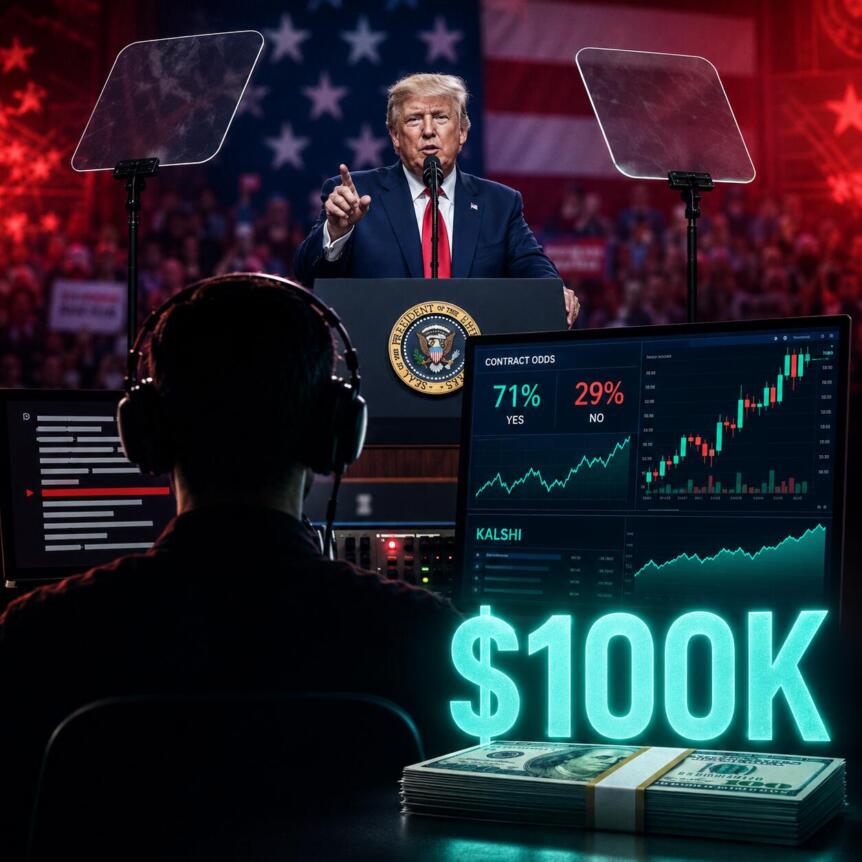
Regulators are reportedly in talks with a former White House teleprompter operator as the U.S. probes whether nonpublic information was used to profit from political prediction markets. ABC News reported that Gabriel Perez—who has supported the Trump teleprompter since 2016—has been accused of betting on Kalshi markets tied to words and topics appearing in the president’s speeches.
According to ABC, Kalshi’s surveillance identified activity linked to more than a dozen speech-related contracts over roughly three months, with profits reportedly exceeding $100,000. The report adds a familiar but thorny issue to the growing prediction market sector: when real-time access and politically sensitive timing can create opportunities for alleged “insider” advantages.
Key takeaways
- ABC News says Gabriel Perez, the teleprompter operator since 2016, allegedly profited from Kalshi “Mentions” markets tied to Trump speeches.
- Kalshi reportedly detected the trades and referred them to the Commodity Futures Trading Commission, linking activity to more than a dozen speeches over about three months.
- ABC reports that Perez sometimes exited positions mid-speech when Trump skipped prepared passages containing wagered words.
- The White House placed Perez on unpaid administrative leave after the report, according to White House press secretary Karoline Leavitt.
- Congressional and regulatory attention has intensified as other prediction-market cases raised concerns about information timing and potential misconduct.
What ABC says happened on Kalshi
ABC News reported that Perez, a technical assistant who operated the president’s teleprompter, placed bets on Kalshi markets tied to phrases and topics expected to appear during Trump’s remarks. The contracts were part of Kalshi’s “Mentions” suite, which lets users trade on whether specific words, phrases, or topics will show up in public speeches.
Per ABC’s sources, the alleged conduct involved bets on more than a dozen markets associated with multiple speeches, including the State of the Union and remarks delivered at the World Economic Forum. The outlet also reported that the activity generated more than $100,000 in profits.
ABC further claims that Perez sometimes exited positions while speeches were underway, particularly when Trump skipped portions of prepared text that included words Perez had allegedly wagered would be mentioned. That detail—timing trades to the content that ultimately appears—could be central to how regulators evaluate whether the trades reflected privileged access or legitimate market behavior.
Kalshi’s surveillance and a CFTC referral
In ABC’s account, Kalshi detected the trades using its surveillance systems and referred the activity to the Commodity Futures Trading Commission. For prediction market participants, the practical implication is straightforward: platform monitoring may increasingly focus not only on trading volume or profit patterns, but also on whether trades cluster around sensitive events in ways that could indicate information advantages.
The case also underscores how prediction markets, even when they are built around public speech formats and verifiable outcomes, can intersect with regulatory scrutiny if trading appears coordinated with nonpublic material.
White House response and administrative leave
Following ABC’s report, the White House placed Perez on unpaid administrative leave, according to press secretary Karoline Leavitt. Leavitt said Trump called the alleged conduct a “disgrace.”
While the report describes accusations and an ongoing regulatory engagement, readers should note that administrative leave is not the same as a final finding of wrongdoing. Still, the action signals that the alleged behavior—if confirmed—would represent more than a routine market dispute, given Perez’s role in the teleprompter operation and the claimed linkage to politically sensitive communications.
Why this matters to prediction markets now
This development arrives as prediction markets have faced mounting attention over potential insider trading risks, particularly as activity and visibility grow. Cointelegraph previously reported that Polymarket traders earned roughly $1 million after correctly betting on a U.S. strike against Iran before the end of February, raising questions about whether some traders may have had access to information ahead of public reporting. Bloomberg, citing analytics firm Bubblemaps, was also reported to have identified wallets placing bets only hours before explosions were first reported in Tehran.
Other cases described by Cointelegraph have similarly involved timing concerns. Cointelegraph reported on instances where wallets earned more than $1.2 million by betting on an onchain investigation into DeFi platform Axiom shortly before blockchain investigator ZachXBT published allegations involving an employee. Separately, another trader was reported to have made about $400,000 by wagering on a Venezuelan political event shortly before news became public, with subsequent disappearance reported by Cointelegraph.
Taken together, these examples highlight a recurring asymmetry in prediction markets: while outcomes are ultimately verifiable, the period between a potentially market-moving piece of information and its public release can create incentives to seek advantages. That tension is especially acute for contracts that map closely to political messaging, breaking news, or other time-sensitive developments.
Beyond enforcement, lawmakers have also begun to weigh in. Cointelegraph reported that Republican Representative Bryan Steil, who chairs the House subcommittee on digital assets, introduced legislation intended to bar members of Congress and their immediate families from trading prediction market contracts tied to public policy and political outcomes.
Kalshi’s referral to the CFTC and the reported involvement of a White House insider adds another dimension to the debate: even without legislative restrictions, platforms and regulators may increasingly treat “who had access to what, and when” as central to market integrity.
What to watch next
For market participants, the next signals to monitor are whether the CFTC’s involvement leads to formal charges, and how Kalshi and other prediction platforms refine surveillance and compliance measures for politically related or otherwise sensitive events. The broader question remains whether regulators will draw clear lines between ordinary trading behavior and trading that plausibly depends on nonpublic access—lines that will shape how confident users can be in the fairness of future prediction market outcomes.
https://www.cryptobreaking.com/trump-teleprompter-operator-earned-100k/?utm_source=blogger%20&utm_medium=social_auto&utm_campaign=Trump%20Teleprompter%20Operator%20Earned%20$100K%20Betting%20on%20Kalshi%20via%20Speeches,%20ABC%20Reports%20
Comments
Post a Comment