
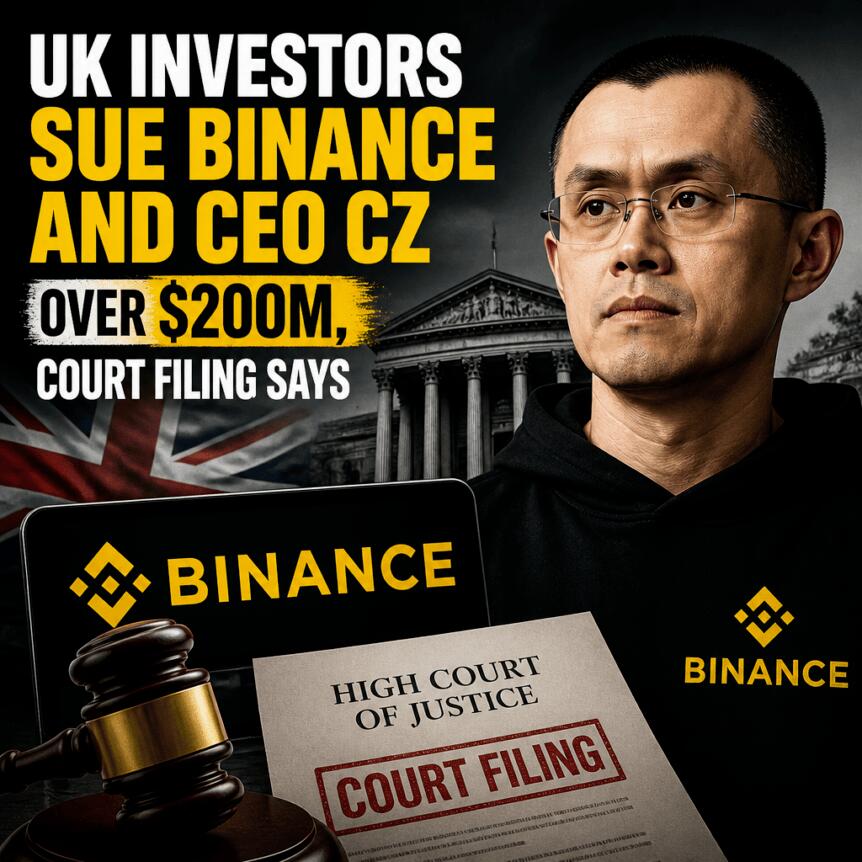
Nearly 1,700 investors in the United Kingdom have reportedly launched legal action against Binance and its founder, Changpeng Zhao, seeking £150 million (about $200 million). The claim alleges that Binance offered and sold crypto derivatives—including leverage tokens, futures contracts, and options—without the regulatory approval required under UK law.
According to the law firm KP Law, the case focuses on alleged violations of the Financial Services and Markets Act 2000 and on the continued availability of these products after the UK Financial Conduct Authority (FCA) banned them from being offered to retail customers in January 2021. Binance, for its part, says it will defend itself through the legal process and asserts it remains committed to operating in line with applicable law.
Key takeaways
- KP Law says almost 1,700 UK investors are pursuing a combined £150 million claim against Binance and Changpeng Zhao over crypto derivatives offerings.
- The lawsuit targets leverage tokens, futures, and options, alleging breaches of the Financial Services and Markets Act 2000.
- The case centers on alleged continued access after the FCA banned such products to UK retail customers in January 2021.
- Binance has denied wrongdoing and told Cointelegraph it will defend the claims in court.
- The complaint was reportedly filed in the London High Court, naming Binance-affiliated Nest Exchange and “persons unknown.”
What the lawsuit alleges
The investors are represented by KP Law, which states that Binance’s leverage tokens and derivatives offerings violated the Financial Services and Markets Act 2000. KP Law also argues that these products kept being offered to UK customers even after regulatory restrictions were issued.
In its statement, the law firm suggests there was “no effective barrier” preventing UK customers from accessing the products. While the precise mechanics of access are not detailed in the available reporting, the legal thrust is clear: the plaintiffs contend that the exchange’s products were distributed in a way that did not respect the regulatory prohibition for retail customers.
Reuters reported that multiple UK users lost “tens of thousands of pounds” through the affected products, underscoring that the suit is not framed as a purely technical regulatory dispute but as a remedy-seeking effort over financial losses.
Binance’s response and the legal posture
Binance told Cointelegraph it would “defend against these claims through the appropriate legal process.” The exchange also said it “remains committed to its obligations to users and to operating in accordance with applicable law.”
That stance positions the lawsuit squarely as a dispute over whether Binance’s derivative offerings were unlawfully provided to UK retail customers and whether the FCA’s January 2021 ban was effectively enforced in practice. As with any civil claim, the next steps—procedural rulings, discovery, and eventual merits arguments—will determine how those allegations are substantiated in court.
How this fits into Binance’s broader regulatory pressure
Lawyers and regulators are not acting in a vacuum. The filing adds to what Cointelegraph described as a growing list of legal and regulatory challenges for Binance, including compliance uncertainty linked to Europe’s Markets in Crypto-Assets (MiCA) framework.
Earlier coverage from Cointelegraph noted that Binance faced difficulty securing a MiCA-compliant license from an EU member state before a July 1 deadline. That type of licensing timeline matters to investors because MiCA was designed to create a clearer compliance structure across the EU—yet uncertainty around authorization and product restrictions can translate into uneven availability of services, shifting venue risk, and changes to how platforms present derivatives and related products.
In addition, Cointelegraph previously reported on allegations that Binance facilitated transactions tied to a sanctioned Iranian financier and that flowed to Iran’s Islamic Revolutionary Guard Corps. Binance strongly denied those allegations, and the case now reflects how regulatory scrutiny has spanned both market-structure compliance (derivatives access and retail suitability) and broader concerns around illicit finance and sanctions risk.
Who may be affected—and what changed for UK operations
The plaintiffs are said to be identifying the full scope of affected customers. KP Law said the precise number of UK customers affected is not publicly known, but argued that Binance’s global scale could mean a larger pool of exposure than the reported 1,700 claimants.
One individual described in coverage is Tomas Sutas, a financial controller who allegedly invested more than £100,000 into Binance’s derivatives products before the value was wiped out, the Financial Times reported. Reuters also described multiple UK users losing “tens of thousands of pounds.” While these accounts represent specific claim narratives rather than a verified aggregate loss figure for the full class, they help explain why the dispute has advanced as a high-stakes damages case.
Cointelegraph also pointed to earlier restrictions affecting Binance in the UK. Binance’s operations in the region reportedly became heavily constrained in June 2021, when the FCA informed Binance Markets Limited that it could not operate without written consent. That timeline is central to how the plaintiffs frame causation: the argument is that regulatory action came earlier, but access to the relevant derivatives continued.
Reuters reported that the lawsuit was filed in the London High Court. The defendants reportedly include the Binance-affiliated Nest Exchange as well as “persons unknown,” a formulation often used when claimants cannot yet identify all involved parties or when seeking broader injunctive and compensatory relief. KP Law said the firm is still working to determine the full set of impacted customers.
For UK-based investors and traders, the practical takeaway is that product availability can become a long-term legal issue, not just a short-lived trading restriction. Even when regulators impose bans, the continuing question—central to this lawsuit—is whether platforms effectively prevent retail access and how that is assessed under the relevant financial services framework.
As the case moves through the UK courts, readers should watch for early procedural developments, including how the court interprets the FCA ban’s reach and whether plaintiffs can demonstrate that the alleged access after January 2021 was sufficiently direct and attributable to Binance’s offerings. Beyond the outcome, the litigation could influence how exchanges design and enforce geo- and user-level controls for derivatives and other complex products in jurisdictions with active retail restrictions.
https://www.cryptobreaking.com/uk-investors-sue-binance-and/?utm_source=blogger%20&utm_medium=social_auto&utm_campaign=UK%20Investors%20Sue%20Binance%20and%20CEO%20CZ%20Over%20$200M,%20Court%20Filing%20Says%20
Comments
Post a Comment