
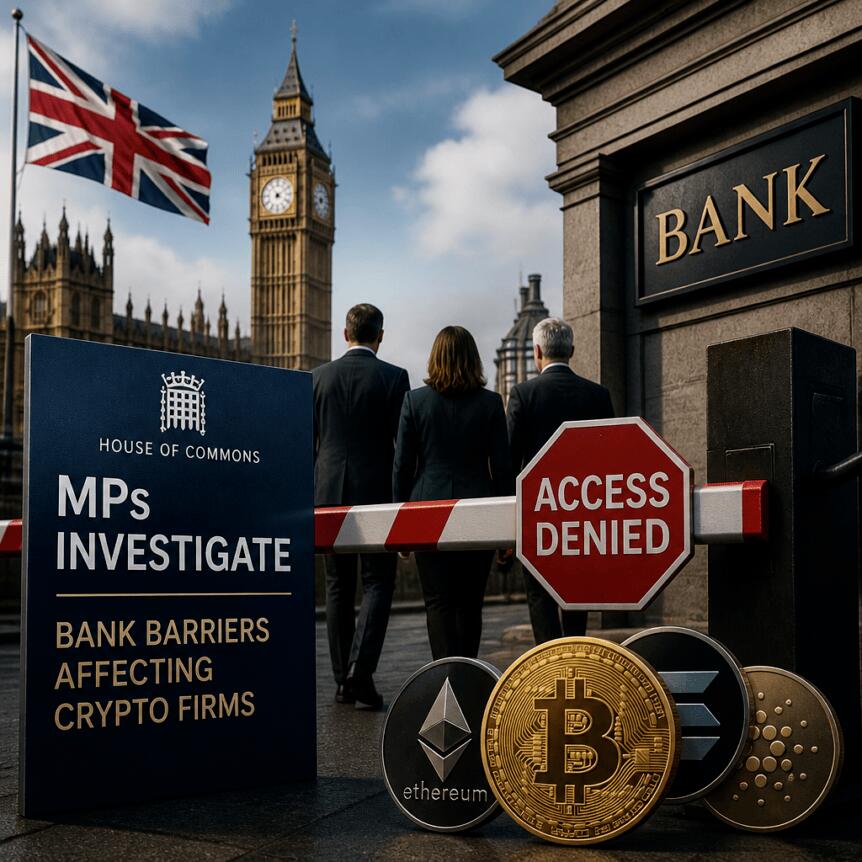
Concerns over “debanking” and banking access for the UK crypto sector have moved onto the parliamentary agenda, with a new inquiry set to examine whether crypto firms and consumers face barriers to core financial services.
On Monday, the Crypto and Digital Assets All-Party Parliamentary Group (APPG) announced it will investigate how restrictions on account access and crypto-related transactions may affect investment, competition, and broader economic growth. The group says it will assess whether any limits are proportionate and has opened written submission requests to banks, payment providers, crypto businesses, and other stakeholders until Aug. 31, ahead of publishing its findings and recommendations.
Key takeaways
- The APPG inquiry will focus specifically on access to banking services for UK crypto businesses and consumers, including limits that may restrict crypto-related payments and transfers.
- UK Cryptoasset Business Council (UKCBC) data cited by the inquiry claims banks blocked or delayed 40% of transactions to crypto platforms across 10 exchanges in a January survey.
- Most surveyed exchanges reportedly saw more customers experiencing blocked or limited transfers over the prior year and described the UK banking environment as increasingly “hostile.”
- UKCBC is urging the FCA to require banks to differentiate between firms based on regulatory status and controls rather than applying uniform restrictions.
- Industry commentary warns that the upcoming UK crypto licensing framework could lose practical value if approved firms still struggle to access mainstream banking.
A parliamentary inquiry into banking access
The Crypto and Digital Assets APPG’s announcement frames the debate around whether barriers to banking services are limiting the sector’s ability to grow within the UK. According to the group, the review will examine how restrictions influence investment decisions, competitive dynamics, and economic outcomes—and whether existing banking practices meet a proportionality standard.
The inquiry also signals a potential policy collision: while the UK is moving toward a new regulatory approach for crypto firms, banks and payments providers may still treat many crypto activities as inherently high risk. The APPG’s request for submissions will allow financial institutions and market participants to make the case for both sides, including how fraud and money-laundering risk assessments are applied in practice.
UKCBC survey highlights blocked transfers and reduced willingness to invest
A January survey conducted by the UK Cryptoasset Business Council (UKCBC) is central to the debate. The council’s report (linked in the APPG-related coverage) states that, among 10 crypto exchanges surveyed, banks blocked or delayed 40% of transactions to crypto platforms.
It also claims that 70% of respondents said the restrictions had reduced their willingness to invest, expand, or hire in the UK. The exchanges referenced in the survey include Coinbase, Kraken, Gemini, OKX, Bitpanda, Luno, Uphold, Wirex, Zumo and Xapo Bank.
Within that same survey, eight of the 10 respondents reported increased instances over the prior year where customers experienced blocked or limited transfers. Seven described the overall banking environment for digital asset businesses as becoming more “hostile.”
The survey further alleges that one exchange observed nearly £1 billion (about $1.35 billion) in transactions declined by banks over a year. The figure, as described in the referenced material, covers rejected card payments and transfers initiated through open banking, while abandoned or blocked transactions via other channels were excluded.
Industry pressure: banks should distinguish by risk, not blanket restrictions
UKCBC has urged the UK’s Financial Conduct Authority (FCA) to push banks toward more targeted approaches—requiring differentiation between exchanges based on regulatory status, governance, and fraud controls rather than applying the same constraints to every platform.
Yuriy Brisov, a partner at London-based consultancy Digital & Analogue Partners, told Cointelegraph that while banks have legitimate obligations to manage fraud and money-laundering risks, he argues that controls should scale with risk level rather than be applied uniformly. He said proportionality should depend on whether measures distinguish between high-risk and low-risk cases, adding that, in his view, current practices do not consistently do so.
Brisov cited blanket policies and fixed transaction caps that may apply regardless of where funds are destined—whether to an FCA-registered exchange or an unlicensed offshore platform.
He also pointed to potential incentives created by payment fraud reimbursement rules. Since October 2024, payment providers have generally been required to reimburse eligible fraud victims for losses of up to £85,000 per claim under faster payments-related requirements described by the UK Payment Systems Regulator (PSR). Brisov argued this can encourage banks to block crypto-linked transactions rather than assess them individually, effectively shifting the risk-management burden away from case-by-case evaluation.
Licensing timeline raises a “hub” inconsistency
The APPG inquiry comes as the FCA prepares to accept authorization applications from crypto firms starting Sept. 30. Brisov said this scheduling creates a contradiction between the government’s stated ambition to build a global crypto hub and the continued use of banking restrictions against exchanges, including firms already registered under the FCA framework.
His core argument is that once a regulator licenses a firm, banking decisions should not treat that entity as unknowable in risk terms. He said supervisors should ask banks to provide written reasons if they still consider regulated firms effectively “untouchable,” suggesting that clearer justification could become a key theme of any parliamentary or regulatory follow-up.
Policy changes are already in motion. HM Treasury laid the Cryptoassets Regulations before Parliament in December 2025, with the full regime expected to take effect in October 2027. The industry question, according to Brisov, is whether regulatory authorization will translate into practical access to the payment system.
Brisov argued that licensing would have limited value if approved crypto businesses remain unable to access mainstream banking channels. In his view, a country positioning itself as a crypto hub cannot keep its payment infrastructure effectively closed to the industry it licenses.
What to watch next
As the APPG collects submissions through Aug. 31 and the FCA moves toward crypto authorization applications beginning Sept. 30, the key uncertainty for the sector is whether policymakers can drive a more risk-sensitive approach from banks and payment providers—or whether restrictions will persist even after new licensing rules take effect. Investors and builders will likely look for signals around whether any guidance or enforcement will target “proportionality” in a measurable, bank-by-bank way.
https://www.cryptobreaking.com/uk-mps-investigate-bank-barriers/?utm_source=blogger%20&utm_medium=social_auto&utm_campaign=UK%20MPs%20Investigate%20Bank%20Barriers%20Affecting%20Crypto%20Firms%20
Comments
Post a Comment