
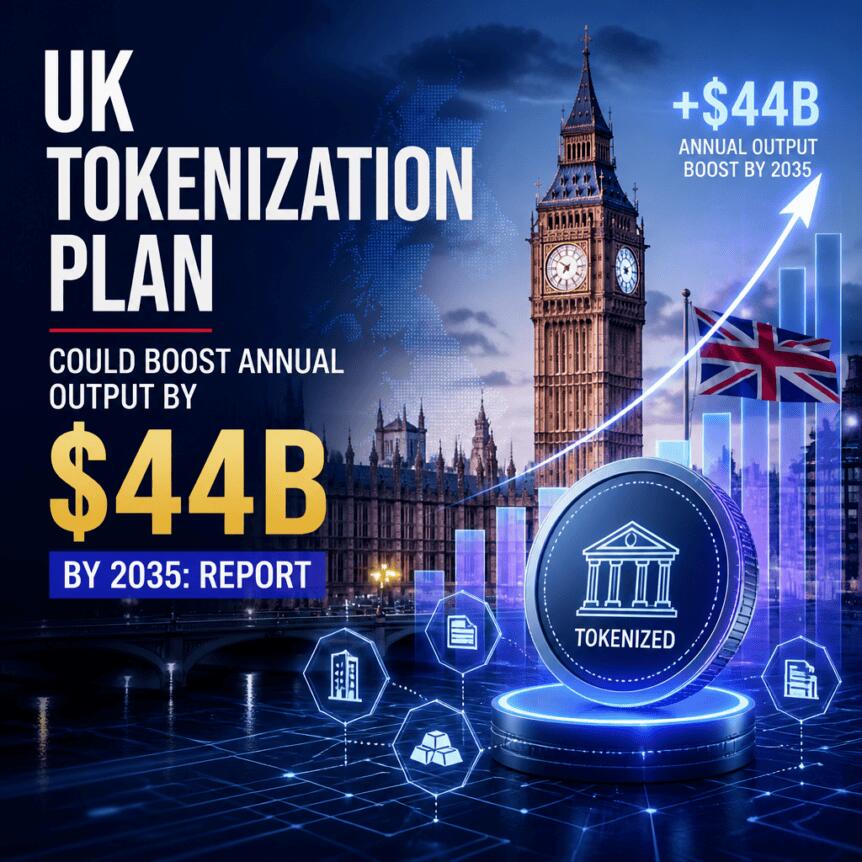
The UK is preparing to move tokenized financial markets from experimental pilots to scaled, live trading and settlement, according to a government-backed industry task force report published by Wholesale Digital Markets Champion Chris Woolard. The document estimates that, if the country becomes a leader in tokenized markets, the effort could add as much as £33 billion (about $44 billion) to annual economic output by 2035.
The report outlines a 12-month plan to test blockchain technology in a financial transaction that uses securities to borrow cash, and it calls for the UK to issue its first tokenized government bond—known as a gilt—by the first quarter of 2027. Woolard’s role is tied to HM Treasury’s digital markets strategy, with the task force assembled to connect traditional market infrastructure providers with digital-asset firms.
Key takeaways
- The task force aims to progress from isolated blockchain trials to “scale,” with real-market trading, settlement, and use of tokenized securities as collateral.
- Plans include a 12-month blockchain test focused on repo-like mechanics where securities are used to raise cash.
- The roadmap targets a first tokenized UK government bond issuance by the first quarter of 2027.
- The report urges the Bank of England to accept tokenized gilts as collateral, positioning collateral eligibility as a major adoption gate.
- Task force membership spans leading banks, market infrastructure firms, and crypto companies, underscoring a cross-industry approach.
From pilots to live tokenized securities markets
While tokenization has been discussed for years, the report’s emphasis is on practical market plumbing—moving beyond demonstrations toward arrangements that can support securities issuance, secondary-market activity, and settlement workflows. The task force describes its mission as shifting “from pilots to scale” and “from ambition to action,” reflecting a more implementation-focused posture than many earlier initiatives.
Central to that approach is the report’s view that tokenized assets have limited real-world value unless they can be traded and used to obtain cash. In the document’s framing, the ability to raise funding against tokenized securities—and to have those tokens participate in established collateral frameworks—determines whether tokenization can materially change market behavior.
To that end, the task force’s 12-month plan centers on testing blockchain in a financial transaction where securities are used to borrow cash. Although the report does not present additional implementation details in the provided text, the structure aligns with the market logic of repo transactions, where the speed and settlement efficiency of collateral exchanges can have meaningful operational and cost implications.
Tokenized gilts: a timeline and expanded end goals
Tokenized government bonds are not a brand-new idea in the UK. The government previously announced the Digital Gilt Instrument (digit) pilot in November 2024, using public documentation to describe the initiative.
Later updates pushed the concept further. A July 2025 update laid out intentions covering onchain settlement, over-the-counter trading, and secondary-market development. The government also appointed HSBC’s Orion platform to support the pilot on Feb. 12, signaling that at least part of the effort is geared toward real operational systems rather than purely theoretical trials.
The new task force report builds on that foundation by adding a clearer timetable and broadening how the tokenized gilt would be used. Beyond issuance, the roadmap seeks subsequent digital-gilt offerings, live secondary-market trading, and—importantly—eligibility for use as central bank collateral.
The collateral angle is where the report becomes more than a rollout plan. It explicitly argues that tokenized securities only become economically meaningful when they can be used to raise cash, and it calls on the Bank of England to accept digital gilts as collateral. For market participants, that would be a key step toward turning tokenized assets into a mainstream funding and settlement tool rather than a niche alternative.
Task force composition and industry buy-in
Woolard’s first report was developed with a task force described as bringing together more than 50 companies spanning traditional finance and crypto. The membership list in the text includes BlackRock, Goldman Sachs, JPMorgan, Morgan Stanley, HSBC, UBS, Coinbase, Circle, Ripple, Kraken, DTCC, and Euroclear.
Ripple, which appears among the industry members, publicly supported the initiative in a statement shared on Monday. The company said that onchain funds, bonds, and repo are not experiments, arguing that such instruments are already proving “cheaper, better and faster” than legacy equivalents.
For investors and builders, the breadth of the task force matters. A tokenization roadmap that includes both major securities market infrastructure players and crypto platforms suggests the UK is trying to align interfaces—custody, settlement, and compliance—rather than relying on a single ecosystem.
How UK payment infrastructure could connect the dots
The report’s tokenized-gilt ambition also intersects with existing UK efforts to improve settlement and payments. The text points to a blockchain-based wholesale payment infrastructure that could support tokenized-market settlement.
In December 2023, London-based Fnality launched a sterling-denominated payment system tied to central bank reserves. The network was designed to enable real-time repo, tokenized securities settlement, and cross-currency payments, potentially providing the infrastructure layer needed for tokenized collateral to move quickly and consistently across parties.
By pairing that sort of settlement/payment capability with a phased approach to tokenized gilts and secondary-market trading, the UK’s roadmap is effectively trying to solve two problems at once: how tokenized assets are issued and traded, and how the cash legs and settlement mechanics work end to end.
Still, the biggest practical uncertainty remains whether collateral eligibility—specifically Bank of England acceptance of digital gilts—can be achieved on a timeline that matches the planned issuance and market scaling. The report’s call for central bank collateral suggests that regulators and system operators will play a decisive role in determining how quickly tokenization can move into full-market usage.
Going forward, market participants should watch for updates on the 12-month blockchain test details, the operational requirements for secondary trading, and any announcements that clarify how the Bank of England and other oversight bodies plan to treat tokenized gilts as collateral. If those pieces align, the UK could shift tokenization from a series of pilots into a functioning market segment with real funding utility.
https://www.cryptobreaking.com/uk-tokenization-plan-could-boost/?utm_source=blogger%20&utm_medium=social_auto&utm_campaign=UK%20Tokenization%20Plan%20Could%20Boost%20Annual%20Output%20by%20$44B%20by%202035:%20Report%20
Comments
Post a Comment