
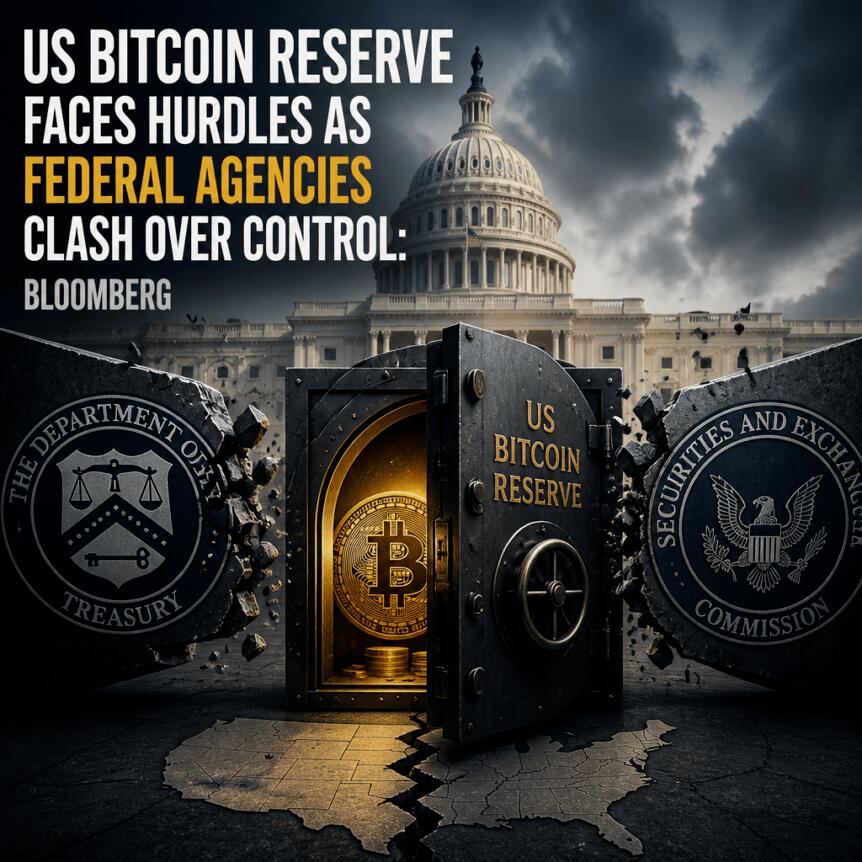
The Trump administration’s plan to create a US Strategic Bitcoin Reserve (SBR) is reportedly running into an unexpected hurdle: an internal dispute over the reserve’s legal structure and which federal agency should hold primary oversight of the Bitcoin assets. The disagreement centers on how the reserve would be organized and managed, according to reporting from Bloomberg and people familiar with the matter.
While US President Donald Trump’s March 2025 executive order envisioned housing the SBR within the Treasury Department—with other agencies supporting tasks tied to asset seizures—questions have emerged about whether Treasury has the legal authority to manage Bitcoin holdings. Bloomberg reported Monday that these issues are part of the reason the plan has not moved forward as smoothly as originally outlined.
Key takeaways
- Bloomberg reports a roadblock in the SBR effort due to disagreements among the Commerce and Treasury departments over structure and oversight.
- Legal concerns have been raised about whether Treasury can manage Bitcoin directly, given the asset’s volatility and the scope of its authority.
- Commerce has reportedly emerged as a potential alternative for primary oversight, with the Justice Department also assessing legally available options.
- Congress is pursuing parallel legislation—such as the BITCOIN Act and ARMA Act—that aims to establish a Bitcoin accumulation plan over five years.
- Industry advocates view the SBR concept as creating a new “capital allocation” category, even as execution details remain unsettled.
Treasury vs. Commerce: the dispute behind the reserve
Trump’s executive order calls for a Strategic Bitcoin Reserve housed in the Treasury Department, with other agencies playing supporting roles in building the reserve through asset seizure mechanisms. However, Bloomberg’s Monday report indicates that the departments are now at odds over how the reserve should be structured and which agency should have primary oversight of the holdings.
Central to the reported problem is a question of authority. Bloomberg cited concerns about whether Treasury has the legal power to manage the Bitcoin assets themselves, pointing to the asset’s volatility as part of the legal and regulatory complexity. The report also says Commerce may be positioned as an alternative lead agency, while the Department of Justice is working alongside relevant departments to identify options that are legally available.
For investors and market participants, the significance is not just bureaucratic. If the reserve’s governance framework ends up different than originally proposed, it could affect how assets are safeguarded, how decisions about holding or selling are made, and what kinds of legal constraints apply over time.
Why the SBR concept matters for US policy
The SBR proposal is designed to reposition Bitcoin within government financial planning. Rather than treating Bitcoin primarily as an asset to be seized and liquidated under court processes, the administration’s approach—at least in intent—would treat it as a strategic reserve asset. The White House has framed this as a shift toward making the United States a more central “crypto capital” by formalizing Bitcoin’s role.
In comments to Cointelegraph, a White House spokesperson, Liz Huston, said the administration continues to evaluate “the best structure for a Strategic Bitcoin Reserve and US Digital Asset Stockpile,” emphasizing that the effort is still underway. That statement is consistent with the reported internal review described by Bloomberg, which suggests the plan is still in a formative stage.
Bitcoin held by the US already exists in practice. The US currently holds 328,372 Bitcoin, valued at $21.1 billion, making it the largest known nation-state Bitcoin position. Over the years, the government has sold portions through court-ordered actions, underscoring that the operational reality of state-held Bitcoin is shaped by ongoing legal processes—not only by policy ambitions.
Congress moves in parallel: BITCOIN Act and ARMA Act
While the executive branch works through interagency questions, lawmakers are also attempting to codify the reserve through legislation. Efforts referenced in Cointelegraph’s coverage include the BITCOIN Act and the ARMA Act, introduced in May, both aimed at acquiring a total of 1 million Bitcoin over five years using budget-neutral strategies.
ARMA is described as a step that builds on prior proposals. One of the White House’s top crypto advisers, Patrick Witt, characterized ARMA as “Version 2” of the BITCOIN Act and said the White House had spent significant time examining the legal implications of establishing a Bitcoin reserve. In the same context, Witt said it was a “breakthrough” for putting the program on a legally sound footing and ensuring safeguards for the assets.
Under ARMA, Bitcoin would be held for at least 20 years unless sold to reduce America’s national debt, which is near $40 trillion. That framework highlights a key tension investors may watch: the policy aims to create durability and strategic value over the long term, yet it also provides a pathway for eventual use in debt reduction. How such sell-down authority is implemented could be influenced by the same legal and oversight questions now reportedly complicating the executive branch’s structure.
Industry reaction: “validation” rather than just accumulation
Even with reported disagreements inside government, industry observers continue to see the Strategic Bitcoin Reserve as potentially bullish for Bitcoin’s broader role. Advocates argue that formalizing Bitcoin as a strategic reserve could reinforce its legitimacy as an investment and policy asset—moving it closer to how traditional institutions treat reserve categories.
Tim Kotzman, host of the Bitcoin Treasuries Podcast, commented that the SBR is not only supportive of Bitcoin, but “validates an entirely new category of capital allocation.” He added a comparison between earlier adoption by public companies and the idea that nation-states are now moving in the same direction.
That perspective aligns with the existing landscape of state-level Bitcoin holdings. Cointelegraph’s earlier coverage noted that 15 nation-states hold Bitcoin, but El Salvador is singled out as the only country that has formally established a Bitcoin reserve and makes routine purchases.
For readers, the practical takeaway is that the debate now appears to be shifting from whether the reserve should exist to how it should be governed—particularly which agency leads, what legal authority applies, and how long-term safeguards and eventual liquidity mechanisms would work.
What to watch next is whether the interagency review resolves the legal authority questions quickly, and whether Congress’s ARMA framework—and its long-hold rules tied to debt reduction—moves toward becoming a binding structure that can reduce uncertainty around who controls the reserve in practice.
https://www.cryptobreaking.com/us-bitcoin-reserve-faces-hurdles/?utm_source=blogger%20&utm_medium=social_auto&utm_campaign=US%20Bitcoin%20Reserve%20Faces%20Hurdles%20as%20Federal%20Agencies%20Clash%20Over%20Control:%20Bloomberg%20
Comments
Post a Comment