
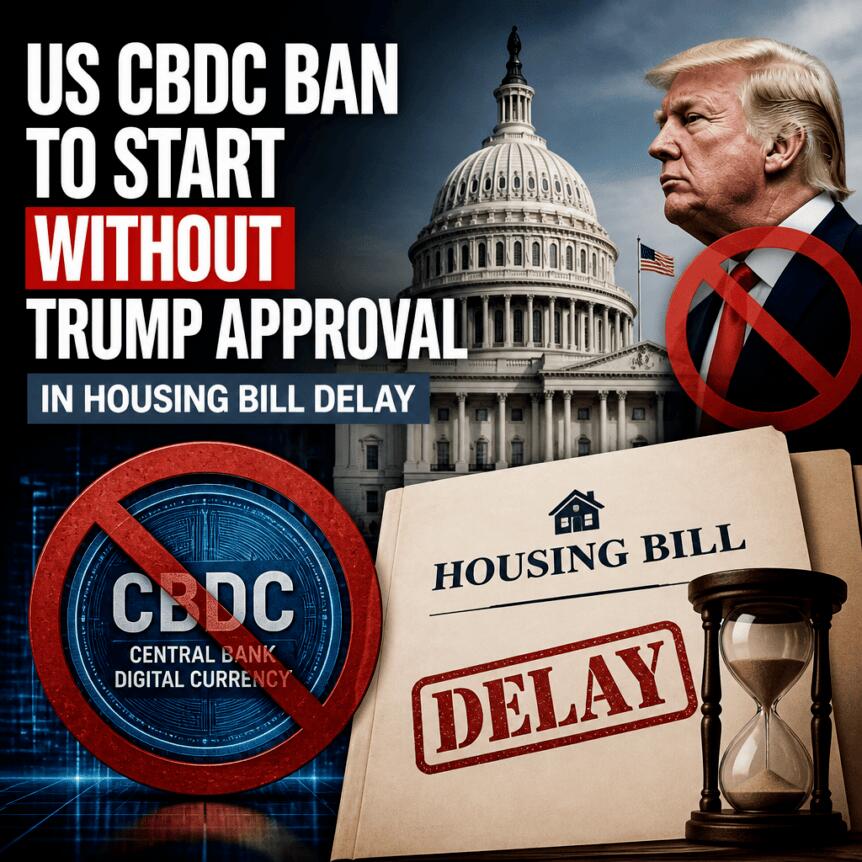
A bipartisan U.S. housing bill that includes a multi-year ban on the Federal Reserve issuing or creating a central bank digital currency (CBDC) is poised to become law after President Donald Trump declined to sign it. The legislation, the “21st Century ROAD to Housing Act,” had been on Trump’s desk for about 10 days after excluding Sundays—an amount of time that, under the U.S. Constitution, allows it to become law automatically if he does not sign or veto it within the allowed window.
Trump canceled a signing ceremony for the measure earlier and reiterated his opposition in a Friday social media post, according to his statement on Truth Social. He said he would not sign the housing bill and urged Senate Republicans to focus instead on the SAVE America Act, a separate voting-related proposal widely criticized for requiring proof of U.S. citizenship in person to register.
Key takeaways
- The “21st Century ROAD to Housing Act” appears set to become law automatically if no signature or veto occurs within the constitutional deadline.
- The bill contains a provision barring the Federal Reserve from issuing or creating a CBDC—or any “substantially similar” digital asset—until Dec. 31, 2030.
- Trump’s decision not to sign does not address the CBDC language directly, according to his Friday remarks.
- His refusal raises questions about whether other pending digital-asset legislation could face similar political friction.
Why the housing bill will likely take effect
The timing matters for how the law will land. As the deadline approached for Trump to either sign or veto the bill, the automatic-law mechanism under the U.S. Constitution became the decisive factor. Reporting leading up to the deadline noted that Trump had already canceled the signing ceremony for the housing package.
On Friday, Trump reiterated that he would not sign the bill, calling Republicans who supported it “dumb” and directing attention toward the Senate’s next priorities—specifically the SAVE America Act. Because this housing legislation involves a defined window on the president’s desk, the practical outcome is that it can become law without an explicit signature if no veto is issued.
Senator Elizabeth Warren, a co-sponsor of the bill, reacted to Trump’s approach by arguing that the measure would still become law regardless of the president’s refusal, according to her remarks cited in the coverage.
The CBDC ban embedded in housing policy
While the bill is framed around housing, its text includes a digital currency restriction directed at the Federal Reserve. The measure bars the Federal Reserve from issuing or creating a CBDC “or any digital asset that is substantially similar” through Dec. 31, 2030. Analysts characterized the CBDC language as politically strategic—an element designed to attract or retain support within certain Republican constituencies.
Notably, Trump’s Friday comments did not engage the CBDC provision. In the context of an administration signaling that it would like to “future-proof” parts of digital asset regulation, the absence of a direct response underscores that the CBDC language may survive primarily due to procedural mechanics rather than presidential endorsement.
Could Trump’s inaction echo in crypto legislation?
Trump has said he intends to “future-proof” U.S. digital asset regulation, but the housing bill episode highlights how political bargaining can still affect legislative momentum—even when the substance of a bill is not the target of a president’s objections. The question now is whether the same kind of non-signing dynamics could arise for other major crypto-related measures moving through Congress.
One focal point is the Digital Asset Market Clarity (CLARITY) Act, which multiple stakeholders have described as one of the more significant pieces of proposed digital-asset regulation in recent years. According to prior coverage, the CLARITY Act has already passed the House and cleared two key Senate committees. Republican leaders have indicated they expect the bill to advance to the full Senate for a floor vote in July, after lawmakers return from scheduled state work periods.
However, the housing bill decision suggests that legislative outcomes in the current Congress may continue to depend on complex cross-party negotiations and the president’s willingness—or reluctance—to sign unrelated bills. Even if the CLARITY Act’s substance differs from the housing package, the broader lesson for market participants is that process can matter as much as policy details.
There is also an additional political dimension. Previous reporting noted that Trump has personal financial ties to crypto, including disclosures stating he earned more than $1.4 billion in income from his crypto ventures in 2025. That income, as described in the earlier coverage, includes references to memecoins and the family’s World Liberty Financial platform. Such ties have been used by critics and observers to argue that negotiations over market-structure legislation can become entangled with broader political considerations.
In practice, that means traders and builders watching the next steps for the CLARITY Act may want to pay close attention not only to committee progress and floor schedules, but also to the tone and priorities Trump signals as other high-profile bills move simultaneously through the Senate.
What to watch next
With the housing bill likely to become law due to constitutional timing, the immediate uncertainty shifts to how digital-asset bills like the CLARITY Act progress toward a Senate vote—and whether future major measures face similar executive friction. Investors and users should monitor not just bill text and committee approvals, but also the political calendar and any indications that the president may or may not choose to sign subsequent crypto-relevant legislation.
https://www.cryptobreaking.com/us-cbdc-ban-to-start/?utm_source=blogger%20&utm_medium=social_auto&utm_campaign=US%20CBDC%20Ban%20to%20Start%20Without%20Trump%20Approval%20in%20Housing%20Bill%20Delay%20
Comments
Post a Comment