
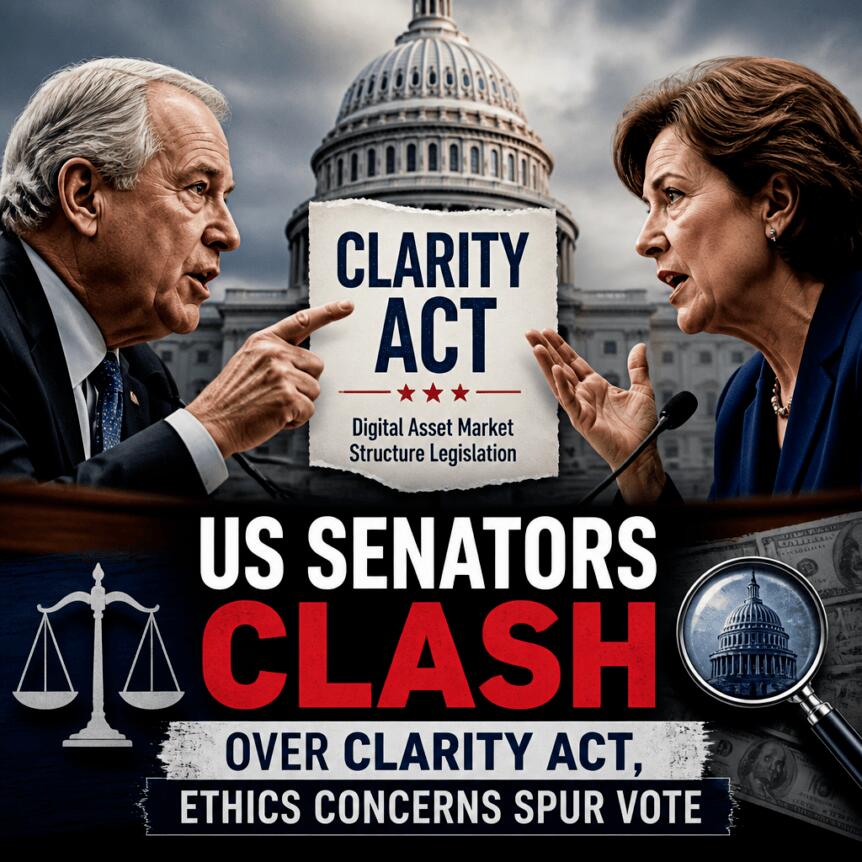
The US Senate is nearing a vote on the Digital Asset Market Clarity (CLARITY) Act, a market-structure bill backed by Republicans that would set new rules for digital-asset activity. But a vocal bloc of Senate Democrats and civil-society groups says the legislation is incomplete, arguing it fails to address ethics concerns tied to President Donald Trump’s financial relationships with parts of the crypto industry.
At a press conference on Tuesday, Senators Chris Murphy, Jeff Merkley, and Chris Van Hollen—along with representatives for Americans for Financial Reform and Indivisible and actor Ben McKenzie—criticized the bill for what they characterized as “Trump’s crypto corruption.” The lawmakers argued that passing a new regulatory framework without curbing potential conflicts would effectively “protect” the President’s ability to influence the sector.
Key takeaways
- Democratic senators Murphy, Merkley, and Van Hollen signaled they will not back the CLARITY Act unless ethics safeguards are added.
- The bill’s Senate path is tight: it must clear a 60-vote threshold and then return to the House, meaning some Democratic support is likely required.
- Majority Leader John Thune says the Senate will vote before the Aug. 10 work period, though the exact timing was not confirmed in the Senate calendar as of Tuesday.
- The CLARITY Act has support from at least two law-enforcement organizations, which argue it would help combat digital-asset crime.
Ethics fight threatens a bipartisan milestone
The CLARITY Act has been moving through Congress for roughly a year, having already passed the House as part of a broader Republican “Crypto Week” agenda. As the bill heads to the Senate floor, opposition has focused less on whether rules are needed—and more on whether the proposed framework includes sufficient ethics provisions.
In the Tuesday remarks, Murphy argued there is “no reason” to create a new regulatory system for crypto if it does not prevent what he described as corruption across the industry. He warned that legislation could become “in and of itself a fundamental corruption” if it effectively shields the President’s influence over how the sector is regulated.
Other Senate Democrats have raised similar concerns. Van Hollen, Murphy, and Merkley cited recent disclosure activity by Trump as part of the broader push for safeguards. The article notes that Trump disclosed that he earned $1.4 billion from crypto ventures in 2025, a point connected to objections about the bill’s ethics posture. Senator Elizabeth Warren—an influential critic of many crypto-related policies—has also called for the bill to address “brazen financial corruption,” aligning her position with the group opposing the legislation’s current form.
Still, the ethics dispute also has practical implications: with the CLARITY Act requiring 60 votes, any Democratic refusal could make passage difficult even with Republicans’ slim majority. The Senate’s voting arithmetic becomes especially relevant as party leaders consider whether they can secure enough support to avoid a failed floor vote.
What the Senate vote means for timing and leverage
Majority Leader John Thune told Bloomberg Government News that the Senate would hold a vote before the August recess/work period, which is scheduled to begin Aug. 10. As of Tuesday, the precise timing was reportedly not yet reflected in the official Senate calendar.
Thune’s pledge matters because it compresses the window for negotiations that could produce amendments or side arrangements. If lawmakers expect a vote before Aug. 10, there is less time to resolve disagreements over ethics language, stablecoin provisions, or other implementation details.
The political pressure around timing has also been heightened by developments on the Republican side. The article says Trump urged senators to pass the bill “in honor of” Senator Lindsey Graham after his death over the weekend. While the article notes that Graham did not appear to make public statements directly supporting CLARITY, it frames the President’s comments as additional momentum for the vote.
At the same time, the article highlights the narrowness of Republican numbers in the chamber following Graham’s passing, and notes that Senator Mitch McConnell was still hospitalized as of Tuesday. With the party reportedly holding a 52-47 majority after Graham’s death, the chamber’s effective attendance could be even more consequential for a time-sensitive floor schedule.
Law enforcement support adds a counterweight
Despite the ethics-focused pushback, the CLARITY Act also has backing from law enforcement organizations. The article says the National Organization of Black Law Enforcement Executives and the Federal Law Enforcement Officers Association have endorsed the bill, arguing it would help address digital-asset-related crime.
This matters for lawmakers trying to bridge the gap between regulatory design and political feasibility. While ethics provisions may be the deciding factor for some Democrats, law enforcement endorsements provide a separate policy narrative: the claim that clearer rules would improve compliance, investigation, and prosecution in markets historically associated—rightly or wrongly—with illicit activity.
The tension between those two narratives—ethics safeguards versus criminal enforcement benefits—could become the central question for observers watching the Senate whip count. If the ethics amendments are viewed as non-negotiable by some senators, the enforcement arguments may not be enough to secure the 60-vote threshold.
Where the bill stands and what to watch next
The CLARITY Act is expected to return to the House if the Senate amends it, meaning any changes—whether aimed at ethics, stablecoin-related details, or other market-structure mechanics—could restart parts of the legislative process. With the bill already cleared the House nearly a year after “Crypto Week,” supporters will likely want to avoid a cycle that delays implementation.
For investors, builders, and market participants, the upcoming Senate floor vote is less about short-term price noise and more about policy certainty. The key question now is whether Senate Democrats who raised ethics objections can be brought on board through clarifications or carveouts—or whether their opposition will be strong enough to force either a delay or a reshaped bill.
As senators head toward a vote before Aug. 10, watch for when the bill’s final text is released, whether ethics language becomes a sticking point on the floor, and how quickly negotiations can turn opposition into enough votes to reach the 60 threshold.
https://www.cryptobreaking.com/us-senators-clash-over-clarity/?utm_source=blogger%20&utm_medium=social_auto&utm_campaign=US%20Senators%20Clash%20Over%20CLARITY%20Act,%20Ethics%20Concerns%20Spur%20Vote%20
Comments
Post a Comment