
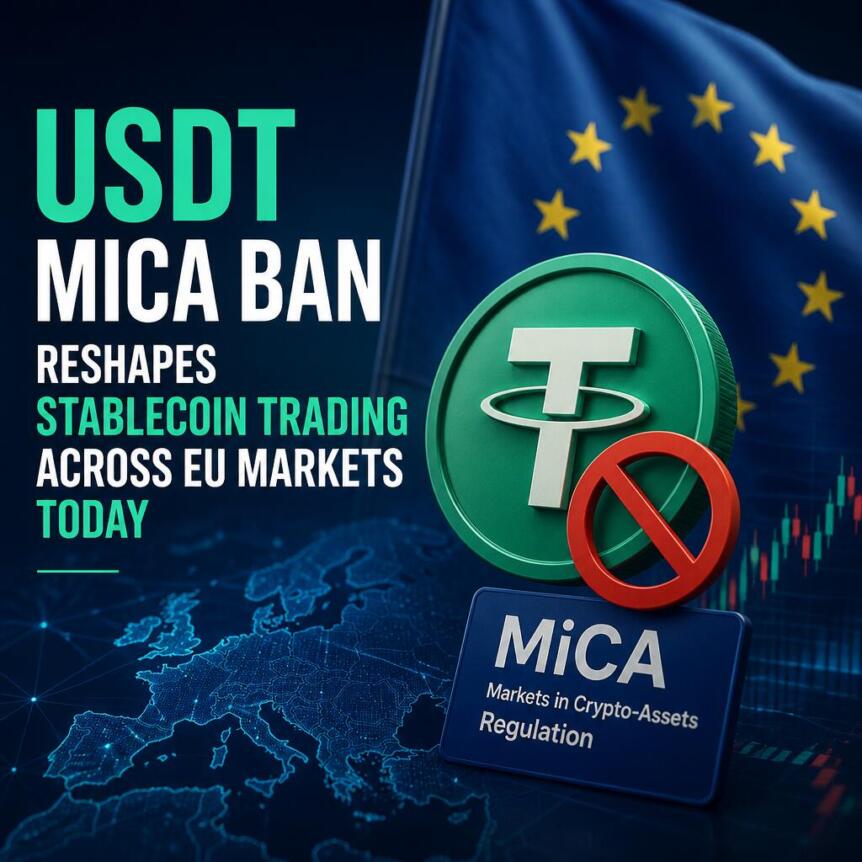
Europe’s stablecoin market entered a stricter phase as MiCA reached its full enforcement deadline across member states and licensed platforms. The July 1, 2026, cutoff removed USDT from regulated exchange access across the bloc’s licensed venues. The shift redirects licensed liquidity toward USDC, EURC, and new euro-backed tokens under tighter EU supervision and clearer reserve controls.
USDT Loses Its Regulated EU Route
Europe has removed USDT from regulated crypto trading as MiCA now reaches full force across licensed markets and service providers. The deadline blocks non-compliant stablecoins from licensed EU exchanges, brokers, and trading venues under the new regime for stablecoin issuers. That decision ends Tether’s direct regulated access to the bloc’s main crypto platforms and order books.
The change followed months of phased exchange action rather than one sudden cutoff. Coinbase Europe removed USDT in December 2024, and Crypto.com followed in January 2025 under the same compliance pressure. Binance later restricted EU USDT pairs, while Kraken moved from sell-only trading to paused support for regional clients.
Tether did not seek approval as a MiCA e-money token before the final deadline, despite the market size. The company opposed the reserve rule requiring large deposits inside European banking institutions and supervised accounts under EU oversight. Therefore, USDT lost its regulated pathway despite its leading role in global stablecoin trading liquidity and offshore demand.
USDC Takes The Main Dollar Route
Circle used the same rulebook to strengthen its position inside the European crypto market under MiCA and local oversight. The company secured a French Electronic Money Institution license before the hard deadline took effect across the bloc. As a result, USDC can operate across all 27 EU member states through passporting rights and local supervision.
USDC now stands as the leading compliant dollar stablecoin on licensed European exchanges and broker platforms. Platforms can list it without the legal pressure now attached to USDT in Europe after the cutoff. Consequently, trading desks and market makers must rebuild liquidity around new compliant pairs and settlement routes for clients.
The transition may tighten short-term liquidity because USDT still drives large global volumes. Yet regulated EU exchanges now need tokens that fit MiCA’s stablecoin rules and reserve standards for issuers. That requirement gives USDC a stronger role in euro-area crypto trading and settlement flows.
EURC And Euro Tokens Push Local Control
Circle’s EURC also gains from the same regulatory approval and passporting rights across Europe. The euro-pegged token gives exchanges a compliant local currency stablecoin option under MiCA and local oversight. In turn, platforms can reduce reliance on dollar pairs for selected regional trading activity inside Europe.
Tether still has indirect exposure to Europe through other regulated token projects and partners. StablR and Oobit launched MiCA-compliant tokens using Tether’s Hadron tokenization platform for compliant issuance. Their EURR and USDR products show how Tether can support compliant issuers without listing USDT on regulated venues.
Banks are also preparing a larger euro stablecoin push under the new framework. A group of 37 European banks, including BNP Paribas and ING, is developing Qivalis. MiCA now sets the rulebook, and July 1 resets regulated European stablecoin trading.
https://www.cryptobreaking.com/usdt-mica-ban-reshapes-stablecoin/?utm_source=blogger%20&utm_medium=social_auto&utm_campaign=Usdt%20Mica%20Ban%20Reshapes%20Stablecoin%20Trading%20Across%20Eu%20Markets%20Today%20
Comments
Post a Comment