
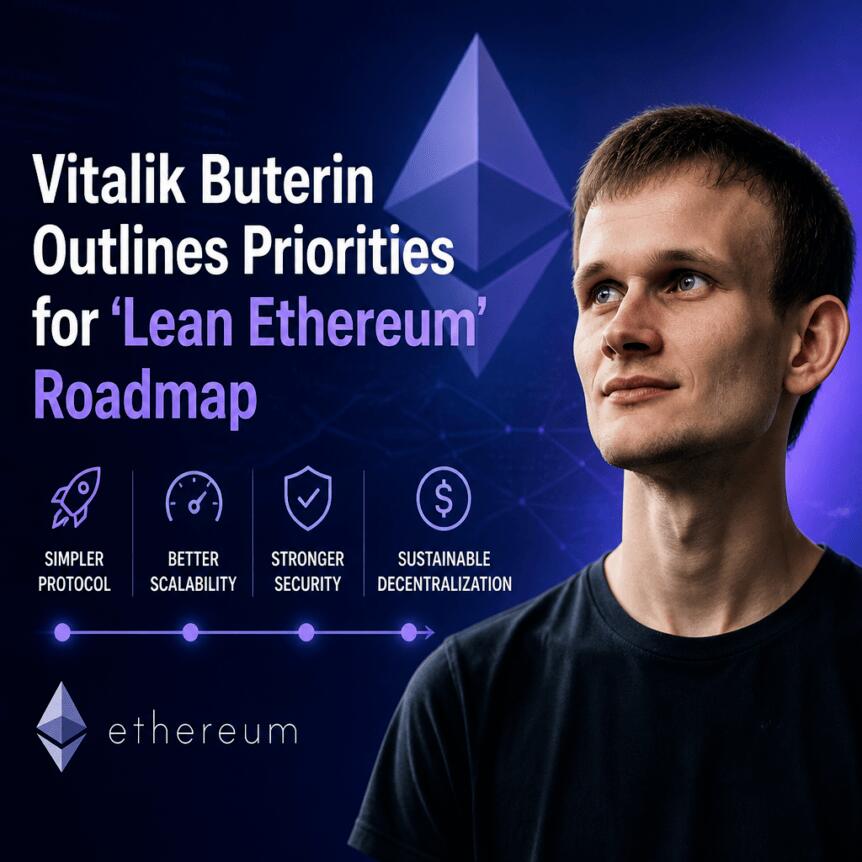
Ethereum co-founder Vitalik Buterin has outlined a renewed technical direction for the network in a new “Lean Ethereum” strawmap, placing quantum resistance, scalability, and privacy at the top of Ethereum’s priorities for the coming years. In a post on X, Buterin said the roadmap is designed to be rolled out over the next three to four years and to span “nearly every layer” of the ecosystem.
Buterin compared the expected breadth of change to the September 2022 “Merge,” when Ethereum shifted away from energy-intensive mining to a proof-of-stake consensus mechanism. The updated plan also comes as Ethereum Foundation restructuring efforts are ongoing, following recent staffing cuts intended to reduce spending and streamline operations.
Key takeaways
- “Lean Ethereum” prioritizes quantum safety, scaling improvements, and stronger privacy, with changes planned across most parts of the stack.
- Buterin says quantum safety has become a much higher priority and that finalizing a quantum-safe approach for “blobs” is now urgent.
- Privacy is described as a “first class goal,” alongside efforts to expand programmable privacy and scalability.
- Several Ethereum Foundation departures and a reported ~20% staff reduction have raised questions about delivery timelines.
- Critics argue the three-to-four-year window may be too slow and question whether the Ethereum Foundation can meet the proposed schedule.
Quantum safety and “Lean” upgrades across Ethereum
Buterin’s post frames “Lean Ethereum” as a long-running technical roadmap that begins in 2026 and extends through 2029, according to the strawmap hosted on Strawmap.org. The thrust is not a single upgrade, but a coordinated sequence of work meant to address multiple categories of risk and performance constraints.
One of the most urgent elements, according to Buterin, is quantum safety. He stated that “quantum safety has shifted up a LOT in priority,” and specifically flagged the need to finalize a quantum-safe solution for Ethereum’s “blobs.” While the details of that solution were not described in the article, Buterin’s emphasis suggests Ethereum is accelerating preparation for a future in which quantum computing could threaten today’s cryptographic assumptions.
Scalability remains another central theme. Buterin linked the roadmap to architectural improvements that touch the network broadly, echoing the scale of the Merge as an analogy for how disruptive but necessary the coming work could be.
Privacy moves from feature to priority
Alongside quantum safety and scalability, privacy has been elevated to the top tier of Ethereum’s objectives. Buterin said privacy has become a “first class goal,” signaling that privacy considerations are no longer expected to be an optional add-on for niche use cases.
Buterin also pushed for work on a new virtual machine design—described as similar to “leanISA or RISC-V”—intended to support programmable privacy and improve scalability. The thrust of this idea is to make privacy-related logic more adaptable at the protocol level, while continuing to address throughput and efficiency constraints that have historically shaped Ethereum’s upgrade path.
Ethereum Foundation restructuring adds delivery pressure
The timing of “Lean Ethereum” matters as Ethereum Foundation operations are undergoing changes. Earlier coverage noted that the Ethereum Foundation cut roughly 20% of its staff last month as part of an effort to become leaner and reduce its budget by 40%. The broader reorganization has also included executive departures in recent months, including Hsiao-Wei Wang and Tomasz Stańczak.
Protocol contributor exits were also reported. In May, Tim Beiko and Barnabé Monnot left, adding to a recent pattern of personnel changes.
From an investor and developer perspective, the key issue is not the concept of a new roadmap—Ethereum has repeatedly used multi-year upgrade plans—but the practical question of execution capacity. Roadmaps often collide with staffing, coordination bandwidth, and cross-client implementation realities, especially when multiple layers are expected to evolve in parallel.
Debate over whether the timeline is realistic
While some researchers praised the direction, the proposed three-to-four-year window drew immediate skepticism from others. Dankrad Feist, a researcher behind the payments-focused layer-1 Tempo blockchain, said the plan was positive but argued that the schedule may be too slow. He suggested that AI could help developers ship upgrades within a year.
Crypto analyst Ignas Fiodorovas also supported the general goals but raised doubt about whether the Ethereum Foundation can deliver within Buterin’s timeframe, citing what he described as a history of missed deadlines. Importantly, his critique focused less on the technical ambition and more on execution risk—how likely teams are to complete complex protocol changes on schedule.
Fiodorovas also pointed out a perceived omission from the strawmap: improved tokenomics for Ether (ETH). In the article’s reporting, he connected that gap to ongoing downward pressure on ETH’s price amid a broader market downturn, implying that even a technically successful roadmap may not directly satisfy market expectations in the near term.
These tensions highlight a recurring dynamic in large-scale blockchain roadmaps. Technical upgrades can strengthen the network’s long-term security and usability, but token performance, governance priorities, and deliverable milestones often remain coupled in traders’ minds—particularly when the community expects ecosystem-wide “leaning” to translate into clearer value capture or incentives.
Looking ahead, readers should watch for clarification on how Ethereum intends to finalize a quantum-safe approach for blobs and what specific milestones are attached to the 2026–2029 strawmap. The next signal to monitor will be whether the Foundation’s reorganized structure—and the teams implementing across multiple clients and layers—can convert the roadmap into measurable, time-bound deliverables.
https://www.cryptobreaking.com/vitalik-buterin-outlines-priorities-for/?utm_source=blogger%20&utm_medium=social_auto&utm_campaign=Vitalik%20Buterin%20Outlines%20Priorities%20for%20'Lean%20Ethereum'%20Roadmap%20
Comments
Post a Comment