
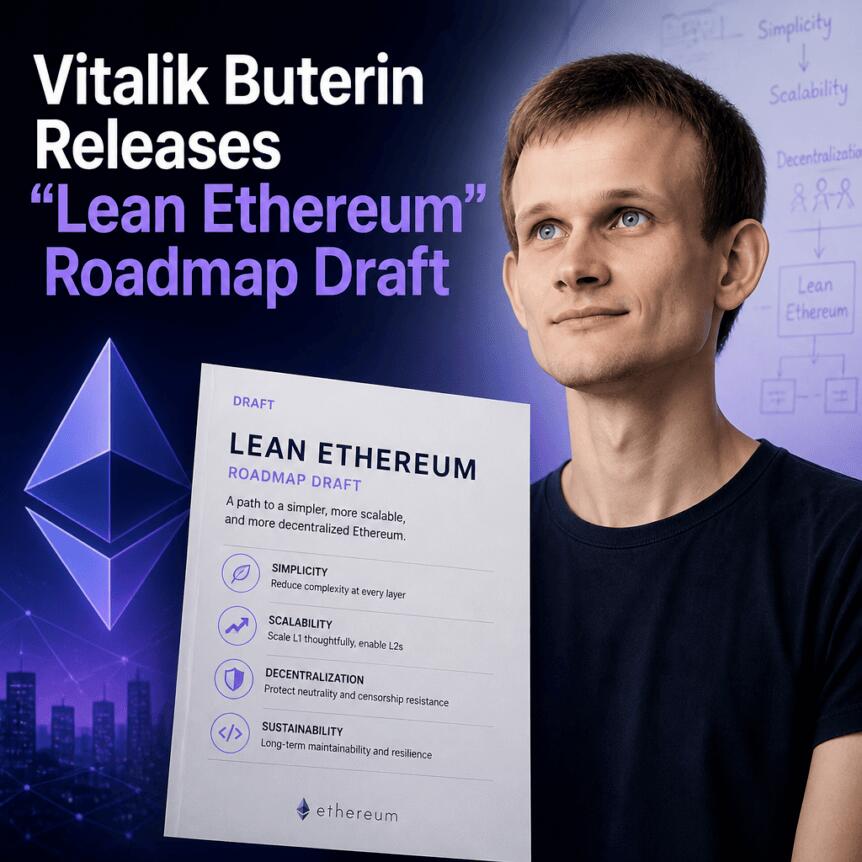
Ethereum co-founder Vitalik Buterin has laid out a new long-term technical direction for the network under a “Lean Ethereum” strawmap, prioritizing quantum resistance, scalability, and privacy. In a post shared on X, Buterin said the upgrade effort is expected to roll out over the next three to four years, spanning nearly every layer of Ethereum.
Buterin framed the proposed transformation as comparable in magnitude to Ethereum’s September 2022 “Merge,” which moved the network away from energy-intensive mining. He also said that “quantum safety has shifted up a LOT in priority,” and that arriving at a quantum-safe approach for “blobs” has become urgent. Privacy, meanwhile, was described as a “first class goal.”
Key takeaways
- Buterin’s “Lean Ethereum” strawmap targets quantum resistance, scalability, and privacy as top priorities.
- The roadmap envisions deployment over roughly the next three to four years, affecting multiple Ethereum layers.
- Quantum-safe protection for “blobs” is highlighted as an urgent item to finalize.
- Privacy is treated as a core objective rather than a secondary enhancement.
- Critics question whether the Ethereum Foundation can deliver the timeline, and note missing items such as ETH tokenomics.
A wider overhaul beyond a single upgrade
In his X post, Buterin described “Lean Ethereum” as a strawmap for technical work across the remainder of the decade. While the exact list of upgrades isn’t fully detailed in the coverage provided, the thrust is clear: the roadmap aims to unify improvements that span security, throughput, and user protections.
Quantum readiness is now positioned at a higher tier of urgency. Buterin specifically pointed to the need for quantum-safe solutions related to blobs—an element of Ethereum’s scaling design that supports data availability for rollups. If implemented on schedule, these changes would aim to reduce the risk that future quantum computing advances could undermine cryptographic assumptions used across parts of the system.
Roadmap timeline and why it matters for users
Buterin’s stated expectation is that the upgrades will be delivered over the next three to four years. The comparison to the 2022 Merge matters because it signals that the update plan is intended to be more than incremental tuning. The Merge wasn’t just a software revision—it reshaped Ethereum’s consensus mechanism, changing its operating model for years to come.
For developers and ecosystem participants, a roadmap that touches “nearly every layer” implies coordination across execution, data handling, and privacy-related tooling. For users and applications, improvements in scalability and privacy can directly affect transaction costs, throughput, and the strength of protections around sensitive activity.
Buterin also advocated for building a new virtual machine concept—described as being like “leanISA or RISC-V”—with an emphasis on programmable privacy and improved scalability. If this direction accelerates, it could influence how future smart contract execution and privacy primitives are designed and integrated across the stack.
Foundation restructuring adds pressure to execute
The roadmap arrives at a time when the Ethereum Foundation has been undergoing organizational changes. Cointelegraph previously reported that the foundation cut roughly 20% of staff as part of an effort to become leaner and reduce its budget by 40%. That restructuring follows executive departures mentioned in recent months, including Hsiao-Wei Wang and Tomasz Stańczak, while protocol contributors Tim Beiko and Barnabé Monnot also left in May.
In that context, the “lean” theme of Buterin’s plan has an added layer of significance. A technical roadmap spanning years typically depends on sustained contributor capacity, research throughput, and execution discipline. Budget and staffing reductions can either sharpen focus—or make delivery timelines harder—depending on how workstreams are reorganized.
Both Buterin’s technical goals and the foundation’s operational shift will therefore be read closely by builders who need predictability for roadmaps such as rollup integrations, privacy tooling, and core protocol changes.
Pushback on delivery speed—and on what’s missing
Not everyone agrees with the practicality of the proposed three-to-four-year window. Dankrad Feist, a researcher behind the payments-focused layer-1 Tempo blockchain, praised the direction but argued the timeline is too slow. He suggested that AI could help developers ship the upgrades within a year, an assertion that highlights the debate over whether the bottleneck is fundamentally technical complexity, coordination, or resourcing.
Crypto analyst Ignas Fiodorovas also supported the overall plan while expressing doubt about the Ethereum Foundation’s ability to deliver within the stated timeframe. His reasoning, as reported, pointed to the organization’s history of missing deadlines—an issue that matters because credibility around timing affects investor expectations, developer planning, and the broader ecosystem’s willingness to align product timelines to Ethereum core changes.
Fiodorovas also said the only key feature missing from the roadmap was improved tokenomics for Ether (ETH), noting that ETH has continued to slide in price amid broader market weakness. That critique underscores a recurring tension in crypto governance and roadmap setting: technical upgrades may improve the network’s functionality, but participants often also expect clearer signals on economic incentives and value capture mechanisms.
What to watch next
Readers should watch for concrete milestones tied to quantum-safe handling for blobs, as well as any detailed proposals for privacy-focused execution and the proposed “lean” virtual machine direction. Just as importantly, the ecosystem will want clarity on resourcing and sequencing—especially after recent foundation restructuring—as timing, coordination, and deliverable scope will determine whether “Lean Ethereum” becomes a coordinated execution plan or remains a broad intent statement.
https://www.cryptobreaking.com/vitalik-buterin-releases-lean-ethereum/?utm_source=blogger%20&utm_medium=social_auto&utm_campaign=Vitalik%20Buterin%20Releases%20“Lean%20Ethereum”%20Roadmap%20Draft%20
Comments
Post a Comment