
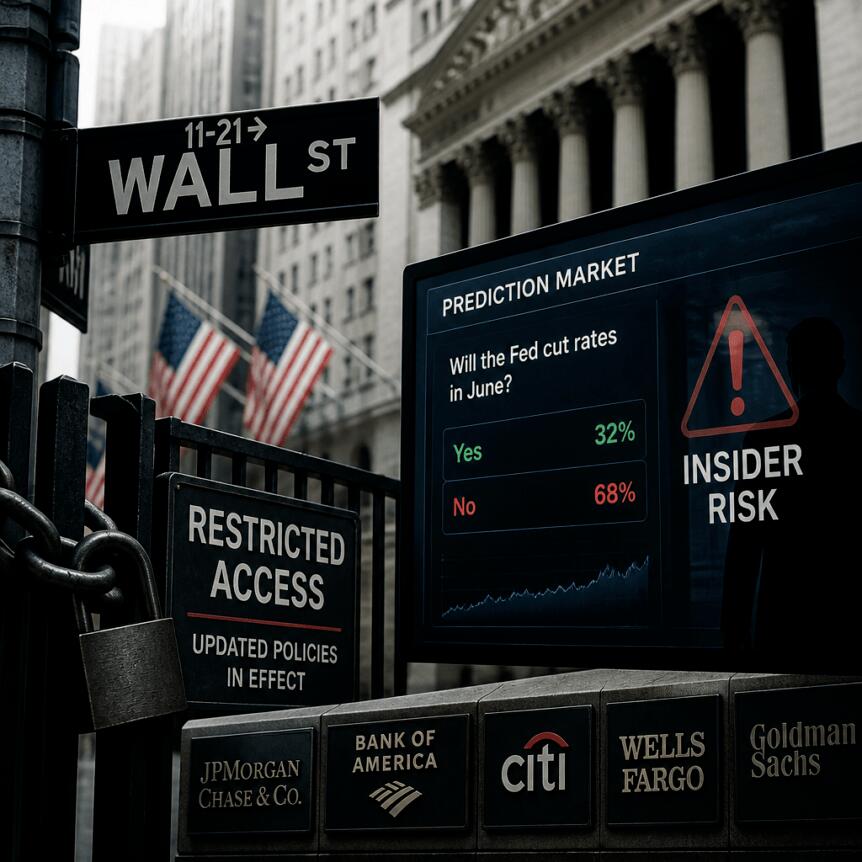
Major US investment banks are tightening internal rules around prediction market trading, according to reporting by CNBC. The move is driven by concerns that employees could use nonpublic information when trading event-based contracts—an issue that has increasingly drawn regulatory and political scrutiny in the United States.
CNBC said Goldman Sachs has reportedly banned employees from trading certain event contracts tied to the bank, including those related to financial markets, macroeconomic developments, elections, and geopolitics. Meanwhile, Morgan Stanley and Bank of America have also outlined or are preparing employee restrictions, reflecting how quickly predictive markets have moved from a niche concept to an area regulators and policymakers are willing to investigate.
Key takeaways
- Goldman Sachs has reportedly restricted employee trading on bank-specific event contracts after insider-trading concerns resurfaced.
- Other large banks are also implementing or updating internal prediction market policies, signaling a broader compliance shift.
- US oversight pressure has been building through enforcement actions and proposed legislation targeting political prediction market activity.
- Polymarket is seeking regulatory permission for margin trading for US users, which could expand participation but also raise compliance considerations.
Why banks are moving to restrict prediction market trading
Prediction markets allow participants to buy and sell contracts tied to real-world outcomes, including political and macroeconomic events. The very structure that makes these platforms useful—payoffs linked to information—also creates a perceived risk when traders have access to material nonpublic information through their day jobs.
CNBC’s report frames the banking restrictions as a response to that risk. In Goldman Sachs’ case, the reported ban covers event contracts “specific to the bank,” spanning topics such as financial markets, macroeconomic events, elections, and geopolitics. CNBC attributed the details to people familiar with the matter, and said Goldman declined to comment when approached by Cointelegraph.
Morgan Stanley reportedly has policies governing employees’ prediction market activity, according to unnamed sources cited by CNBC. Bank of America, according to the same report, is in the process of issuing additional prohibitions for employees regarding trading on prediction markets.
Regulators and lawmakers have been escalating insider-trading concerns
The banking clampdown comes amid heightened attention on insider trading risks in prediction markets. Earlier this year, the US Justice Department and the Commodities Futures Trading Commission (CFTC) said in a case involving Google software engineer Michele Spagnuolo that she profited $1.2 million on Polymarket after accessing nonpublic information at work, according to Cointelegraph coverage.
At the same time, political institutions have begun focusing on whether certain government-connected participants should be allowed to trade on outcomes connected to public policy. Cointelegraph also reported that White House attention and US lawmakers’ activity led to proposed legislation aimed at restricting political prediction market trading by government officials.
In mid-June, Wisconsin Representative Bryan Steil introduced a law intended to prevent certain public officials from “wagering on public policy issues and political outcomes,” according to Cointelegraph reporting. The proposal, as described in the coverage, does not single out lawmakers in the White House.
One earlier flashpoint underscored how quickly these platforms can intersect with real-world political events. In January, Cointelegraph reported that a soldier was charged over an alleged bet of roughly $400,000 on Polymarket tied to the removal of Venezuelan President Nicolás Maduro—a case that, while distinct from bank policies, helped intensify scrutiny of betting activity around consequential political outcomes.
Polymarket pushes for US margin trading approval
While banks focus on restricting internal trading, the prediction market ecosystem itself continues to pursue broader access in the US. Polymarket is seeking regulatory approval to offer margin trading to US users, a feature that would allow participants to place trades with less upfront capital, potentially increasing volume and market participation.
According to a July 3 filing with the National Futures Association (NFA), Polymarket applied to become a futures commission merchant through its affiliate, Coming Home GBA LLC. This step is part of the platform’s effort to expand its US footprint. Cointelegraph reported reaching out to Polymarket for comment on the proposal.
The filing process reflects a key regulatory distinction: Polymarket also needs authorization from the CFTC to enable non-fully collateralized trading for users. Until those approvals are in place, the ability to scale using margin remains conditional.
Polymarket’s competitor has already moved ahead on this specific capability. Cointelegraph reported that Kalshi’s affiliate, Kinetic Markets LLC, received an NFA authorization in March, allowing it to offer margin trading in the US. That earlier grant may shape expectations among users and market participants for how quickly Polymarket’s own application could progress.
Market activity keeps setting records as oversight tightens
Regulatory scrutiny has not stopped growth in prediction market usage. Data cited by Dune shows Polymarket hit a record $713 million in daily taker volume on June 20. Cointelegraph reported that the milestone arrived more than a week after the June 11 start of the World Cup, highlighting how major televised events can drive demand for outcome-based trading.
Other venues have also recorded strong figures tied to the same global tournament cycle. Cointelegraph reported that Kalshi posted a record monthly trading volume of nearly $9.4 billion in June, again attributing activity to the 2026 FIFA World Cup’s role in fueling participation across prediction markets.
Importantly, these growth indicators illustrate a tension that market participants will likely need to navigate: demand continues to rise, yet institutions—both regulators and traditional finance firms—are increasingly focused on information risk, conflicts of interest, and compliance controls.
For traders and builders, the next signal to watch is whether Polymarket’s margin-trading application advances in the NFA/CFTC process and how banks operationalize their restrictions in practice—particularly which categories of contracts and employee roles are treated as higher risk. As enforcement remains on the table and lawmakers continue to consider targeted rules around political outcomes, internal bank policies may become an increasingly common feature of the market landscape.
https://www.cryptobreaking.com/wall-street-banks-tighten-prediction/?utm_source=blogger%20&utm_medium=social_auto&utm_campaign=Wall%20Street%20Banks%20Tighten%20Prediction%20Market%20Rules%20Over%20Insider%20Concerns%20
Comments
Post a Comment