
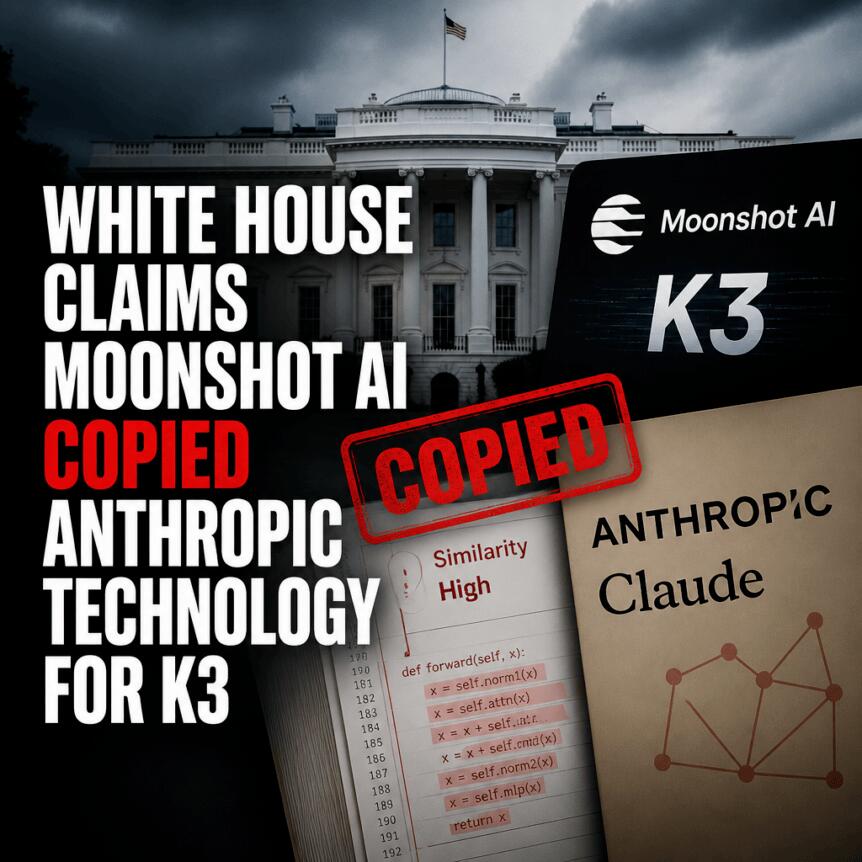
A senior official from the White House’s Office of Science and Technology Policy has accused the Chinese AI firm behind Kimi K3 of using “covert industrial distillation” techniques to replicate capabilities from U.S. models. The allegation, posted to X on Wednesday by Michael Kratsios, underscores how U.S. concerns about AI competitiveness are increasingly blending with fears of large-scale intellectual property (IP) theft.
Kratsios said the company built an internal platform to distill U.S. models “at scale,” specifically using methods intended to evade detection. While he argued that distillation—compressing a model into a smaller one—can be legitimate and part of open innovation, he framed the alleged approach as unacceptable because it targets proprietary American technology rather than improving models through transparent research.
Key takeaways
- White House OSTP Director Michael Kratsios alleged Chinese firm Moonshot AI used large-scale covert distillation tied to the Kimi K3 release.
- Kratsios contrasted legitimate model distillation with alleged industrial-scale techniques aimed at stealing U.S. IP and avoiding detection.
- Some AI researchers dispute claims that Anthropic’s Fable was used to produce Kimi K3’s performance, citing technical plausibility and timing constraints.
- U.S. officials warned that sanctions and Entity List designations could follow IP-theft-style distillation attacks.
Why the allegation matters beyond headlines
AI distillation is not inherently controversial. In general terms, distillation helps create smaller, more efficient models by training them on outputs generated by a larger “teacher” model. The White House’s argument, as stated by Kratsios, is that scale and secrecy change the nature of the activity—turning a common engineering practice into something closer to a targeted extraction of proprietary capability.
That distinction is critical for investors, developers, and researchers because it signals a potential shift in how regulators and governments may view certain AI training pipelines. If authorities treat “covert industrial distillation” as IP theft, it could influence enforcement priorities, compliance expectations, and the willingness of model providers to share weights, outputs, or licensing terms—especially across geopolitical lines.
Timing and the dispute over Anthropic’s role
Kratsios’s claim places particular focus on the question of whether U.S. model technology was used in the preparation of Kimi K3. Cointelegraph previously reported that Anthropic’s Fable 5 was taken offline quickly due to U.S. export controls, then re-released on July 1. Kimi K3, meanwhile, launched on July 16—creating what critics describe as a narrow window for any distillation-derived transfer.
Elie Bakouch, a researcher at Prime Intellect, publicly questioned whether the technical story matches the observed outcomes. In an X post referenced in the original reporting, Bakouch argued that there are only “15 days between fable 5 ban removal and kimi K3 release,” and he added that the performance “could” not be explained in a straightforward way by distillation from Fable.
Dean Ball, head of strategic futures at OpenAI, also pushed back. On Friday, Ball said he did not believe K3’s performance could be “explained away by distillation or anything like that.” Both responses reflect a broader point: even if distillation happened, it may not be the sole—or even the primary—reason for a model’s capabilities, and establishing a clean causal link can be technically difficult.
In the absence of publicly available technical evidence, these disputes matter because they highlight uncertainty. Government accusations may have intelligence backing, but for the wider AI community, the plausibility and traceability of model-to-model influence is a separate question from whether the activity would violate policy or law.
Washington escalates from concerns to potential enforcement
The posture from U.S. officials appears aimed at deterrence. In addition to Kratsios’s claim that “covert industrial distillation” intended to steal U.S. technology is unacceptable, U.S. Treasury Secretary Scott Bessent warned that sanctions and restrictions could be pursued.
Bessent said the U.S. supports open-source AI and the innovation it enables, but he argued open source does not mean “open season” on American IP. He also warned that if firms conduct covert, industrial-scale distillation attacks that cross into IP theft, consequences could include sanctions and Entity List designations.
That statement suggests the U.S. may attempt to treat certain distillation behaviors under the same enforcement logic used for other technology-transfer and IP-protection efforts. For AI companies, the practical takeaway is that even widely used ML techniques could be reinterpreted depending on intent, transparency, and scale.
It also raises a policy tension: distillation can improve accessibility and efficiency, but enforcement actions could push industry toward more restrictive handling of model outputs and training procedures. Developers may respond by tightening documentation, auditing data provenance, or changing how they handle third-party model access.
What to watch next
Whether the dispute becomes a broader enforcement campaign will likely depend on what additional evidence, if any, is made public and how regulators define “industrial-scale” and “covert” distillation in measurable terms. For now, observers should watch for any formal government actions tied to Kimi K3 and for further clarification from researchers on what technical signals can reliably connect teacher models to student performance.
https://www.cryptobreaking.com/white-house-claims-moonshot-ai/?utm_source=blogger%20&utm_medium=social_auto&utm_campaign=White%20House%20Claims%20Moonshot%20AI%20Copied%20Anthropic%20Technology%20for%20K3%20
Comments
Post a Comment