
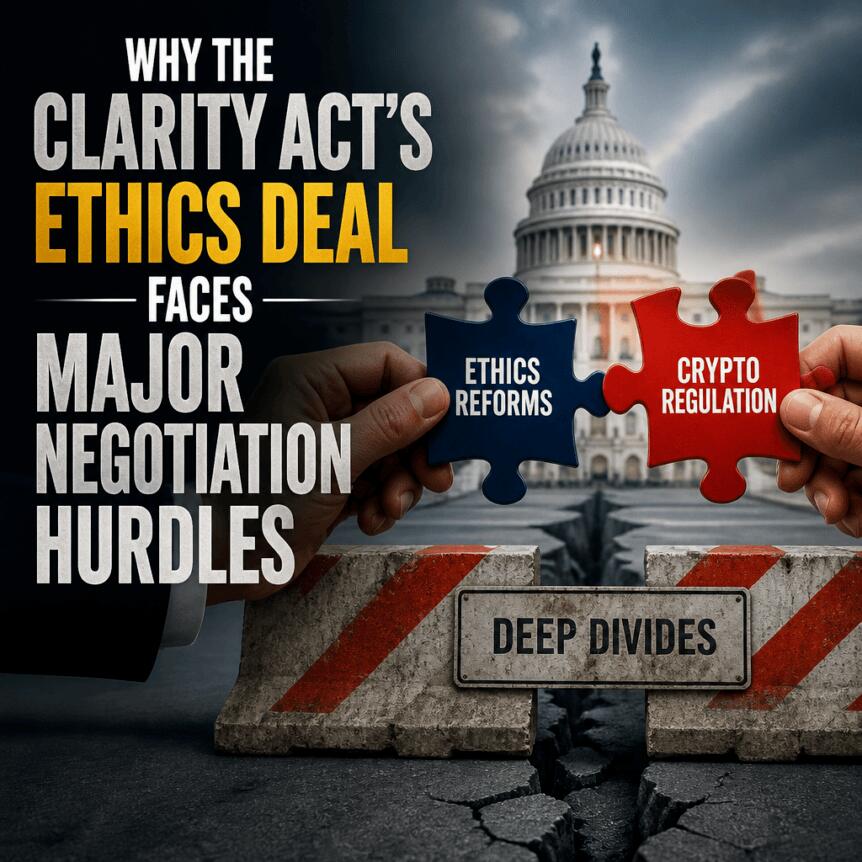
Negotiations over the long-awaited US Digital Asset Market Clarity Act—known as the CLARITY Act—have reportedly narrowed to one of the most politically sensitive issues: ethics rules for federal officials and who will enforce them. After months of drafting and bargaining, a dispute over a “code of conduct” element is now threatening to derail a bill that many in the industry view as crucial for regulatory certainty.
Democratic senators say the current version of the proposal does not go far enough, particularly on ethics provisions covering elected officials and related consumer and market-integrity safeguards. Republicans, meanwhile, argue that ethics enforcement should remain within the Department of Justice (DOJ) under a single national framework, rather than being handled by state attorneys general.
Key takeaways
- Seven Democratic senators said the current CLARITY Act text “falls short,” calling for stronger ethics, consumer protection, illicit finance, conflict-of-interest, and market-integrity provisions.
- The latest draft would bar senior federal officials and their spouses from issuing or sponsoring digital assets while in office, alongside limits on crypto platforms listing such assets.
- Democrats want ethics enforcement to allow state attorneys general to step in if DOJ does not enforce the law; Republicans insist DOJ should be the sole enforcement channel.
- Multiple policy and industry stakeholders say lawmakers may still be able to compromise, but uncertainty over ethics is becoming the central bottleneck.
- Even if senior officials are restricted from sponsoring or issuing new tokens, the draft would still allow covered officials to own cryptocurrencies.
What the new CLARITY ethics language would change
According to the latest Senate draft made public Wednesday, the CLARITY Act would prohibit the president, vice president, members of Congress, and other senior federal officials—along with their spouses—from issuing or sponsoring digital assets while they are in office. This would apply to officials covered under the bill’s ethics framework.
The draft also includes a platform-facing restriction: crypto platforms would be prevented from listing assets issued or sponsored by covered officials. As described in coverage of the text, these prohibitions are set to expire in 2029, after President Donald Trump’s current term ends.
Importantly for investors and market participants, the restrictions would focus on “issuing or sponsoring” while in office, not on personal ownership. Covered officials would still be allowed to hold cryptocurrencies even during the restricted period.
Why Democrats say the proposal isn’t strong enough
In a joint statement released Wednesday, seven Democratic senators argued that the bill’s current provisions are inadequate. They said “key provisions,” including those addressing ethics for elected officials, consumer protection, illicit finance, conflicts of interest, and market integrity, must be strengthened.
“Key provisions including those addressing ethics for elected officials, consumer protection, illicit finance, conflicts of interest and market integrity must be strengthened,” the senators said.
Senator Angela Alsobrooks—speaking at a Semafor event on Wednesday—stated that while negotiations may be “fairly close,” the ethics language remains a dealbreaker. She indicated she would not support the legislation on the Senate floor unless it includes stronger ethics provisions.
Alsobrooks’ primary concern is both the substance and the enforcement structure. She said it cannot be taken for granted that DOJ will enforce the law effectively, framing the issue as a credibility problem rather than a purely theoretical one.
Democrats’ stance has been amplified by scrutiny of President Trump’s growing crypto-related business interests, which have reportedly included meme coin activity and a broader portfolio of digital asset exposure. Critics argue that this creates incentives and potential conflicts that stronger ethics and enforcement mechanisms should address.
Senator Elizabeth Warren has also signaled that she views the draft as insufficient, arguing that it would not prevent the president from profiting from new crypto activity in a way that could be economically significant. Separately, former SEC official Amanda Fischer argued that the restrictions could still allow the president to benefit from existing crypto projects, with the proposed limitations aimed at future income streams.
Republicans push for DOJ-only enforcement
Republicans contest the idea that the ethics provisions are too weak, while also objecting to Democratic calls for additional enforcement leverage for state attorneys general. They argue that federal ethics requirements should be enforced through a single national mechanism—DOJ—rather than through a patchwork of state interpretations and political priorities.
Attorney and former Republican Senate candidate John Deaton said the CLARITY Act is federal legislation and that DOJ, not “fifty different state AGs,” is the appropriate body to enforce federal law. In this view, allowing state officials to intervene would risk undermining the uniformity that supporters say the bill is intended to provide.
Other Republican-aligned commentators characterized the ethics language as unprecedented. For example, Senator Bernie Moreno described the current draft as containing “the most powerful ethics language in US history.”
Patrick Witt, a former White House and Senate counsel, suggested the disagreement may be driven by two incompatible Democratic positions: that ethics rules would be meaningless without state AG enforcement, or that the proposal could not be changed in a way that would satisfy concerns about constitutional constraints. Witt argued that endorsing the first position would effectively dismiss the enforceability premise behind existing federal ethics laws, while the second position would be difficult or impossible to meet without violating constitutional principles.
Industry and policy observers see a path—but not an easy one
Despite the ethics dispute, many observers believe the bill can still progress through negotiation. Kristin Smith, former CEO of the Blockchain Association and now president of the Solana Policy Institute, told Cointelegraph that the latest draft reflects meaningful compromise on ethics—an element viewed as necessary for Senate Democrats to come closer to supporting the measure.
Smith also emphasized that ethics is only one component of the broader package. She pointed to additional elements added to the Senate’s work, including a disclosure regime, an illicit finance section, and improved spot market regulation. In her view, rejecting the bill on ethics alone could mean lawmakers lose more than just the ethics language—they could lose the rest of the regulatory structure altogether.
“There is no version of a ‘no’ vote that produces a stronger bill,” Smith said. “A ‘no’ vote produces no bill at all: no disclosure regime, no illicit finance protections, no spot market improvements, no ethics provisions, nothing.”
Vincent Chok, co-founder and CEO of stablecoin issuer First Digital, likewise suggested that narrowing negotiations to ethics rather than the overall structure indicates progress. He framed the question less as whether the US needs a framework and more as how to finalize one that can attract broad support.
Chok argued that no regulatory scheme is likely to be perfect at the start, but businesses can adjust if the market gets clarity. Long periods of uncertainty, he said, make it harder to justify long-term investment and product development.
Other industry figures expressed cautious optimism while still criticizing how far the initial ethics proposal goes. Salman Banaei, head of public policy at Plume, a blockchain network focused on tokenized real-world assets, said compromise may be possible, but cautioned that the White House’s initial ethics proposal was “not a good starting point.”
At the heart of the debate remains the enforcement question: the current draft appears to rely heavily on DOJ for ethics implementation, while Democrats want a mechanism that gives state attorneys general a clearer role if federal enforcement falls short. How lawmakers balance these competing views—without stalling the broader CLARITY framework—may determine whether the bill reaches the next stages.
As negotiations continue, the key variable for readers is whether the parties can agree on an enforcement structure that satisfies Democrats’ concerns about DOJ reliability while preserving Republicans’ push for a single federal enforcement lane. With the bill’s timetable dependent on this remaining sticking point, investors and builders should watch for the next revised ethics draft and any accompanying language changes that clarify whether enforcement authority can shift beyond DOJ.
https://www.cryptobreaking.com/why-the-clarity-acts-ethics/?utm_source=blogger%20&utm_medium=social_auto&utm_campaign=Why%20the%20CLARITY%20Act’s%20Ethics%20Deal%20Faces%20Major%20Negotiation%20Hurdles%20
Comments
Post a Comment