
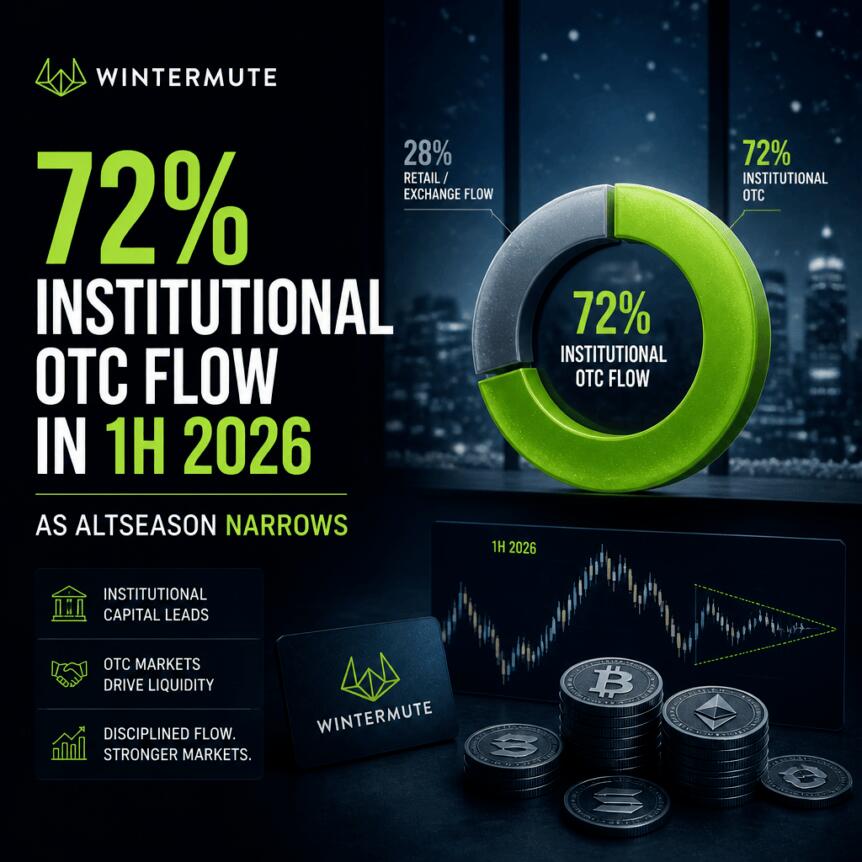
Crypto’s next phase of altcoin trading may look less like a wide, multi-token “altseason” and more like a tighter set of bets, according to market maker Wintermute. In its OTC flow report for the first half of 2026, the firm says institutional counterparties became the dominant source of spot trading on its desk—an important signal for how liquidity and momentum may behave during future rallies.
Wintermute reports that institutions generated 72% of spot flow across all tokens in its OTC activity, the highest share on record. The figure rose from 61% in the second half of 2025 and from 59% in the first half of the prior year.
Key takeaways
- Institutional spot OTC flow reached 72% in H1 2026, up from 59% in H1 2025—marking a clear shift toward narrower participation.
- Institutional liquidity appears to concentrate in fewer tokens, while demand weakens across the market’s “long tail.”
- After price surges, institutional interest fades faster: roughly one day versus about three days for retail, Wintermute says.
- Third-party data echoes the concentration trend, including exchange-volume clustering among the largest altcoins.
Why Wintermute’s OTC data changes the altcoin outlook
Wintermute’s report points to a structural change in how capital is allocated across the altcoin market. When institutions concentrate their activity in a smaller set of tokens, liquidity tends to follow the institutions’ preferences. That can reshape both market depth and the duration of momentum when prices jump.
Wintermute argues that this concentration also affects the “long tail”—the many smaller, less liquid assets that often benefit when broader retail speculation kicks in. As institutional activity becomes more focused, those smaller tokens may not receive the same sustained attention during breakout moments, reducing the odds of broad-based rallies.
Concentration is rising, and it’s not just a theory
Beyond the headline share of institutional flow, Wintermute highlights how widespread the trading footprint is on its OTC desk. Between the first half of 2024 and the first half of 2026, the number of unique tokens traded by Wintermute’s institutional counterparties increased by 24%. Over the same period, the number for retail clients rose by 76%.
In practical terms, this suggests institutions are not only accounting for more of the activity—they are also broadening more slowly across tokens. That matters for traders because it implies that liquidity and “spot attention” can become more clustered, potentially increasing the chance that rallies are sharper in a handful of assets while fading sooner elsewhere.
Wintermute also examines what happens after a token’s price and volume surge. The firm says institutional activity following such spikes typically fades after roughly one day. Retail participation, by contrast, often stays elevated for about three days. That time gap is a key difference: it can influence how long market participants expect follow-through, and it can alter the risk profile of buying after a sudden move.
Signals from other market data: rotation is less visible
Wintermute’s findings align with other monitoring of crypto trading behavior. On June 20, CryptoQuant CEO Ki Young Ju said the traditional rotation of Bitcoin profits into smaller crypto assets had “basically disappeared.” According to CryptoQuant data highlighted in that context, Bitcoin-denominated altcoin pair volumes were near their weakest level since 2021.
The broader pattern is that altcoin trading may be becoming less driven by systematic cross-market rotation and more focused on a narrower set of assets with deeper liquidity and clearer institutional demand.
Concentration is also visible in market share statistics. The 10 largest non-stablecoin altcoins were said to account for roughly 80.5% of the capitalization of the non-Bitcoin, non-stablecoin market. On the exchange side, Kaiko reported a similar clustering: in July 2025, the data provider said the ten largest altcoins represented 63% of altcoin trading volume, rising from around 50% several months earlier as activity in smaller tokens weakened.
From “altseason” breadth to selective moves
The implication of this body of data is that “altseason” may increasingly resemble selective sector rotation rather than a catch-all surge across a wide universe of coins. The market narrative is being reshaped by the participants who can move size and manage risk efficiently—especially institutions.
Commentary from DWF Labs managing partner Andrei Grachev argued that broad altcoin rallies are giving way to more selective sector moves. In March, he suggested that too many tokens compete for limited capital, while institutional investors maintain focus on Bitcoin, Ether, and tokenized real-world assets.
Wintermute’s OTC report provides a quantitative way to interpret that shift: if institutions concentrate spot OTC liquidity, then price pressure and sustained post-surge buying may cluster around a smaller portion of the altcoin landscape. Retail activity may still energize moves across a broader set of tokens, but the institutional “after-effect” appears shorter-lived in Wintermute’s findings—potentially reducing the runway for long-cycle altcoin runs.
As H2 2026 unfolds, investors and traders may want to watch whether this institutional dominance persists across more tokens—or whether it continues to narrow liquidity further. The next signal to monitor is whether post-surge institutional follow-through remains compressed to about a day, since that would reinforce a market regime where winners are more concentrated and rallies fade faster outside the most liquid, institution-favored assets.
https://www.cryptobreaking.com/wintermute-data-shows-72-institutional/?utm_source=blogger%20&utm_medium=social_auto&utm_campaign=Wintermute%20Data%20Shows%2072%%20Institutional%20OTC%20Flow%20in%201H%202026%20as%20Altseason%20Narrows%20
Comments
Post a Comment