
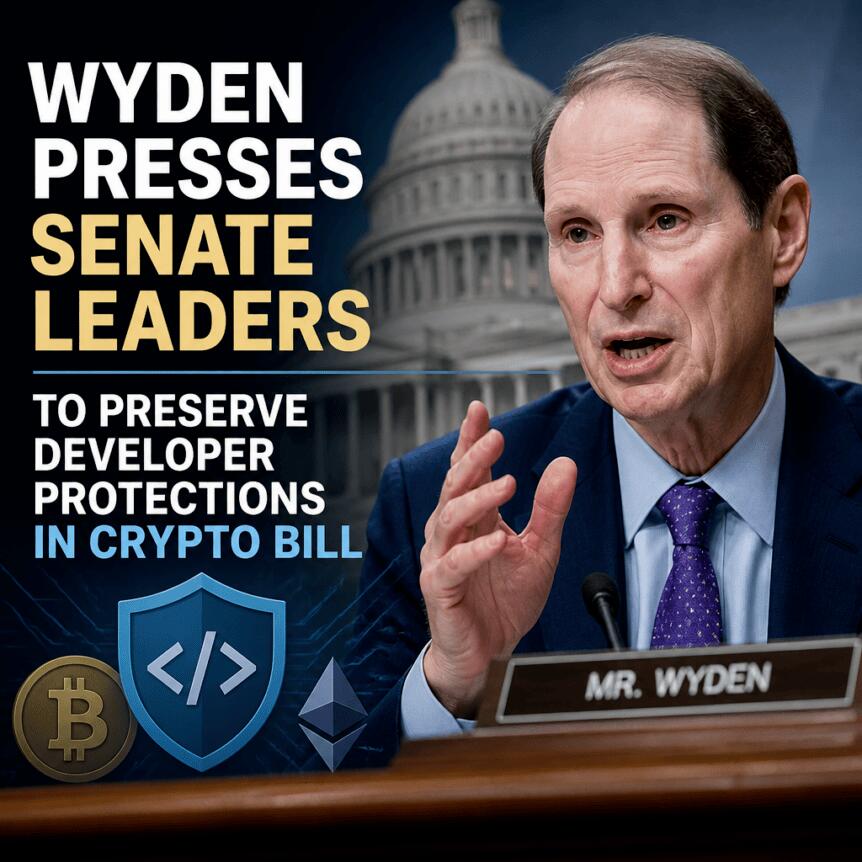
Sen. Ron Wyden has urged top US Senate leaders to keep a developer-focused provision inside the proposed CLARITY Act framework, arguing that the Blockchain Regulatory Certainty Act (BRCA) is needed to prevent non-custodial software builders from being treated as “money transmitters.”
In a letter sent to Senate Minority Leader John Thune and Senate Majority Leader Charles Schumer—shared by Crypto in America podcast co-founder Eleanor Terrett—Wyden said the BRCA would preserve regulatory clarity for developers who write tools that allow users to control their own digital assets.
Key takeaways
- Wyden wants Senate leaders to preserve the BRCA section of the CLARITY Act to protect non-custodial crypto developers from being categorized as money transmitters.
- The push follows opposition from some law enforcement and Catholic coalition groups, which warned the provision could create oversight gaps for illicit activity.
- Crypto industry stakeholders have urged lawmakers to keep BRCA, saying developers of open-source and non-custodial technology do not control user funds.
- Negotiations remain ongoing, with Senate leaders aiming to secure broad support before a possible vote this month to avoid extended floor debate.
- Time pressure is increasing as Congress approaches its August recess and heads toward midterm elections in November.
Why Wyden is defending the BRCA
Wyden’s central argument is rooted in how responsibility works in decentralized systems. According to the letter, developers who create and publish software that helps users manage their own digital assets—and where the developer does not control those assets—should not be treated as money transmitters simply for releasing code.
Wyden also argued that applying money-transmitter rules to software developers “punishes technological innovation and advancement” in areas he described as strategically important, especially at a time when the United States should maintain global competitiveness.
In addition to his innovation-focused rationale, Wyden said the BRCA reflects guidance from the Financial Crimes Enforcement Network (FinCEN) and would provide legal certainty for developers building open-source and non-custodial projects. He framed smart policy as a way to support both law enforcement priorities and continued development of decentralized finance in the US.
The senator concluded with a direct request: as the Senate continues considering the CLARITY Act, he urged Thune and Schumer to include the Blockchain Regulatory Certainty Act in any legislative package.
Opposition raises concerns about enforcement coverage
The letter comes as certain organizations and lawmakers have pushed back against parts of the CLARITY Act, including the BRCA. Earlier coverage from Cointelegraph noted that a coalition of law enforcement organizations and Catholic groups warned that the broader CLARITY Act approach could create gaps in oversight related to illicit activity.
That criticism highlights the core tension shaping the negotiations: policymakers appear to be weighing regulatory certainty for decentralized innovation against the risk that certain structures could reduce traditional enforcement visibility.
Crypto groups argue “non-custodial” should matter
While law enforcement and allied organizations have questioned the effect of developer protections, crypto industry groups have made the opposite case. Cointelegraph previously reported that stakeholders urged the Senate to keep the section intact, arguing that developers building non-custodial technology cannot control users’ funds and therefore should not be treated as financial intermediaries.
Wyden’s letter echoes that logic, emphasizing that the relevant distinction is custody and control: if developers do not control the assets and are instead providing software that enables self-management, money-transmitter treatment is, in his view, not aligned with how decentralized systems operate.
Timing pressures and competing provisions
Negotiations over the CLARITY Act’s provisions are ongoing. According to Cointelegraph’s earlier reporting, Senate leaders are pushing for movement this month and want to bring a bill to the floor that has wide support, partly to avoid prolonged debate.
However, BRCA is not the only issue under discussion. The Senate also faces other questions that must be addressed before the bill can reach a floor vote. Cointelegraph noted that some lawmakers have called for tighter ethics provisions related to government officials’ involvement in crypto following disclosures that US President Donald Trump made $1.4 billion from crypto interests last year.
Supporters of the bill want to pass it before this Congress ends to avoid restarting the legislative effort in a new Congress next year. But the window is narrowing: Congress will take a monthlong recess in August, and the country is also approaching midterm elections in November.
That uncertainty has already started affecting market expectations around the bill’s odds. Cointelegraph reported that Galaxy Digital recently cut its odds of the CLARITY Act becoming law this year to 50%, citing the Senate’s limited time to act before the August recess.
What to watch next
As Senate leaders try to unify enough support to move the CLARITY Act forward, the BRCA dispute will likely remain a focal point for both sides—law enforcement groups emphasizing enforcement coverage and crypto advocates pushing for non-custodial developer protections. The next signal will be whether negotiators can preserve BRCA without triggering new objections strong enough to derail a timely floor vote.
https://www.cryptobreaking.com/wyden-presses-senate-leaders-to/?utm_source=blogger%20&utm_medium=social_auto&utm_campaign=Wyden%20Presses%20Senate%20Leaders%20to%20Preserve%20Developer%20Protections%20in%20Crypto%20Bill%20
Comments
Post a Comment