
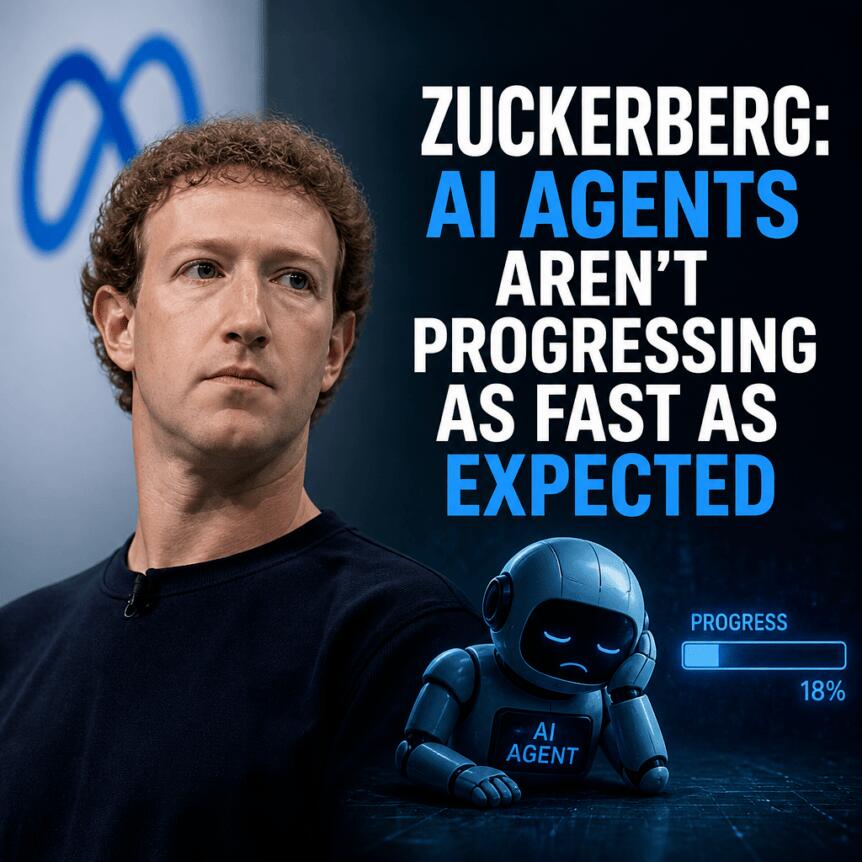
Meta CEO Mark Zuckerberg has sounded a note of caution on the pace of “agentic” AI development, telling employees that progress on autonomous agents has not accelerated as quickly as expected despite heavy investment by major technology and crypto firms.
Speaking during a company meeting on Thursday, Zuckerberg said the “trajectory of the agentic development over at least the last four months hasn't really accelerated in the way that we expected,” Reuters reported after reviewing a recording of the call. He added that the broader bet on agent adoption “hasn’t come to fruition yet,” even as leadership pushed harder into agent-focused infrastructure earlier this year.
Key takeaways
- Zuckerberg said Meta’s agentic AI progress has not matched expectations over the past four months, according to Reuters.
- Meta executives accelerated agent-focused infrastructure plans in January due to concerns they were moving too slowly.
- Meta still expects returns from its AI spending within three to six months, Zuckerberg said.
- Meta expanded its Meta Business Agent globally for businesses across Instagram, Messenger, and WhatsApp.
- Blockchain data suggests AI-agent transaction activity remains limited, including only about $2 million in x402-facilitated volume over the last 30 days, per Artemis.
Meta’s AI agents: expectations versus delivery
Zuckerberg’s remarks highlight a growing mismatch between the industry’s timeline for autonomous AI agents and how quickly real-world systems can scale and deliver value. While agentic AI has captured attention from both software giants and crypto-adjacent companies, Zuckerberg indicated that even within a company widely positioned for rapid experimentation, momentum has been slower than planned.
Reuters reported that Zuckerberg pointed to a lack of acceleration in the “last four months,” despite a push intended to close perceived speed gaps. He acknowledged that an aggressive January push into agentic infrastructure was driven by fears that Meta wasn’t advancing “fast enough,” while also framing the current state as not yet reaching the level of adoption leadership expected.
At the same time, Zuckerberg said he believes Meta’s AI investments will start paying off within the next three to six months. That timeframe matters for investors and teams because it signals management still expects near-term results—even if the broader agent ecosystem remains behind schedule.
Business Agent rollout across Meta’s messaging and social apps
Meta’s comments came alongside new product deployment. On Thursday, the company expanded its Meta Business Agent globally, aiming to bring agent capabilities to businesses operating across Instagram, Messenger, and WhatsApp.
According to Meta, the Business Agent is designed to handle customer inquiries, make product recommendations, and close sales without requiring human intervention. For businesses, the appeal is straightforward: agent systems can reduce response times and staffing pressure while enabling commerce flows inside channels where customers already interact.
Zuckerberg also previously said in March that he was building a personal AI agent to support CEO decision-making, reinforcing Meta’s view that agent tooling can move beyond customer-facing automation into internal workflows.
Crypto’s agent payments thesis faces measured on-chain activity
Zuckerberg’s reality check lands amid a crypto industry that has largely embraced the idea that AI agents could become major users of blockchain payments. Executives including Coinbase CEO Brian Armstrong and Circle CEO Jeremy Allaire have previously predicted that AI agents may become dominant users of blockchain-based payment rails in the coming years, as noted in coverage referenced by Cointelegraph.
In support of that narrative, several integrations have been announced in recent months. Cointelegraph previously reported that Amazon Web Services integrated Coinbase’s x402 payments protocol into Amazon Bedrock AgentCore in May, enabling agents to transact using the USDC stablecoin. Other examples cited include a Visa-supported virtual card for AI agents from Oobit launched in April for purchases in USDt (USDT).
However, the gap between “capability” and “usage” is showing up in on-chain volume. Artemis data cited by Cointelegraph suggests that AI-agent transaction activity facilitated through the x402 protocol remains comparatively small: only $2 million in trading volume over the past 30 days.
This matters because the crypto payments story around autonomous agents depends not just on integrations being possible, but on consistent demand emerging from actual agent behavior. Low volume can indicate early-stage adoption, experimentation without sustained deployment, or limitations in how agents currently interact with payment endpoints.
What to watch next for agentic AI and stablecoin payments
Zuckerberg’s comments suggest the industry may need to plan for a slower-than-hoped transition period as agentic systems mature and as businesses learn where automation genuinely outperforms human-led workflows. At the same time, Meta’s investment outlook—expecting payback within three to six months—signals continued pressure to convert AI spending into operational results.
For the blockchain segment, the next checkpoint should be whether on-chain payment volume tied to agent infrastructure increases materially from current levels, and whether new business-facing deployments like Meta Business Agent lead to measurable downstream demand for stablecoin payment rails.
https://www.cryptobreaking.com/zuckerberg-ai-agents-arent-progressing/?utm_source=blogger%20&utm_medium=social_auto&utm_campaign=Zuckerberg:%20AI%20agents%20aren’t%20progressing%20as%20fast%20as%20expected%20
Comments
Post a Comment