
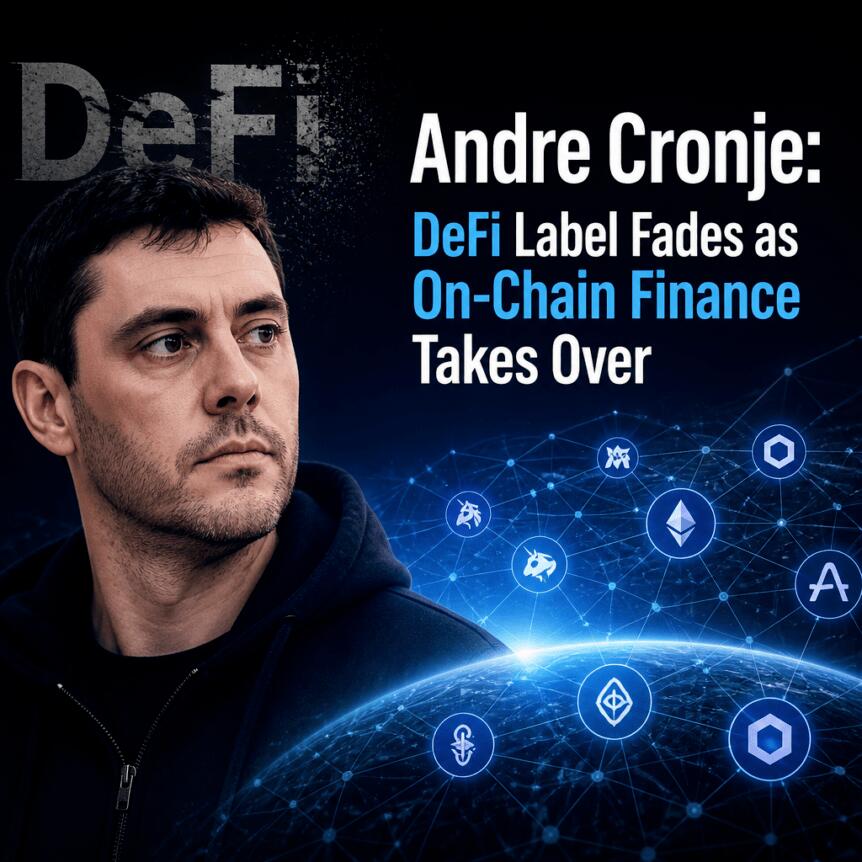
Andre Cronje, the architect behind Yearn.finance and the creator of Fantom Network, says most decentralized finance has drifted away from what many in the sector have historically meant by “DeFi.” In a conversation with Cointelegraph during Chain Reaction X, Cronje argued that true DeFi exists only in small pockets, while the broader ecosystem has evolved into something closer to conventional finance layered on-chain.
His remarks arrive as quantitative signals point to contraction in DeFi activity and as regulators and policy makers continue to scrutinize whether DAOs are genuinely decentralized enough to remain outside traditional oversight. With DeFi total value locked (TVL) falling sharply and governance widely concentrated in major protocols, the debate over decentralization—technical, economic, and legal—has moved from philosophy to governance design and regulatory classification.
Key takeaways
- Andre Cronje argues that most DeFi today is no longer “true DeFi,” because intermediaries and decision-makers effectively remain in the system.
- DefiLlama data cited in the report shows DeFi TVL fell from about $167 billion in early October 2025 to roughly $75 billion at the time of writing.
- The European Central Bank has questioned whether large DAO ecosystems should be considered “fully decentralized,” citing governance token concentration across major protocols.
- Cronje also renews a long-running technical debate in DeFi: whether emergency controls like circuit breakers are compatible with decentralization.
Cronje’s “true DeFi” critique: decentralization vs. onchain finance
Cronje’s central claim is that DeFi, as practiced by most mainstream protocols, has departed from the decentralization ideal. “I don’t think DeFi exists anymore outside of those very small niches,” he told Cointelegraph during Thursday’s Chain Reaction X Spaces. He further argued that “true DeFi” should be decentralized, immutable, and without an intermediary, adding that those standards are not met by “pretty much any other protocols running today.”
Rather than rejecting decentralization entirely, Cronje reframed the shift as an evolution into “onchain finance or open finance.” In his view, the ecosystem has moved into a structure where roles that traditionally belong to banks and other intermediaries—curation, risk committees, and decision-making—are effectively performed by other entities within the protocol’s operating reality.
“We’ve long since moved on from . Because your intermediary now is a company, it’s a decision maker, it’s a curator, it’s a risk committee, it’s all the traditional kind of things we saw in banking.”
That argument matters for investors and users because it reframes what decentralization is supposed to guarantee. If governance and administrative control concentrate around identifiable decision-makers—whether individuals, foundations, or companies—then the “trust-minimized” promise can weaken. For market participants, the practical outcome is not just a philosophical disagreement; it affects how risks are priced, how upgrades and interventions occur, and how credible the threat of “exit” really is when the system’s controls are not distributed.
Cronje did leave room for a more optimistic interpretation. He said the critique does not rule out “true DeFi” altogether and suggested that genuine innovation is still occurring among some protocols.
From circuit breakers to governance control: the decentralization test
According to the same reporting thread, Cronje has been making this point for months. Earlier in the year, he said that much of DeFi is “no longer DeFi” in the strict sense, as builders debate whether circuit breakers and other emergency controls are necessary safeguards against exploits. The implication is that emergency mechanisms may introduce discretionary intervention—potentially conflicting with the immutability and autonomy expected from “true DeFi.”
This internal engineering debate has increasingly spilled into governance questions. If a system’s safety depends on a special intervention path, the governance structure that can authorize those interventions becomes part of the decentralization equation. That is where decentralization is no longer only about smart contract code; it becomes about who can change outcomes under stress.
Cronje’s comments also intersect with a broader policy question: when is a DAO decentralized enough to qualify as outside the scope of financial regulation?
DeFi’s contraction meets regulatory pressure
The article’s discussion places Cronje’s remarks alongside data showing that DeFi has been shrinking. DefiLlama data cited in the report indicates DeFi TVL fell to about $75 billion at the time of writing, down from $167 billion in early October 2025—more than halving over roughly the past 10 months. While TVL is not a direct measure of decentralization quality, it can reflect broader market appetite, capital rotation, and confidence in protocol risk—factors that often rise when governance effectiveness and system resilience come under scrutiny.
In parallel, the European Central Bank has questioned whether certain DAOs meet the threshold implied by “fully decentralized” services under regulatory frameworks. In a March working paper, the ECB examined Aave, MakerDAO, Ampleforth, and Uniswap. It reported that, based on governance tokenholder holdings snapshots from November 2022 and May 2023, the top 100 governance token holders controlled more than 80% of the token supply in each protocol.
The ECB authors said these findings challenge assumptions about inherent DAO decentralization and whether such systems should remain outside Europe’s Markets in Crypto-Assets Regulation (MiCA) as “fully decentralized” services.
For readers, the tension is clear: DeFi’s decentralization narrative is often presented as a property of code and onchain governance, but regulators and researchers look at real-world concentration of economic power. Even where the smart contracts are decentralized, the governance tokens may be held and coordinated in ways that create effective control at the top.
What changes next: the decentralization debate is shifting from rhetoric to design
Cronje’s intervention reflects a wider sector shift—from arguing about whether DeFi is “dead” to asking how DeFi should be structured if decentralization is treated as a measurable standard. When TVL declines and governance concentration becomes a regulatory talking point, protocol designers face increasing pressure to demonstrate that decision-making is genuinely distributed and that emergency actions are constrained in ways that users can evaluate.
For investors and builders, the practical watchlist is likely to focus less on slogans and more on governance architecture: distribution of voting power, how upgrades and circuit breakers are authorized, and what level of intervention is actually possible by identifiable parties.
As policy scrutiny continues and market participation evolves, readers should watch whether major protocols modify governance mechanisms or strengthen decentralization claims with clearer, more testable structures—because the definition battle is increasingly tied to risk, regulation, and how resilient these systems are under stress.
https://www.cryptobreaking.com/andre-cronje-defi-label-fades/?utm_source=blogger%20&utm_medium=social_auto&utm_campaign=Andre%20Cronje:%20DeFi%20Label%20Fades%20as%20On-Chain%20Finance%20Takes%20Over%20
Comments
Post a Comment