
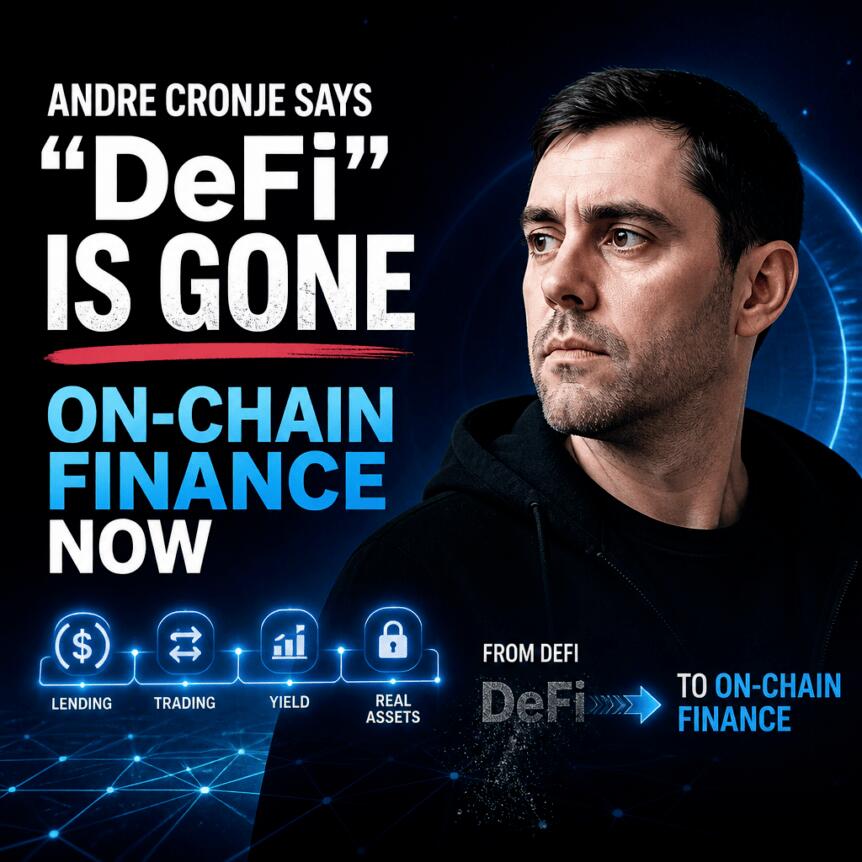
Andre Cronje, founder of DeFi platform Flying Tulip and creator of the Fantom Network, says “most” decentralized finance no longer fits the strict definition of DeFi. Speaking during Cointelegraph’s Chain Reaction X Spaces event on Thursday, Cronje argued that true DeFi should be decentralized, immutable, and free of intermediaries—conditions he believes many major protocols no longer meet.
His comments come as industry-wide concerns about concentration in DeFi governance and real-world controls continue to grow, alongside data showing DeFi activity has cooled substantially over the past year. According to DefiLlama, total value locked (TVL) in DeFi has fallen to about $75 billion, down from roughly $167 billion in early October 2025—more than a 50% decline.
Key takeaways
- Andre Cronje argues that most current DeFi relies on intermediaries and decision-makers, undermining the “true DeFi” model.
- Cronje frames the shift as movement toward “onchain finance or open finance,” rather than the original DeFi ethos.
- DefiLlama data cited in the discussion shows DeFi TVL has more than halved over the past 10 months, reflecting weaker momentum.
- European Central Bank analysis has questioned DAO decentralization, suggesting top governance token holders control large shares of supply.
- The debate is increasingly about whether emergency controls, governance concentration, and protocol dependencies should keep DeFi outside regulation.
From decentralized finance to “open finance”
Cronje’s central claim is that DeFi has drifted away from its original design principles. In his view, many protocols that present themselves as decentralized now include centralized elements in practice—such as companies or other entities functioning as decision-makers, curators, or risk-management bodies.
“We’ve long since moved on from . Because your intermediary now is a company, it’s a decision maker, it’s a curator, it’s a risk committee, it’s all the traditional kind of things we saw in banking.”
That framing matters because it shifts the discussion away from user interfaces and token-based governance, toward the actual mechanisms that control execution and risk. When “decentralization” is defined as the absence of discretionary intermediaries, the question becomes whether today’s DeFi protocols are merely automated fronts for off-chain power—or truly credibly minimized in terms of who can intervene.
Cronje also stopped short of saying the concept of true DeFi is dead. He argued that some protocols still show genuine innovation consistent with his definition, even if the broader ecosystem has moved toward a different model.
Why the industry is arguing about circuit breakers and controls
The critique is not new for Cronje. Earlier this year, he said much of DeFi is “no longer DeFi” in the strict sense while builders debate whether circuit breakers and other emergency measures are now necessary to protect users from exploits. Those controls can improve safety, but they also introduce practical questions: Who can trigger them? How discretionary are they? And do they effectively reintroduce centralized authority into systems marketed as decentralized?
The tension is becoming more explicit. If protocols are forced to rely on intermediated responses to security incidents, then the “immutable” component of true DeFi becomes harder to defend. At the same time, users and developers may view emergency capabilities as unavoidable once real-value systems and complex smart contracts face exploitable edge cases.
DeFi TVL contraction adds weight to the skepticism
While decentralization debates are partly philosophical, the numbers indicate the ecosystem’s broader traction has slowed. DefiLlama data cited in the discussion shows DeFi TVL has dropped to about $75 billion from around $167 billion in early October 2025—an overall contraction of more than half over approximately 10 months.
Decreasing TVL does not automatically prove decentralization is failing, but it does support the idea that the center of gravity in crypto finance has shifted. When capital and liquidity concentrate elsewhere—whether in centralized venues, tokenized markets, or other on-chain segments—protocol governance concentration and dependency risks tend to receive more scrutiny from investors.
For market participants, falling TVL also changes the incentives behind governance. With less capital flowing through protocols, participants may become more aligned with risk-averse decisions or concentrated operators—especially if recovery and security mechanisms require coordination.
Regulators and academics look at DAO concentration
Cronje’s comments align with earlier concerns raised by institutional researchers. In a March working paper, the European Central Bank questioned whether decentralized autonomous organizations (DAOs) are sufficiently decentralized to remain outside regulators’ scope.
According to the ECB paper, researchers examined Aave, MakerDAO, Ampleforth, and Uniswap, finding that the top 100 governance token holders controlled more than 80% of the supply in each protocol. The analysis was based on holdings snapshots from November 2022 and May 2023.
The ECB authors said these findings challenge the idea of “inherent decentralization” and whether DAOs should qualify as “fully decentralized” services outside Europe’s Markets in Crypto-Assets Regulation (MiCA). In other words: even if protocols use token voting and smart contract execution, governance concentration can still mean power is effectively centralized among a relatively small set of participants.
This matters for the practical question investors and users face: how much confidence should be placed in the permissionless nature of governance when major influence is concentrated? If decentralization is measured not by code architecture alone but by distribution of influence, concentration becomes a key regulatory and compliance problem.
What to watch next
The debate over “true DeFi” is likely to intensify as protocols balance security controls, governance participation, and real-world operational dependencies. Investors should watch how builders define decentralization in practice—especially around emergency powers and concentrated governance—and whether regulators treat “token-based coordination” as meaningfully decentralized when custody, influence, or intervention remain concentrated.
https://www.cryptobreaking.com/andre-cronje-says-defi-is/?utm_source=blogger%20&utm_medium=social_auto&utm_campaign=Andre%20Cronje%20Says%20“DeFi”%20Is%20Gone,%20On-Chain%20Finance%20Now%20
Comments
Post a Comment