
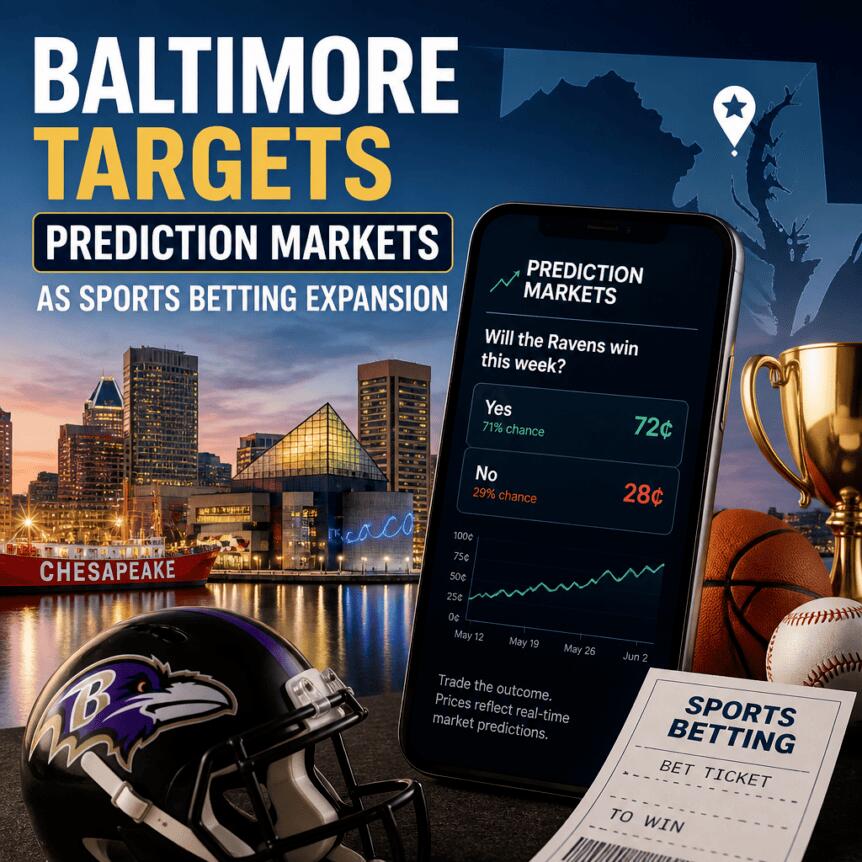
Baltimore and its mayor, Brendan Scott, have filed legal actions against two major prediction market platforms—Kalshi and Polymarket—arguing that the companies are conducting sports-betting activity without the required licenses and have misrepresented how their products are regulated in Maryland.
In a Thursday notice, the mayor’s office said both companies operate “illegal, unlicensed sports-betting platforms” and mislead users about the “legality and regulatory status” of their offerings. The lawsuits focus on whether certain “event contracts” marketed by the platforms are best understood as wagers under Maryland law, disputing how Kalshi and Polymarket describe those trades.
Key takeaways
- Baltimore claims Kalshi and Polymarket are running sports-betting activities without proper local licensing and are overstating the legality of their products in Maryland.
- The city argues that “event contracts” sold and traded on these platforms function as unlawful wagers under state law, challenging the platforms’ legal characterization.
- Baltimore’s complaint against Kalshi also names Robinhood, Webull and Coinbase, alleging promotional practices that imply the contracts can be lawfully purchased and traded in Maryland.
- The dispute reflects an ongoing split between federal regulators—particularly the CFTC—and state-level authorities on how prediction market instruments should be classified.
- Legal observers expect the conflict to eventually draw national scrutiny, potentially reaching the US Supreme Court if appeals progress.
What Baltimore alleges about Kalshi and Polymarket
According to the city’s notice, Baltimore’s complaint centers on two related issues: licensing and user-facing representations. The mayor’s office says Kalshi and Polymarket provide sports-betting platforms without authorization, and that their marketing misleads customers about the legality and regulatory status of their products.
The core legal theory, as described by the city, is that the platforms’ “event contracts” are effectively wagers. Baltimore’s lawsuit challenges the way the companies frame those trades—arguing that the transactions amount to unlawful betting under applicable state laws.
Mayor Scott’s statement emphasizes the city’s view that large businesses are prioritizing profits over community protections. He said the companies are “running sportsbooks without licenses and betting that a new label will put them above the law,” adding that Baltimore “will not let multibillion-dollar companies” harm local communities through illegal gambling.
Broker and exchange partnerships under scrutiny
One notable aspect of Baltimore’s action is the company it pairs with Kalshi. The city’s complaint reportedly includes Robinhood, Webull and Coinbase as partners with the prediction market platform. Baltimore alleges deceptive practices tied to how sports-related contracts are marketed to users.
Specifically, the complaint accuses these companies of promoting sports contracts in ways that suggest the instruments can be “lawfully be purchased and traded in Maryland.” The implication is that the liability may not rest solely with the prediction market operator, but could extend to intermediaries involved in distribution or access.
Why federal and state views are colliding
The Baltimore lawsuits arrive within a broader regulatory dispute in the US over prediction markets. As experts have noted, the tension often boils down to how event contracts should be classified.
On one side, the US Commodity Futures Trading Commission (CFTC) and some industry participants have argued that prediction market event contracts fall under the CFTC’s framework as “swaps.” The notice references the CFTC under Chair Michael Selig and points to prior arguments advanced by the agency and companies that prediction market instruments are regulated through federal channels.
On the other side, Baltimore’s position—and the position taken by other state-level authorities in similar disputes—is that the products do not neatly fit into the federal classification. The lawsuits dispute the federal framing and contend that state gambling rules apply to these activities.
In response, a Polymarket spokesperson told Cointelegraph that Baltimore’s approach is inconsistent with the CFTC’s established framework. The spokesperson argued that prediction markets on CFTC-registered exchanges are governed by federal law, not a “patchwork” of state and local rules, and that the case is therefore not properly targeted to how the industry is regulated.
What this could mean for the broader prediction market industry
For investors and market participants, the Baltimore filings highlight a risk that has been building in prediction markets: even when federal regulators and market operators argue for one regulatory category, state governments may pursue separate enforcement under their own gambling statutes.
This is not merely a theoretical conflict. The lawsuits claim that event contracts can be treated as unlawful wagers, which could affect how platforms market products, how exchanges or trading apps describe access, and what compliance steps intermediaries consider necessary for state-by-state operations.
It also raises practical questions for users deciding where and how to trade prediction market instruments. If courts treat certain contracts as wagers under local law, users may face restrictions or service changes even if platforms continue to assert that their operations comply with federal frameworks.
More broadly, the dispute between federal “swaps” classification arguments and state gambling enforcement theories could become a test of how far federal regulatory authority extends over prediction market instruments. The notice indicates many experts expect the issue to end in an appeal to the Supreme Court, suggesting the legal reasoning could influence future cases well beyond Baltimore.
What to watch next
Readers should watch how quickly courts respond to these complaints and whether higher courts engage with the federal-vs-state classification question at the heart of the filings. The next procedural moves—especially any appeal posture—may determine whether this escalates into the kind of nationwide ruling that could reshape how prediction markets are structured and marketed across the US.
https://www.cryptobreaking.com/baltimore-targets-prediction-markets-as/?utm_source=blogger%20&utm_medium=social_auto&utm_campaign=Baltimore%20Targets%20Prediction%20Markets%20as%20Sports%20Betting%20Expansion%20
Comments
Post a Comment