
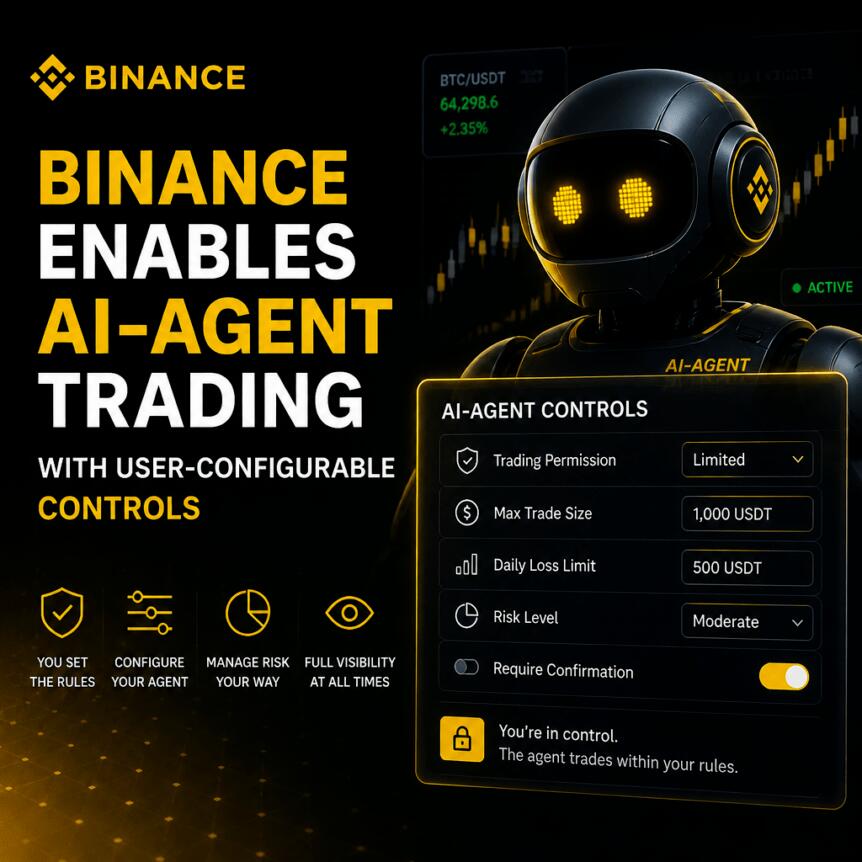
Binance has rolled out Agent OS, a new developer platform designed to let AI agents connect to crypto-market data, monitor user accounts, and execute trades on the exchange—subject to permissions and limits set by the user.
In an announcement, the company said the platform supports popular AI tools, including ChatGPT, Claude Code, Codex, and Cursor. Users can authorize agents to view account information and place orders within configured boundaries, while also being able to revoke access and adjust permissions at any time.
Key takeaways
- Binance Agent OS is positioned as a developer platform for AI agents to access exchange data and trade on Binance.
- Authorization controls—permissions, limits, and the ability to revoke access—are central to how agents can act.
- Account separation is supported via dedicated subaccounts, allowing funds and activity to be isolated per agent.
- Exchange monitoring, not agent cognition: Binance can monitor trades placed through Agent OS but cannot see an agent’s external data sources or decision logic outside the chosen AI application.
- Onchain and payment integrations are included, enabling agents to initiate payments and interact with wallets and other onchain services.
What Binance’s Agent OS enables
Agent OS is built around the idea that AI systems should be able to perform structured actions in financial applications—rather than simply providing advice. According to Binance, users can authorize agents to view account information and execute trades on the exchange under a permission model.
The platform is designed to give users practical control over automation. Binance says agents can be assigned to dedicated subaccounts, which can help separate funds and trading activity tied to different agents or strategies. That separation matters for risk management, particularly when multiple agents are running different tasks or operating with different levels of access.
Permissions, limits, and transparency into agent activity
A key detail in Binance’s explanation is what the company can and cannot observe. Binance said it can monitor trades placed through Agent OS, but it does not have visibility into an agent’s external information sources, its interpretation of inputs, or the decision-making process—those occur within the user’s chosen AI application.
This distinction is important for both builders and users. It suggests Binance is implementing guardrails at the exchange-action layer while leaving the reasoning layer to the third-party AI stack. For users, that can reduce exposure to unclear automation behavior, but it also means they still need to carefully audit what their selected AI tools are doing, where they pull information from, and how they translate that information into trading actions.
Binance also emphasized that access is not permanent: users can revoke access at any time and adjust permissions and limits as their needs change.
Beyond trading: payment and onchain connectivity
Agent OS is not limited to market monitoring and order placement. Binance says the platform connects agents to its payment and onchain tools, enabling agents to make payments and interact with wallets and other onchain services.
That broadens the potential use cases for agent automation from trading-centric workflows to wider transaction tasks. For example, an agent might be configured to move assets, execute payments, or coordinate onchain interactions—again within whatever boundaries the user sets.
Binance joins an emerging “agentic” exchange trend
Binance’s move fits into a wider pattern among crypto trading platforms exploring how far AI agents can go in executing tasks. The push is not uniform: different exchanges appear to be testing different levels of autonomy and different product shapes.
In June, Coinbase launched “Coinbase for Agents”, described as a tool that lets AI models such as ChatGPT and Claude connect to user accounts and execute crypto trades and strategies. Coinbase also highlighted support for agent-driven payments via its x402 protocol.
Meanwhile, Kraken reportedly took a more controlled approach in July with an AI-powered investing assistant that monitors markets and recommends trades based on users’ goals and risk preferences, but requires user approval before executing a trade.
Other players have extended the concept beyond direct trading. In a separate development, OKX launched a beta marketplace where AI agents can find work, transact autonomously, and hire other agents for tasks, using stablecoin payments and an onchain reputation system.
The broader narrative has also been reinforced by prominent executives arguing that AI agents may become significant participants in onchain activity. Coinbase CEO Brian Armstrong and Circle CEO Jeremy Allaire have both suggested agents could soon represent a large share of onchain transactions. Binance co-founder Changpeng Zhao has echoed the idea, describing crypto as the “native currency” of AI agents.
What to watch next for Agent OS
With Agent OS, Binance is effectively turning trading permissions into an interface for automation—while keeping the “why” behind decisions inside the user’s AI environment. The next phase for users and developers will likely hinge on how reliably permissions behave in practice, how agents are isolated via subaccounts, and how Binance’s integrations handle real-world onchain and payment flows as more automation moves from demos into production.
https://www.cryptobreaking.com/binance-enables-ai-agent-trading/?utm_source=blogger%20&utm_medium=social_auto&utm_campaign=Binance%20Enables%20AI-Agent%20Trading%20With%20User-Configurable%20Controls%20
Comments
Post a Comment