
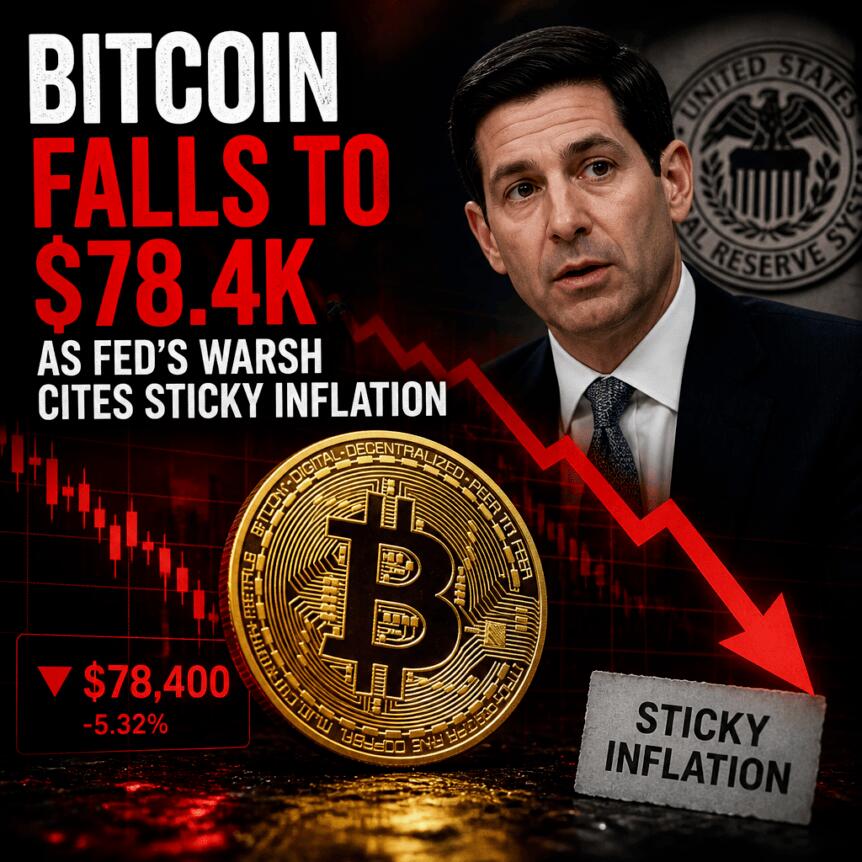
Bitcoin’s price whipsawed early in the Wall Street session after U.S. Federal Reserve official Kevin Warsh used his Jackson Hole keynote to temper expectations around inflation progress and to signal skepticism toward traditional “forward guidance.” The reaction was immediate: BTC/USD slid to a fresh intraday low near the high-$70,000s before recovering back toward the $80,000 area.
Market observers are now focused less on a single macro headline and more on whether Bitcoin’s derivatives complex can help sustain price levels near $83,000—especially as August trading closes and liquidity conditions tighten.
Key takeaways
- Bitcoin fell during Warsh’s Jackson Hole remarks, briefly trading near $78,442 on Bitstamp before rebounding toward the $79,500 area.
- Warsh said lower PCE and CPI prints do not amount to “meaningfully improved” underlying inflation trends, maintaining the Fed’s 2% target.
- US equities traded positive after Warsh’s comments, but BTC’s move suggests crypto is still parsing inflation-policy uncertainty closely.
- QCP Capital highlighted that BTC strength above roughly $83k depends on derivatives market structure—particularly whether leverage grows alongside price.
- CoinGlass data shows Bitcoin up about 26% month-to-date, with August performance described as its best for the month since 2017.
Warsh’s Jackson Hole message: no “meaningful” shift in inflation
According to the speech text posted by the Federal Reserve, Warsh delivered his first keynote at the Jackson Hole Symposium with a cautious tone on the inflation outlook. While he reiterated commitment to the Fed’s 2% goal, he argued that recent improvements in headline inflation measures have not translated into a clear change in the underlying trend.
Warsh also criticized the Fed’s practice of offering consistent forward guidance. He said the approach—commonly used during the Global Financial Crisis—has “overstayed its welcome” and added that it would not return as a regular tool for communicating policy direction.
On the inflation numbers themselves, the Fed speech emphasized that CPI and PCE have fallen from prior peaks, but that progress over the last couple of years has been more modest. He acknowledged that this summer’s PCE and CPI readings were better than expected, but he stopped short of treating them as evidence that the underlying trajectory has “meaningfully improved.”
This combination—tempering the market’s interpretation of cooling inflation while also reducing the likelihood of detailed future-policy signaling—appeared to unsettle crypto traders even as traditional markets looked more comfortable with the message.
Crypto reacts: BTC trades volatile range near $80,000
TradingView data cited in the coverage showed BTC/USD dipping to about $78,442 on Bitstamp during the session, with BTC down roughly 1% around the time of reporting. Bitcoin then worked its way back toward the $79,500 region as risk sentiment stabilized.
Throughout the day, price action remained anchored around the $80,000 mark, with analysts describing the trading as a narrow intraday range leading into the August monthly close. Earlier technical framing discussed the need for BTC/USD to reclaim a downward-sloping trend line and to defend the 50-week exponential moving average around $77,250 to keep the broader uptrend intact.
In parallel, on-chain and market analytics pointed to resistance overhead. One cited view referenced a “thick patch” of liquidity/resistance between the current spot level and $86,000, suggesting that even if buyers push higher, the market could face friction before breaking into new territory.
Why $83,000 matters: derivatives market structure, not just spot levels
While spot price headlines draw the most attention, the latest analysis referenced by QCP Capital argued that the quality of any upside move depends on how derivatives behave. In its market commentary, QCP Capital stressed that even after a breakout, traders should watch whether funding rates and open interest build in a controlled way rather than accelerating in tandem with price.
In the firm’s wording, the key distinction is not simply whether BTC trades above a level such as $83.3k, but whether the follow-through remains supported by broader spot participation or becomes increasingly driven by leveraged positioning.
QCP Capital’s framework effectively gives traders two different scenarios to monitor: one where price advances alongside contained leverage (a “different market structure”), versus another where leverage ramps up quickly and makes the move more fragile. For investors, this matters because the second scenario can leave the market vulnerable to fast reversals if sentiment or liquidation dynamics shift.
That lens also helps explain why macro comments from the Fed can trigger sharp dips without immediately changing the broader trend. If derivatives conditions remain stable, Bitcoin can absorb shocks more effectively; if leverage starts to chase price, it can magnify volatility.
Month-to-date momentum remains strong, but near-term tests loom
Despite the intraday volatility around Warsh’s remarks, CoinGlass data cited in the coverage indicates Bitcoin is up about 26.35% month-to-date. The same reference described this as Bitcoin’s best August performance since 2017, underscoring that the broader bid for risk assets and crypto exposure has remained intact.
Still, the combination of a Fed speech that downplayed inflation “meaningful improvement” and analysts’ emphasis on derivatives readiness suggests the near-term agenda is about confirmation: whether BTC can hold key levels, break through resistance bands, and do so without a buildup of speculative leverage.
Looking ahead, traders and investors will likely watch how funding rates and open interest evolve as the month-end approaches, alongside whether BTC can sustain gains above the $83,000 area rather than reverting to the $80,000 range. The uncertainty is not the direction of the long-run narrative alone, but the mechanics of the move—whether it is broad-based and resilient, or increasingly dependent on leverage that can unwind quickly.
https://www.cryptobreaking.com/bitcoin-falls-to-78-4k/?utm_source=blogger%20&utm_medium=social_auto&utm_campaign=Bitcoin%20Falls%20to%20$78.4K%20as%20Fed’s%20Warsh%20Cites%20Sticky%20Inflation%20
Comments
Post a Comment