
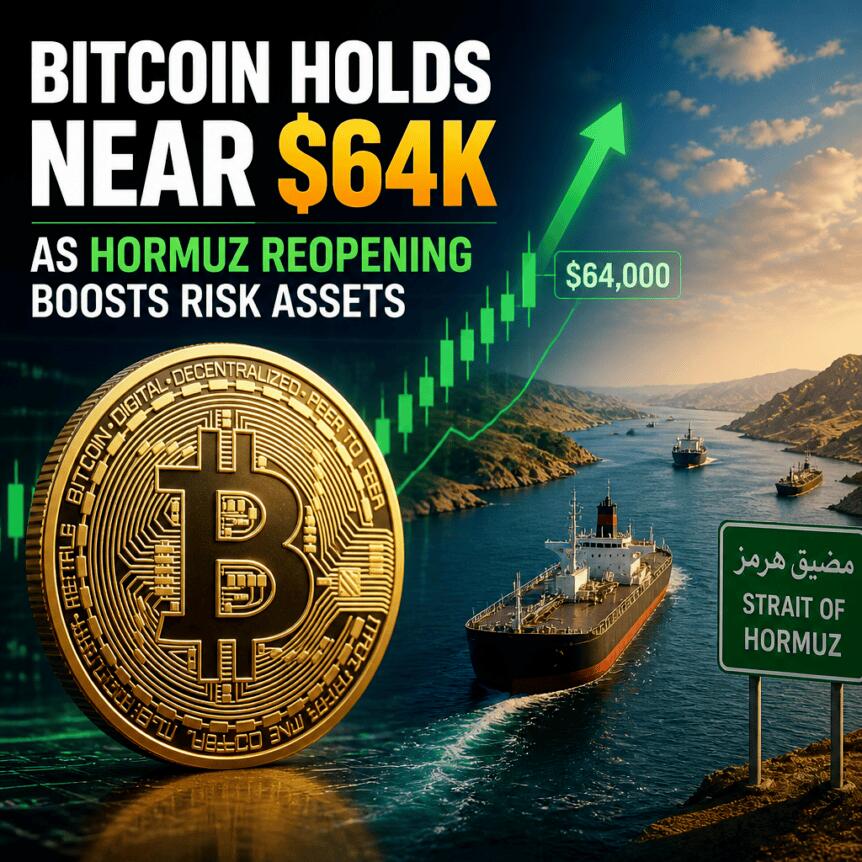
Bitcoin pushed to fresh August highs as hopes that the Strait of Hormuz could reopen calmed broader energy-market fears and lifted risk assets into Tuesday’s Wall Street open. While equities surged, crypto’s rally stayed more controlled—yet on-chain data suggested investors were accumulating rather than chasing.
TradingView data showed BTC/USD rising to $64,176 on Bitstamp, posting maximum daily gains of roughly 1% as market attention focused on US-Iran developments, oil price moves, and how those dynamics could shape expectations for the Federal Reserve.
Key takeaways
- Bitcoin extended gains toward $64,000 on Tuesday, with TradingView marking a peak around $64,176 on Bitstamp.
- US-Iran reopening signals for the Strait of Hormuz pushed oil prices lower; WTI and Brent were down about 4.8% and 4.6%, respectively.
- BTC traded between key moving averages on the hourly view, with the 21-day SMA near $64,388 acting as a near-term ceiling.
- CryptoQuant reported “strong accumulation,” pointing to investors taking positions in the $62,000–$65,000 cost-basis band.
- With rate expectations tied to oil and bond-market dynamics, FedWatch probabilities pointed to a 0.25% hike as a leading scenario for September.
Hormuz optimism lifts stocks—and pulls oil down
The crypto move was part of a wider risk-on shift driven by geopolitical headlines. US Treasury Secretary Scott Bessent told CNBC that there is “a chance we may have a deal today or tomorrow to open the Strait and move towards a more normalized position” amid ongoing US-Iran discussions. The comments followed a day after President Donald Trump said reopening dialogue could happen “as soon as tomorrow.”
Oil reacted quickly. At the time of writing, WTI and Brent crude were trading 4.8% and 4.6% lower, respectively, with prices at their lowest levels since July 13. The direction of travel matters for markets not only because oil is a direct input for inflation expectations, but also because reopening assumptions can quickly change the probability of supply disruptions.
US stocks futures moved higher ahead of the open, and the S&P 500 topped a new milestone. According to market tracking cited in the report, the index reached a record high of 7,713 and achieved a $70 trillion market capitalization for the first time.
Fed expectations hinge on oil, bonds, and the market’s interpretation
Traders linked the Hormuz outlook to future Federal Reserve decisions. The report highlighted an environment of debate among policymakers, describing an “emerging hawkish split” regarding interest-rate timing and magnitude, while markets watched how energy prices could influence the inflation picture.
According to CME Group’s FedWatch Tool, investors were pricing in a 56.7% probability of policymakers approving a 0.25% rate hike at the September meeting. Earlier in the day, Bloomberg macro strategist Michael Ball was quoted emphasizing that Chairman Kevin Warsh’s limited guidance on the Fed’s reaction function means coming data—along with oil prices and the bond market—will have an outsized impact on how investors forecast the policy path.
For Bitcoin, the key takeaway is not that crypto is trading directly off oil headlines, but that macro expectations determine the liquidity and risk appetite that typically flows into high-beta assets. If the market believes reopening reduces inflation pressures, it can soften the “higher for longer” narrative that often weighs on speculative demand.
Bitcoin stays in a tight range, but on-chain shows buyers soaking up dips
Despite BTC/USD slipping into a comparatively narrow technical rhythm, the price still managed to break toward the low-to-mid $64,000s. On the hourly chart referenced in the report, analysts noted BTC was trading between two daily moving averages: the 21-day simple moving average (SMA) near $64,388 acted as an overhead reference, while the 50-day SMA provided support in shorter time frames.
In a market that appears to be waiting for a clearer macro catalyst, this kind of range behavior often reflects “positioning” rather than fresh momentum chasing. That’s where on-chain analysis came in.
CryptoQuant reported “strong accumulation” among investors. Specifically, the platform said 0.7% of the BTC supply—about 155,000 coins—now belongs to participants with a cost basis between $62,000 and $65,000. In CryptoQuant’s framing, the pattern signals absorption rather than capitulation: buyers were accumulating during weakness instead of selling under pressure.
For traders, the practical implication is that a stubborn local range can be consistent with accumulation, especially when there’s no broad liquidation wave. However, accumulation data doesn’t guarantee an immediate breakout; it mainly clarifies whether demand is present beneath the surface.
What to watch next as macro headlines evolve
As the Strait of Hormuz reopening narrative continues to develop, the next swings in oil and US bond yields are likely to remain central to how risk assets—including Bitcoin—trade. Investors should also monitor whether BTC can hold above the 50-day SMA on lower time frames and whether accumulation signals persist as price tests the $64,000 area and beyond.
https://www.cryptobreaking.com/bitcoin-holds-near-64k-as/?utm_source=blogger%20&utm_medium=social_auto&utm_campaign=Bitcoin%20Holds%20near%20$64K%20as%20Hormuz%20reopening%20boosts%20risk%20assets%20
Comments
Post a Comment