
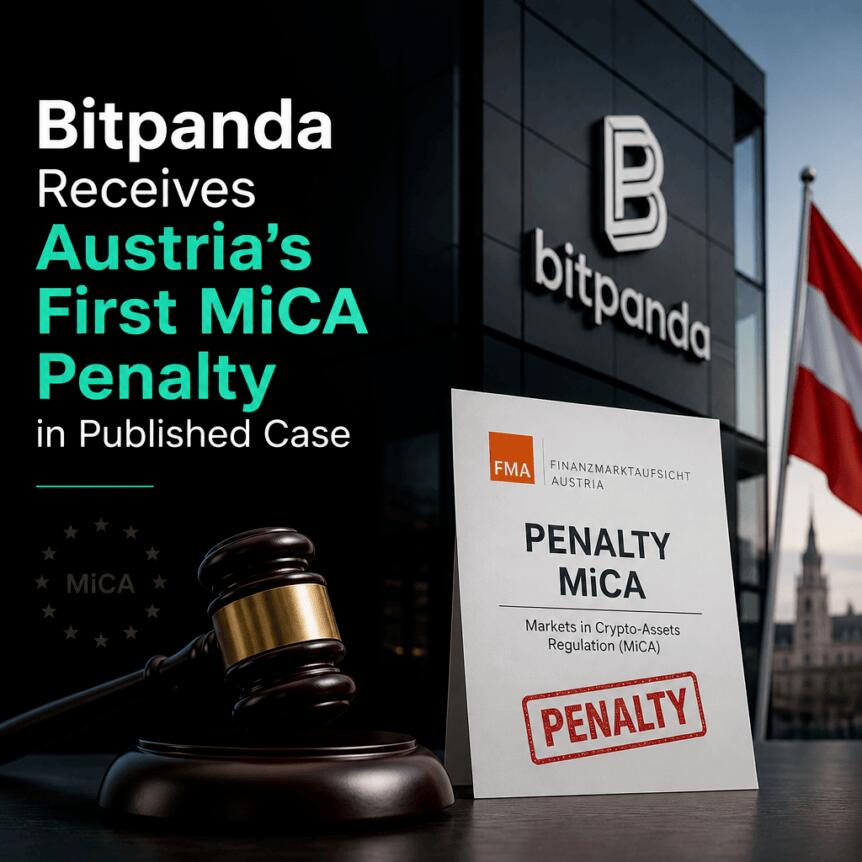
Austria’s financial regulator has issued its first final penalty under the EU’s Markets in Crypto-Assets Regulation (MiCA), fining crypto platform Bitpanda 70,000 euros (about $82,000) for breaching MiCA’s publication and marketing disclosure rules. The Austrian Financial Market Authority (FMA) said the case was handled under an expedited procedure and that the decision is final.
According to the FMA, the issue centered on Bitpanda’s timing and compliance with mandatory pre-publication and disclosure requirements for a crypto-asset white paper.
Key takeaways
- The FMA fined Bitpanda 70,000 euros for failing to submit the required crypto-asset white paper at least 20 working days before publication.
- Regulators also said Bitpanda issued marketing communications before the white paper was filed.
- Another alleged breach involved marketing material that omitted MiCA-mandated disclaimers, including that it had not been reviewed or approved by a competent authority and that Bitpanda is responsible for the content.
- The penalty was issued as the first published final enforcement under MiCA, signaling the EU framework is moving from licensing and guidance into outcomes.
- Bitpanda stated the problems were limited to formal timing and documentation requirements, and said customer funds and platform security were not affected.
FMA details: white paper submission and marketing timing
In a notice published Friday, the FMA said Bitpanda did not submit a crypto-asset white paper to the regulator at least 20 working days prior to its publication, as MiCA requires. The regulator also reported that Bitpanda distributed a marketing communication before publishing the required white paper.
The regulator’s explanation is significant because MiCA’s approach to investor protection depends heavily on structured disclosures. The white paper is intended to provide standardized information before the public is exposed to an offering or related marketing materials.
Disclosure gaps in marketing materials
The FMA further alleged that another marketing communication failed to include mandatory disclosures. Specifically, the regulator said the content did not state that the material had not been reviewed or approved by a competent authority, and that the crypto-asset provider alone was responsible for the content. The regulator also said the marketing communication lacked required contact details, including a telephone number and email address.
These points matter for compliance teams because they show that regulators are not only checking whether documents exist, but whether the surrounding communications include the specific legal language and contact information required under MiCA.
Expedited proceedings and final decision
The FMA said the case was concluded under an expedited procedure and that the penalty decision is final. While the fine amount is comparatively small relative to some large-scale financial enforcement actions, the regulatory significance is larger: this is presented as the watchdog’s first published final penalty under MiCA.
For market participants, the outcome suggests that formal compliance lapses—such as filing timelines and required statement formatting—are actionable under MiCA, even when the core product or platform functionality is not necessarily implicated.
Bitpanda’s response: timing and formal requirements only
Bitpanda told Cointelegraph that the concerns raised by the FMA related exclusively to the timing and formal requirements surrounding the publication of the white paper and an accompanying information document. The company said customer funds and platform security were not affected and that customers suffered no financial harm.
Bitpanda added that it corrected the issues after receiving notice from the FMA, and it opted for a swift, consensual conclusion of the proceedings.
That framing may influence how investors and users interpret the case. The regulator’s enforcement narrative emphasizes process compliance, while Bitpanda points to the absence of customer impact. Still, the penalty itself indicates that regulators are prepared to treat disclosure mechanics and marketing rules as enforceable obligations under the new regime.
Why this is a broader MiCA signal
MiCA created a harmonized regulatory framework for crypto assets across the European Union, including disclosure standards, marketing requirements, and authorization conditions for crypto companies. The FMA’s action reinforces that MiCA compliance is not limited to licensing status or long-form disclosures alone; marketing materials and document submission timelines are also subject to scrutiny.
Earlier coverage of the implementation of MiCA licensing timelines and transitional measures (including references to the end of certain grace periods) highlighted that firms would eventually face stricter enforcement as operational readiness deadlines were crossed. This penalty fits that pattern: once formal requirements are in effect, regulators can convert guidance into penalties.
For the wider industry, the main uncertainty going forward is how frequently regulators will pursue similar “paperwork” cases and whether enforcement will focus on specific categories of issuers or on any instance of noncompliance with pre-publication timing and mandated marketing language. Market participants should watch for more final decisions across member states as regulators test the boundaries of MiCA’s disclosure and communications requirements.
Readers should pay attention to the next enforcement steps from Austria and other EU jurisdictions—particularly whether additional cases involve similar white-paper submission delays and missing mandatory marketing disclaimers, or whether regulators begin targeting other parts of MiCA compliance such as authorization obligations and ongoing disclosure practices.
https://www.cryptobreaking.com/bitpanda-receives-austrias-first-mica/?utm_source=blogger%20&utm_medium=social_auto&utm_campaign=Bitpanda%20Receives%20Austria’s%20First%20MiCA%20Penalty%20in%20Published%20Case%20
Comments
Post a Comment