
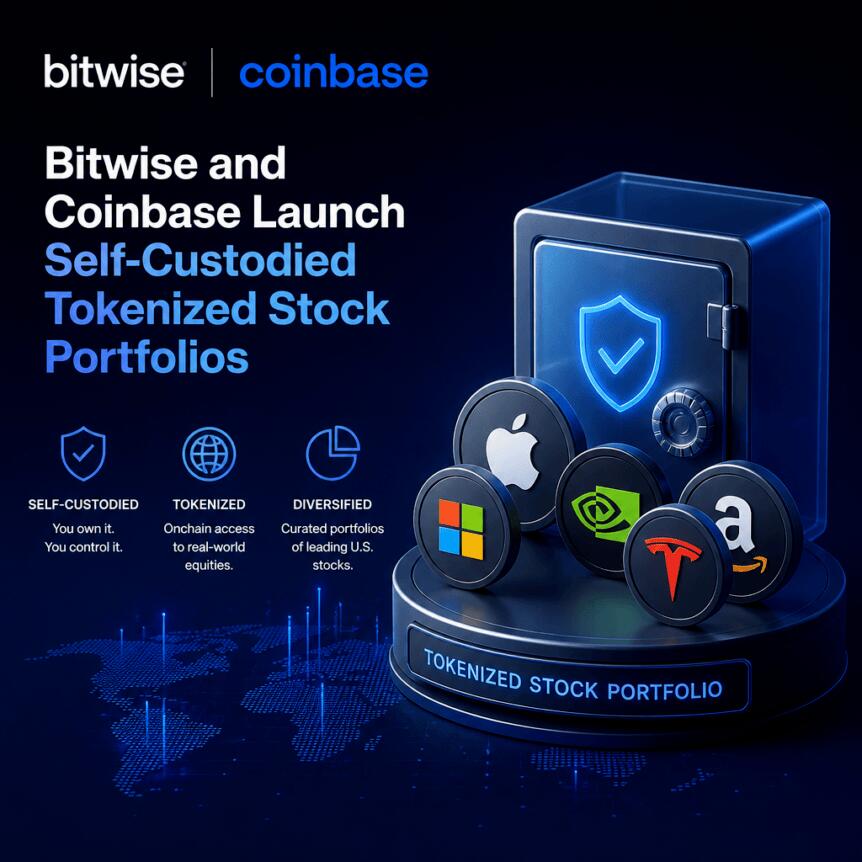
Bitwise Asset Management has introduced automated “tokenized stock” portfolios built on Coinbase’s tokenized US stock infrastructure, aiming to give eligible non-US investors a more hands-off way to follow preset stock strategies.
The new offering uses Coinbase’s recently launched tokenized stocks while Bitwise’s portfolio models are implemented through Glider, which automatically rebalances holdings to track Bitwise’s strategy allocations, according to a Tuesday announcement.
Key takeaways
- Bitwise’s automated portfolios are designed for eligible investors outside the United States using Coinbase’s tokenized stocks.
- Glider handles trade execution and periodic rebalancing to keep portfolios aligned with Bitwise’s model strategies.
- The initial lineup focuses on three approaches, including a Mag7X strategy centered on large-cap tech and related leaders.
- Tokenized stocks remain in users’ non-custodial wallets rather than being held by a traditional fund structure.
- Bitwise charges a 0.15% methodology access fee, separate from trading and Glider platform fees.
Automating tokenized stock strategies for non-US users
According to Bitwise’s announcement, the system is intended to let participants outside the US follow structured investment plans without manually managing each rebalancing event. Instead, the portfolios rely on model allocations designed by Bitwise and then implemented automatically.
The approach draws on Coinbase’s tokenized US stock framework, and it positions Glider as the operational layer that converts those model allocations into ongoing portfolio adjustments. Bitwise retains responsibility for the portfolio methodology, while Glider executes the trades needed to maintain the strategy weights over time.
Portfolio lineup and what’s included
Bitwise said the initial set of strategies includes three distinct approaches. One of them is Mag7X, described as a strategy focused on robotics and AI leaders. The Mag7X basket includes Apple, Nvidia, Microsoft, Tesla, and SpaceX.
While tokenized stock products have expanded across venues and use cases, the key shift in this launch is the packaging: rather than simply buying a tokenized share at a point in time, investors get an automated portfolio that aims to keep them aligned with a predefined thesis.
How ownership works: non-custodial tokens
A central feature of tokenized stock designs in this category is custody and user control. Bitwise emphasized that the tokenized stocks stay in users’ non-custodial wallets, distinguishing the model from a conventional pooled fund where the manager or custodian holds the assets.
Because users retain the individual tokenized instruments, Bitwise also said the assets could be used in decentralized finance applications—such as lending or borrowing—subject to the inherent risks of the DeFi protocols involved. That matters for investors who want potential composability rather than the assets being locked behind a traditional account structure.
For readers tracking adoption of tokenized equities, this launch reinforces the direction of travel: tokenized stocks are not only being traded, but are being packaged into workflows that can plug into broader on-chain activity.
Fees, scale indicators, and the broader tokenized-stock momentum
Bitwise’s methodology access fee is set at 0.15%, with the company noting that this fee is separate from trading costs and Glider platform fees. The announcement frames Bitwise as charging for strategy access rather than for custody or trading execution.
On the market side, rwa.xyz data cited in the announcement suggests tokenized listed stocks have reached $2.49 billion in total value, up 5.18% over the past month. The same source lists 2.25 million holders and $27.28 billion in monthly transfer volume.
These figures provide a sense of how much activity is already flowing through tokenized-stock rails, even as product formats evolve from single-asset tokenization to strategy-based portfolios. In practical terms, higher transfer volume and a larger holder base can matter for liquidity expectations and the user experience of moving between strategies or rebalancing over time.
Coming a day after Coinbase tokenized stocks expanded on Base
This rollout lands shortly after Coinbase tokenized US stocks went live on Base, per earlier coverage from Cointelegraph. That earlier report noted the move enabled eligible non-US users to trade the assets around the clock and use them across decentralized finance applications.
Viewed together, the sequence suggests a broader push to make tokenized equities more accessible and more integrated into on-chain financial workflows. Coinbase provides the tokenized stock instruments, while products like Bitwise’s strategy portfolios—implemented through automation by Glider—aim to lower the operational burden for users who want structured exposure without active day-to-day management.
For investors considering these kinds of offerings, the next questions to watch are how model rebalancing performs in live conditions, how trading and platform fees affect total cost over time, and whether tokenized-stock liquidity continues to strengthen as more strategy-based products enter the market.
https://www.cryptobreaking.com/bitwise-and-coinbase-launch-self/?utm_source=blogger%20&utm_medium=social_auto&utm_campaign=Bitwise%20and%20Coinbase%20Launch%20Self-Custodied%20Tokenized%20Stock%20Portfolios%20
Comments
Post a Comment