
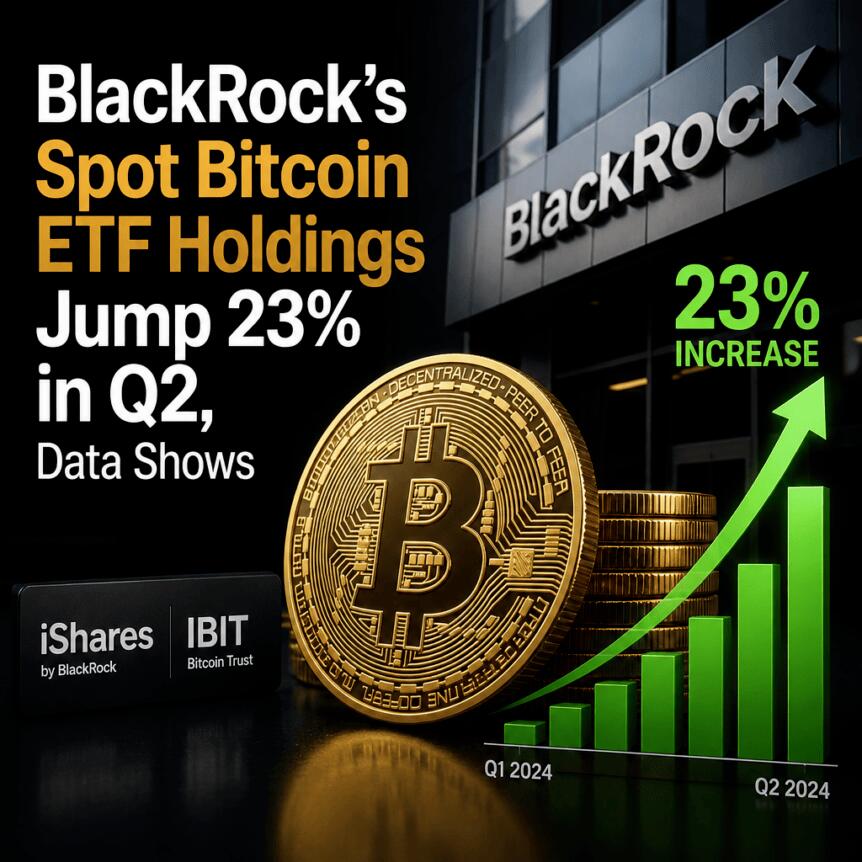
Morgan Stanley increased its reported cryptocurrency-related positions in the second quarter, according to its Q2 13F filing with the US Securities and Exchange Commission. The most notable change was a significant step-up in holdings of BlackRock’s Bitcoin ETF, alongside broader adjustments across other crypto-linked equities and exchange-traded funds.
Specifically, Morgan Stanley’s reported exposure to the iShares Bitcoin Trust ETF (IBIT) rose to roughly 16.5 million shares from 13.4 million, an increase of about 23%, as reflected in the SEC filing submitted on Thursday. The firm also reported 2.57 million shares of its own Morgan Stanley Bitcoin Trust (MSBT), which began trading in April.
Key takeaways
- Morgan Stanley boosted its IBIT share count by more than 3 million shares in Q2, even as the reported dollar value declined due to weaker Bitcoin prices during the quarter.
- Its MSBT position was initiated in the period, adding a new channel for the firm’s own spot Bitcoin product exposure.
- Ether exposure expanded as well, with major increases in iShares Ethereum Trust (ETHA) and Grayscale’s Ethereum staking-focused mini fund.
- The filing shows uneven positioning across the broader crypto equity complex, with gains in some miners and Circle (USDC issuer) contrasted by cuts in others.
- Morgan Stanley’s Circle (CRCL) holdings rose sharply, while reported holdings in Coinbase and some mining names declined.
IBIT adds volume, valuation drops with Bitcoin
While Morgan Stanley added approximately 3.04 million shares to its IBIT position, the value of that stake fell by about 18% to $549 million from $667 million. The filing’s figures reflect a common dynamic for large investors: even when share counts rise, reported portfolio value can still decline if the underlying asset—here, Bitcoin—trades lower over the reporting window.
The SEC filing indicates the increase in IBIT shares occurred alongside also adding to several other Bitcoin ETF exposures. Morgan Stanley reported higher allocations to products including Grayscale’s Bitcoin Mini Trust ETF and Bitwise’s Bitcoin ETF, while its Fidelity Wise Origin Bitcoin Fund (FBTC) position rose by nearly 38%.
Beyond the headline IBIT change, the broader pattern suggests Morgan Stanley was concentrating more into established spot Bitcoin vehicles rather than trimming exposure at the start of Q2. Investors often watch this kind of behavior for clues on whether institutional demand is strengthening at the ETF level, particularly when the share count rises faster than the reported valuation.
Ether positions expand across spot and staking-linked products
Morgan Stanley’s Q2 filing also showed substantial growth in reported Ether-related ETF holdings. Its iShares Ethereum Trust ETF (ETHA) position increased by about 202% to around 4.6 million shares. Morgan Stanley also raised its Grayscale Ethereum Staking Mini ETF (ETH) holding by approximately 26% to about 5.1 million shares.
These increases matter because they signal that Morgan Stanley’s crypto ETF footprint is not limited to Bitcoin. For market participants, large incremental allocations to Ether products can be interpreted as broader institutional participation—especially when the increases span both mainstream spot-style Ether exposure (ETHA) and products linked to staking (Grayscale’s staking-focused mini fund).
In addition, Morgan Stanley initiated new exposure to Solana-related funds. The filing showed additions to Grayscale Solana Staking ETF (GSOL) and Fidelity’s Solana fund (FSOL), with those positions reported at about $4.25 million and $2.26 million, respectively.
Circle and mining/infrastructure names show selective momentum
Beyond ETFs, Morgan Stanley also adjusted its holdings in crypto-adjacent public companies. The firm dramatically increased its reported stake in Circle Internet Group (CRCL), the company behind the USDC stablecoin. According to the Q2 filing, Circle shares rose from roughly 1.46 million to about 8.32 million.
On the mining and infrastructure side, the filing reflected additions to several names, including Cipher Digital (CIFR), Core Scientific (CORZ), Hut 8 (HUT), and Bitdeer Technologies (BTDR). For investors tracking institutional risk appetite, expanding positions across multiple miners and infrastructure providers can indicate confidence in the sector’s operational resilience—or at least a willingness to accumulate exposure while valuations and market conditions fluctuate.
However, the changes were not uniformly positive across every crypto-linked equity. Morgan Stanley reported about 550,000 fewer shares of Coinbase (COIN). It also cut its CleanSpark (CLSK) position by more than 3.1 million shares and fully exited a roughly 8 million-share holding in Bitfarms (BITF).
That mix—adding in some areas while trimming others—suggests a more selective approach rather than a broad increase across the entire crypto equity basket.
What to watch after Morgan Stanley’s Q2 adjustments
Going into the next reporting period, investors will likely focus on whether Morgan Stanley continues to build its ETF share counts—particularly in IBIT and ETHA—or whether the firm’s activity reverts toward valuation-driven changes as crypto prices move. The SEC 13F updates also remain a key way to observe institutional positioning shifts, even though they are inherently lagging compared with day-to-day market flows.
https://www.cryptobreaking.com/blackrocks-spot-bitcoin-etf-holdings/?utm_source=blogger%20&utm_medium=social_auto&utm_campaign=BlackRock’s%20Spot%20Bitcoin%20ETF%20Holdings%20Jump%2023%%20in%20Q2,%20Data%20Shows%20
Comments
Post a Comment