
Trading activity in both centralized and decentralized crypto derivatives cooled sharply in July, with perpetual futures volumes hitting multi-month lows across major venues. The slowdown points to thinner speculative momentum—an environment where liquidity and positioning often matter as much as spot demand.
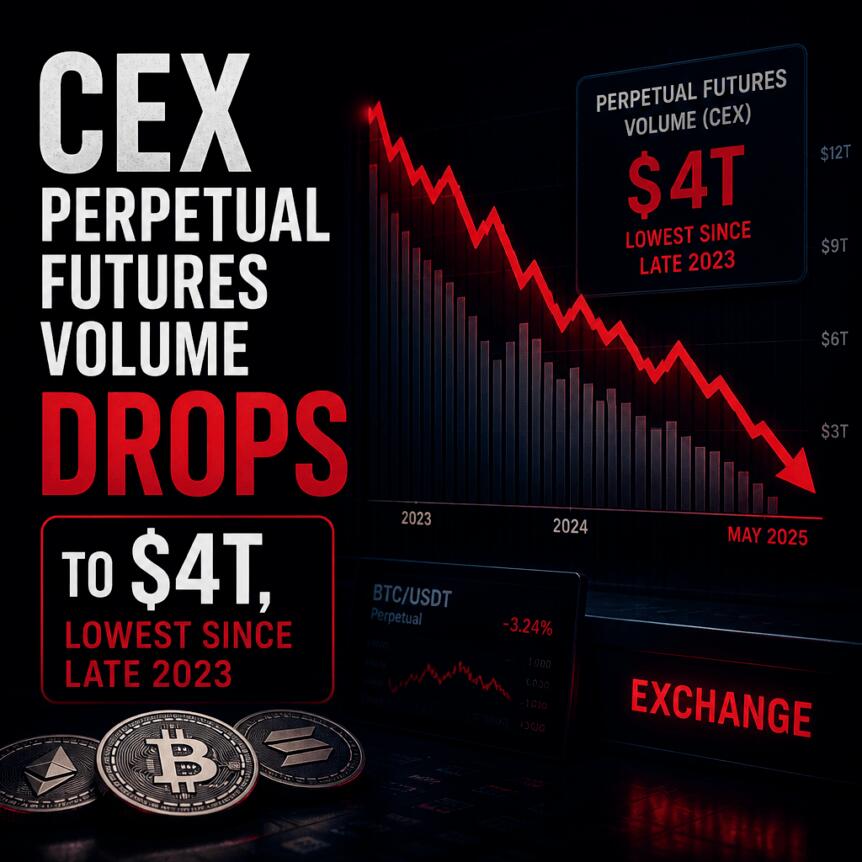
According to CryptoRank’s data posted on X, perpetual futures trading volume on centralized exchanges (CEXs) fell to $4 trillion in July, the lowest level in 31 months since December 2023. The same report also tracked weakness across spot markets during the month, reinforcing the picture of reduced overall market participation.
Key takeaways
- CryptoRank data shows CEX perpetual futures volume dropped to $4T in July, a 31-month low.
- Binance accounted for most CEX perp volume at $1.4T, while OKX and Bybit posted $607B and $300B respectively.
- Coinglass reports CEX spot trading volume declined 23.6% in July to $13.6B from $17.8B at the start of the month.
- DefiLlama data indicates DEX perpetuals fell to $531B in July, near a one-year low, with DEX open interest also sliding.
- On leading DEX Hyperliquid, tokenized RWAs grew in importance, even as overall DEX perp activity declined.
CEX perpetual futures slide to a 31-month low
CryptoRank said that in July, perpetual futures trading on centralized exchanges totaled $4 trillion—down to the weakest point since December 2023. The month’s decline followed a brief recovery between April and June, after which volume fell again across major venues.
Binance led CEXs by volume with $1.4 trillion in monthly perpetual futures activity, according to the CryptoRank post. OKX came next with $607 billion, followed by Bybit at $300 billion.
For market participants, changes in perp volume can be a useful proxy for speculative activity and the willingness of traders to take leveraged exposure. When volumes compress—especially after a short rebound—liquidity and price discovery in derivative-heavy markets can become less resilient, even if underlying spot interest remains intact.
Spot weakness and the pullback in derivatives activity
Part of the broader contraction appears tied to spot trading as well. Coinglass data cited in the report shows daily spot crypto trading volume fell 23.6% from July 1 to July 31, dropping from $17.8 billion to $13.6 billion.
This matters because spot and derivatives flows often move together during risk-on or risk-off phases. With spot participation weakening over the month, it becomes more difficult for perp markets to maintain high turnover—particularly when traders are less eager to hedge or express directional bets through leverage.
DEX perpetuals near a one-year low, open interest declines
Derivatives activity also weakened on decentralized exchanges. DefiLlama data indicates DEX perpetual trading volume fell to $531 billion in July, the lowest level since June 2025. The report also described a 21% decline from June 2026’s $676 billion.
Beyond volume, DEX open interest fell as well. According to the same DefiLlama figures, open interest on DEXs dropped to $17.9 billion in July from a September 2025 peak of $19.4 billion. Open interest reflects the total value of active, unsettled perp contracts and can help signal whether new capital is entering the market or existing positions are being reduced.
In other words, July’s slowdown was not just about lower trading counts—it also reflected less outstanding leveraged exposure on DEX venues.
Hyperliquid remains a volume leader as RWAs gain share
Even as overall DEX perpetual activity declined, Hyperliquid stood out as the leading platform. DefiLlama-tracked performance in the report shows Hyperliquid generated $199 billion in reported trading volume over the past 30 days.
What appears to have changed on Hyperliquid is not its dominance of volume, but the composition of that volume. A larger portion of Hyperliquid’s trading has come from tokenized real-world assets (RWAs). The report states that RWAs accounted for 32% of Hyperliquid’s second-quarter trading activity, which corresponded to 6.6% of the protocol’s $169 million quarterly revenue.
The shift toward RWAs also shows up in category rankings. The article notes that tokenized assets became Hyperliquid’s largest trading category for the first time last month, with RWAs representing 52% of the protocol’s total weekly trading volume between July 13 and July 19.
For traders and builders, this is a meaningful divergence from the broader July picture: while total DEX perp volume and DEX open interest declined, Hyperliquid’s internal mix leaned more toward tokenized assets. That suggests demand for certain contract exposures may remain sticky even when overall leverage appetite cools.
What to watch next
With both CEX and DEX perpetual activity at multi-month lows and spot volume also down in July, the next signal for traders will likely be whether August brings renewed spot engagement and sustained perp open interest, or whether the contraction becomes a longer trend. At the same time, the growing RWA share on Hyperliquid raises a separate question: can tokenized-asset flows offset softer broader derivatives momentum in the months ahead?
https://www.cryptobreaking.com/cex-perpetual-futures-volume-drops/?utm_source=blogger%20&utm_medium=social_auto&utm_campaign=CEX%20Perpetual%20Futures%20Volume%20Drops%20to%20$4T,%20Lowest%20Since%20Late%202023%20
Comments
Post a Comment