
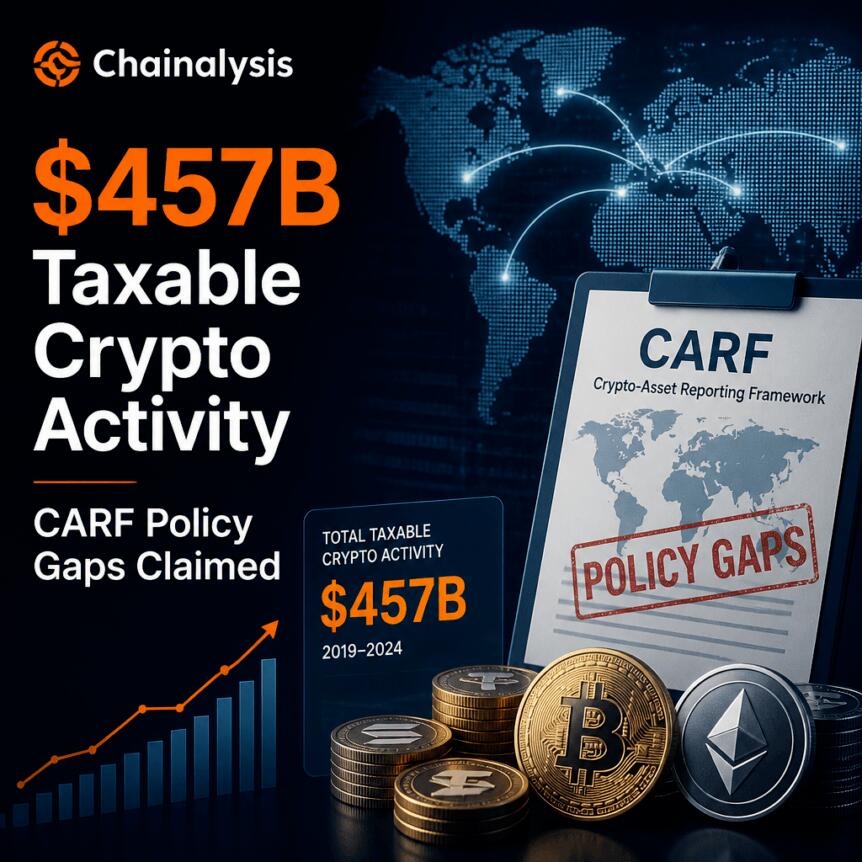
Chainalysis estimates that potentially taxable crypto activity on major public blockchains reached at least $457 billion worldwide in 2025. But the firm argues that current international tax reporting rules will likely capture only a minority of that activity—leaving most onchain activity outside the data flows tax authorities can use.
In Chainalysis’ figures, the United States accounted for an estimated $112.6 billion, while North America led all regions with $134.6 billion. The European Union followed with $125.1 billion. The analysis focuses on realized gains, income from activities such as mining, staking and lending, and crypto-denominated payments across six major blockchains—while excluding activity conducted within centralized exchanges.
Key takeaways
- Chainalysis pegs potentially taxable onchain activity in 2025 at $457 billion globally, but most of it falls outside OECD’s Crypto-Asset Reporting Framework (CARF).
- CARF-covered transactions account for an estimated 14% of the taxable onchain activity Chainalysis identified, with 86% occurring beyond the reporting perimeter.
- The $457 billion estimate includes realized gains and onchain income streams (e.g., staking, lending) and payments, but intentionally leaves out centralized exchange trading activity.
- CARF requires covered providers to collect customer transaction and tax residency information and share it with tax authorities for cross-border exchange.
- Decentralized finance activity may remain largely uncovered because CARF is built around identifiable intermediaries and reporting obligations tied to centralized service providers.
A global onchain tax problem dwarfs what CARF can cover
Chainalysis’ report frames a central mismatch: taxable crypto behavior is heavily onchain and fragmented, while reporting obligations under CARF are structured around intermediaries that can be required to collect and report data.
According to Chainalysis, transactions that fall under CARF account for just 14% of the potentially taxable onchain activity it identified. The remaining 86% includes activity on decentralized exchanges, peer-to-peer transfers, onchain income streams, and crypto-denominated payments—types of activity that may not be routed through centralized, in-scope reporting entities.
This distinction matters for investors and market participants because tax outcomes depend on record availability. Even where taxable events occur on public blockchains, the ability for tax authorities to receive consistent third-party transaction information is limited when reporting requirements don’t extend to the underlying counterparties or decentralized infrastructure.
How CARF is meant to work—and when it starts
CARF was developed by the Organisation for Economic Co-operation and Development (OECD) and announced as a framework for reporting crypto-related customer transaction data to tax authorities. Under CARF, covered crypto service providers collect customer and tax residency information and report transaction data to their domestic authorities, which can then share information across borders.
In practical terms, Chainalysis points to a coverage design that focuses on intermediaries. CARF collection is set to begin on Jan. 1, 2026, in 48 jurisdictions, including the United Kingdom and European Union. For covered platforms, the framework also requires collecting additional customer and tax residency information from that date.
Investors should note that the start date is tied to reporting obligations placed on “covered” providers. The existence of a reporting framework does not automatically mean all onchain activity becomes reportable—coverage depends on whether transactions are processed through entities that fall within CARF’s defined perimeter.
Why DeFi may stay largely outside the reporting perimeter
A key reason for CARF’s limited coverage, Chainalysis suggests, is that CARF is oriented toward crypto intermediaries that facilitate transactions as a business. Colby Mangels, a former OECD adviser who worked on CARF, told Cointelegraph in January that the framework was designed around intermediaries that can be regulated and required to report.
That structure creates friction for decentralized finance. Much DeFi activity may involve no centralized operator in the traditional sense, and potentially no custodial relationship that triggers reporting obligations in the way CARF expects. As a result, decentralized exchanges, peer-to-peer transfers, and various onchain income mechanisms can remain outside direct reporting.
Still, the regulatory landscape is not static. Mangels said tax authorities are watching how anti-money laundering rules evolve, including efforts to determine when DeFi platforms—or their operators—could be treated as regulated crypto service providers. If and when that happens, the boundary between “covered” intermediaries and “uncovered” decentralized activity may shift.
What to watch next as reporting expands
Chainalysis’ estimates highlight an uncomfortable reality: even with CARF rolling out across dozens of jurisdictions, a large portion of taxable onchain activity may remain invisible to tax authorities unless reporting requirements extend to additional kinds of entities or data-generating processes. What matters next is how regulators decide whether and when decentralized platforms—or people operating them—become subject to the same reporting duties as centralized intermediaries.
Readers should watch the implementation details in CARF jurisdictions after the Jan. 1, 2026 rollout begins, as well as any regulatory movement that clarifies how DeFi participants fit into the “crypto service provider” concept. Those determinations will largely determine whether the 14% coverage figure can rise—or whether the reporting gap persists.
https://www.cryptobreaking.com/chainalysis-457b-taxable-crypto-activity-2/?utm_source=blogger%20&utm_medium=social_auto&utm_campaign=Chainalysis:%20$457B%20Taxable%20Crypto%20Activity,%20CARF%20Policy%20Gaps%20Claimed%20
Comments
Post a Comment