
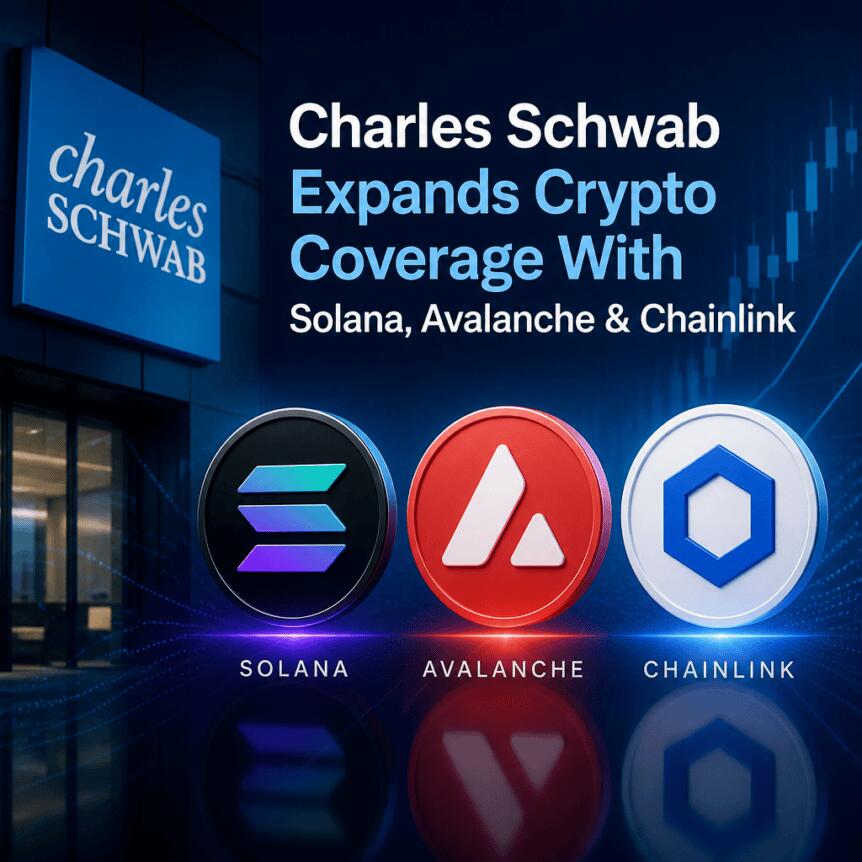
Charles Schwab says it plans to broaden the set of cryptocurrencies offered on its direct crypto trading platform by adding Solana (SOL), Avalanche (AVAX) and Chainlink (LINK) in the coming months. The update would extend Schwab Crypto’s initial rollout, which focused on Bitcoin (BTC) and Ether (ETH).
Schwab Crypto began bringing direct retail crypto trading to customers in May, with access via Schwab’s website, mobile app and thinkorswim. For now, Schwab has not provided additional details on which other digital assets it may consider beyond the three newly announced tokens, nor has it shared a specific schedule for each addition.
Key takeaways
- Schwab Crypto will add Solana (SOL), Avalanche (AVAX) and Chainlink (LINK) to its direct trading offering in the coming months.
- The expansion builds on Schwab Crypto’s May start, which initially supported direct trading in Bitcoin (BTC) and Ether (ETH).
- Schwab charges 75 basis points (0.75%) of the trade’s dollar value for each crypto transaction.
- Schwab Crypto is available in all US states except New York and Louisiana, and it is not offered in US territories or internationally.
Schwab Crypto grows beyond BTC and ETH
Schwab’s move signals a more multi-asset approach to institutional-style crypto access for retail investors. Schwab Crypto started rolling out direct crypto trading to retail clients in May, pairing crypto positions with traditional investment capabilities through Schwab’s existing platforms.
While Schwab has outlined the addition of SOL, AVAX and LINK, it has kept its longer-term roadmap unclear. The company did not specify what other tokens are under consideration or provide a detailed timeline beyond the three assets it has named.
For market participants, the practical question is how quickly Schwab can operationalize additional assets inside a regulated brokerage framework—especially as demand and product expectations evolve among retail investors used to multi-asset trading interfaces.
Pricing and availability for US customers
Schwab Crypto uses a straightforward fee model: a charge of 75 basis points, or 0.75%, on the dollar value of each crypto trade. The service is offered through Charles Schwab Premier Bank, with Charles Schwab & Co. handling certain operational functions on the bank’s behalf.
Geographic restrictions remain part of the offering. Schwab Crypto is available in all US states except New York and Louisiana, and it is not available in US territories or internationally. That footprint matters for traders and advisers evaluating whether Schwab’s expansion can meaningfully broaden access in the near term, particularly in states where other venues may dominate.
Broader push into new trading products
Schwab’s crypto expansion comes as the firm pursues other trading-product initiatives outside of digital assets. In June, The Wall Street Journal reported that Schwab plans to offer prediction contracts tied to the S&P 500 index in partnership with Cboe Global Markets. Those contracts would let clients bet whether the S&P 500 closes above or below a specified level, according to the report, and were described as expected to launch within months.
Unlike some prediction-market platforms that allow a broader set of event-based outcomes, Schwab’s planned offering—based on the reporting—would begin with index outcomes rather than opening immediately to a wider menu of contracts.
Taken together, Schwab’s actions suggest the brokerage is actively expanding its product suite for retail customers while staying inside tightly defined, exchange-partnered or brokerage-regulated structures. That approach can be relevant to how investors think about legitimacy, operational safeguards and compliance—areas that heavily influence adoption for both crypto trading and adjacent market products.
What Schwab’s scale signals for adoption
Schwab’s capacity to add assets may also be influenced by the size of its customer base. As of July 31, Schwab reported holding $13.04 trillion in client assets across 39.9 million active brokerage accounts. In results reported for the second quarter, Schwab also said it delivered record net revenue of $7.1 billion and net income of $2.8 billion.
While those figures are not direct measures of crypto activity, they provide context for how quickly a brokerage can iterate across product lines once a new offering clears operational hurdles. If Schwab Crypto’s early rollout meets internal performance thresholds, expanding from two benchmark tokens to a broader set of networks and use cases could deepen engagement from investors looking for exposure beyond BTC and ETH.
At the same time, Schwab’s decision to announce three specific additions—without committing to a detailed schedule for further tokens—highlights the balancing act between customer demand and the pace of compliance, custody, trading infrastructure and liquidity management.
What to watch next
Investors should keep an eye on when SOL, AVAX and LINK become available in Schwab’s direct trading menus, and whether Schwab provides additional milestones for any further digital-asset expansion. The next signals will likely come from Schwab’s own platform updates and any follow-on guidance that clarifies timing and the scope of future token listings.
https://www.cryptobreaking.com/charles-schwab-expands-crypto-coverage/?utm_source=blogger%20&utm_medium=social_auto&utm_campaign=Charles%20Schwab%20Expands%20Crypto%20Coverage%20With%20Solana,%20Avalanche%20&%20Chainlink%20
Comments
Post a Comment