
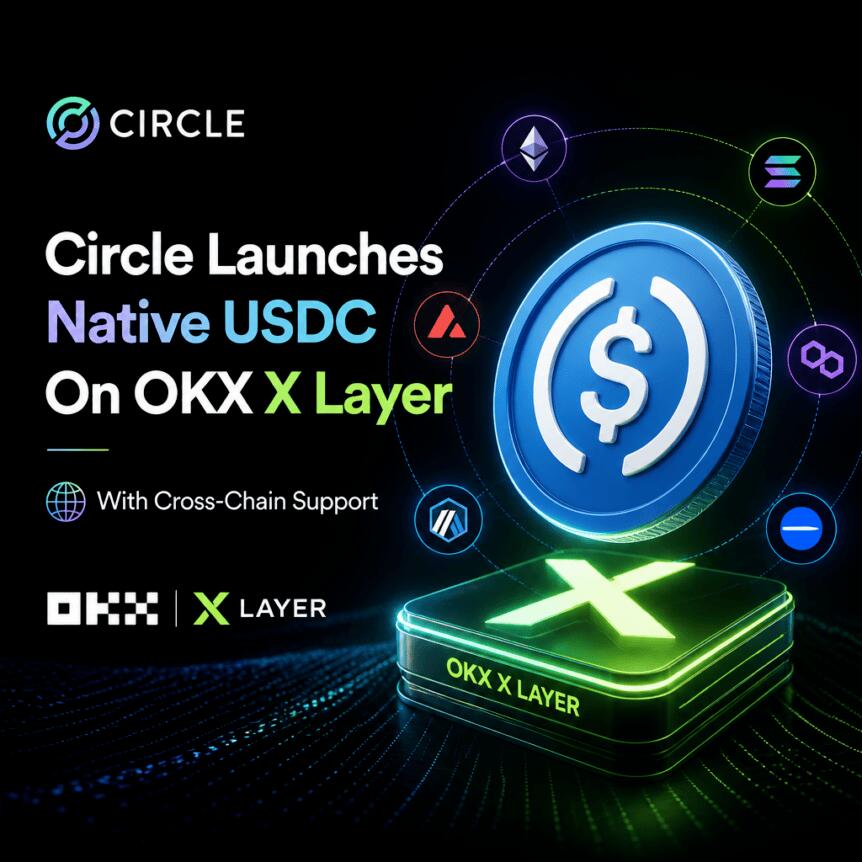
Circle has expanded its blockchain payment infrastructure by launching native USDC and the Cross-Chain Transfer Protocol on OKX's X Layer. The integration increases access to regulated digital dollar payments while improving cross-chain functionality for developers and businesses. It also strengthens X Layer's position as a network supporting decentralized finance, payments, tokenized assets, and artificial intelligence applications.
Native USDC Brings Direct Stablecoin Access To X Layer
Circle has introduced native USDC on X Layer, an Ethereum-compatible layer-2 blockchain developed by OKX. The launch gives developers and businesses direct access to Circle-issued stablecoins across the network. It also reduces dependence on bridged versions that previously supported USDC activity.
The integration allows decentralized applications to use native USDC for payments, trading, lending, and other financial services. Developers can also build applications with regulated dollar liquidity from the network itself. As a result, projects gain direct access to Circle's stablecoin infrastructure.
Qualified businesses can issue and redeem USDC through Circle Mint on X Layer. The service provides institutional access to regulated stablecoin liquidity for settlement and treasury operations. Meanwhile, Circle expands its infrastructure for enterprise blockchain adoption through the integration.
X Layer operates as an Ethereum-compatible layer-2 network with lower transaction costs and faster settlement speeds. The blockchain supports decentralized finance, payment services, tokenized real-world assets, and artificial intelligence applications. Therefore, native USDC strengthens payment capabilities across multiple sectors operating on the network.
Circle continues supporting bridged Ethereum-based USDC on X Layer during the transition period. However, the company encourages applications and ecosystem participants to migrate toward native USDC over time. This approach improves consistency while reducing reliance on external bridge infrastructure.
Cross-Chain Transfer Protocol Expands Multi-Chain Connectivity
Circle also activated its Cross-Chain Transfer Protocol (CCTP) on X Layer. The protocol allows users to move native USDC between supported blockchain networks. Unlike traditional bridge models, CCTP transfers native tokens instead of wrapped assets.
The addition brings the number of blockchains supporting CCTP to 26. At the same time, native USDC now operates across 36 blockchain ecosystems following the X Layer integration. Consequently, developers gain broader access to liquidity across multiple chains.
Cross-chain functionality supports decentralized applications that require efficient movement of stablecoins between different ecosystems. Developers can build services without creating separate liquidity pools for every blockchain. This design also simplifies payment and settlement processes across supported networks.
Circle designed CCTP to improve interoperability between blockchain ecosystems while maintaining native asset movement. The protocol removes the need for wrapped stablecoins during supported transfers. Therefore, developers can create applications with more direct cross-chain payment capabilities.
The expanded network also strengthens X Layer's position within the broader blockchain ecosystem. Applications can connect with supported chains while maintaining access to regulated USDC liquidity. This combination supports payment services and decentralized financial products across several blockchain environments.
Expansion Supports Payments, AI Applications, And Enterprise Services
Native USDC also supports payment providers, fintech companies, decentralized applications, and automated financial systems operating on X Layer. Businesses can settle transactions with regulated digital dollars across the blockchain. Furthermore, developers can integrate stablecoin payments into consumer and enterprise services.
The integration connects with X Layer's x402 ecosystem, which focuses on automated payments between artificial intelligence agents and digital services. Developers can use USDC for application programming interfaces and machine-driven payment processes. As a result, automated systems gain access to regulated blockchain settlement.
Circle continues expanding its blockchain infrastructure beyond the X Layer launch. The company recently introduced founding validators for its Arc blockchain initiative. Participants include BlackRock, DTCC, Galaxy, Mastercard, Visa, Standard Chartered, and other financial and technology organizations.
The validator group reflects Circle's broader strategy to expand regulated blockchain infrastructure across financial markets. Enterprise participation also supports the company's long-term network development goals. Meanwhile, Circle continues increasing the availability of native USDC across additional blockchain ecosystems.
The X Layer integration represents another step in Circle's broader expansion strategy. Native USDC, Circle Mint, and CCTP now provide additional payment and settlement options for businesses and developers. Together, these services strengthen regulated stablecoin infrastructure across an expanding multi-chain blockchain ecosystem.
https://www.cryptobreaking.com/circle-launches-native-usdc-on/?utm_source=blogger%20&utm_medium=social_auto&utm_campaign=Circle%20Launches%20Native%20USDC%20On%20OKX%20X%20Layer%20With%20Cross-Chain%20Support%20
Comments
Post a Comment