
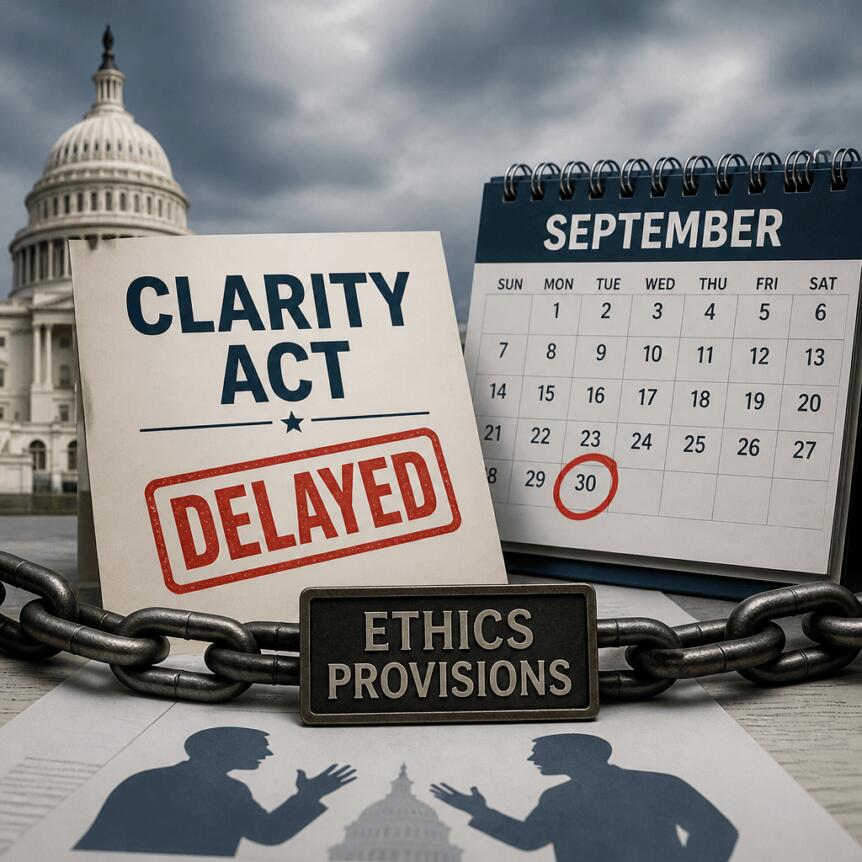
The Clarity Act has been punted to September after lawmakers missed the August window due to disagreements over ethics provisions, stablecoin yields, illicit finance measures, banking industry concerns, and a packed Senate calendar.
According to a statement by US Senator Jim Risch, the Senate will hold a procedural vote on the act on September 15. The delay brings the United States Securities and Exchange Commission’s (SEC) rule-making agenda in the spotlight. SEC Chair Paul Atkins has stated that the commission can, in partnership with the CFTC, provide a regulatory bridge while the Senate continues working on the act.
Clarity Act Faces Another Delay
The Clarity Act has been delayed yet again after lawmakers failed to agree on several key issues, including stablecoin yields and ethics provisions, the two sticking points. Senate Democrats have ruled out supporting the bill, arguing it does not satisfactorily address potential conflicts of interest involving federal officials, including the president, and their digital asset holdings. They have demanded stronger language in the bill, highlighting President Trump’s 2025 financial disclosure, which reported $1.4 billion in crypto-related income.
Additionally, the banking lobby introduced last-minute changes to key provisions dealing with stablecoin rules, while a packed legislative schedule meant the Senate prioritized other legislation, including funding extensions, Russia sanctions, and federal nominations over the Clarity Act.
Senators Ruben Gallego and Thom Tillis sent a bipartisan ethics proposal to the White House. The proposal would give state attorneys the authority to enforce restrictions on federal officials issuing digital assets. The proposal also requires President Trump to divest his crypto interests. However, President Trump has yet to approve the proposal.
Vote Set For September
Senate Majority Leader John Thune confirmed the delay on Thursday, while Senator Jim Risch stated that the Senate will begin the process of passing the Clarity Act on September 15.
“On September 15th, the U.S. Senate will start the process of passing the Clarity Act. The stakes couldn’t be higher. We must advance this important bill and make it law.”
Risch argued that the delay in passing the legislation could leave US citizens vulnerable to scam and fraud attempts, while shifting jobs and investments abroad.
Democratic support is crucial in ensuring the bill passes the Senate. The Republicans hold only 53 seats, significantly short of the 60 seats needed to invoke cloture and defeat a filibuster. While Republicans and crypto-friendly Democrats try to iron out a compromise, Senator Elizabeth Warren wants the Clarity Act to be rejected because it does not offer enough protection for investors and the financial system.
SEC Takes Center Stage
The legislative deadlock puts regulatory responsibility on the SEC while Senators continue efforts to get the legislation passed. SEC Chair Paul Atkins proposed working with the Commodity Futures Trading Commission (CFTC) to provide a regulatory bridge and create a parallel regulatory track. Atkins stated that the collaboration would include token classifications and potential exemptions, permitting some on-chain transactions under specific federal requirements. The agencies issued joint guidance in March, stating that most cryptocurrencies are not securities.
The SEC’s July regulatory agenda targeted specific policy areas, including crypto, custody, fundraising, and tokenized securities. Separately, it is creating rules governing how crypto can be held, traded, and issued under federal securities laws.
However, the SEC Chair has clearly distinguished agency rules from a market framework, calling Congressional legislation “the way to future-proof” crypto regulation in the US. Atkins outlined the SEC's authority regarding crypto, stating that the agency could clarify how securities laws could apply to crypto, address custody rules, establish exemptions, and create rules for securities-related on-chain activities.
Crypto Industry Not Worried
While the delay may have disappointed the industry, key figures believe crypto will thrive even if the Clarity Act fails to pass. Bitwise CIO Matt Hougan believes the industry will move forward despite regulatory uncertainty and legislative delays. Hougan stated,
“Crypto will be fine. Even if Clarity doesn’t pass, the crypto industry will find a way forward.”
Investors, market watchers, and analysts are hopeful after Senator Thune said the Senate will vote on the bill in September. However, with a packed legislative schedule, it might be difficult for the bill to pass this year.
Chris Niebuhr, analyst at Beacon Policy Advisors, stated,
“Nothing is dead until the year is up, technically speaking, but it’s hard to see the issues that have come up being solved in the time they have left.”
Disclaimer: This article is provided for informational purposes only. It is not offered or intended to be used as legal, tax, investment, financial, or other advice.
https://www.cryptobreaking.com/clarity-act-delayed-until-september/?utm_source=blogger%20&utm_medium=social_auto&utm_campaign=Clarity%20Act%20Delayed%20Until%20September%20As%20Impasse%20Over%20Ethics%20Provisions%20Bogs%20Down%20Negotiations%20
Comments
Post a Comment