
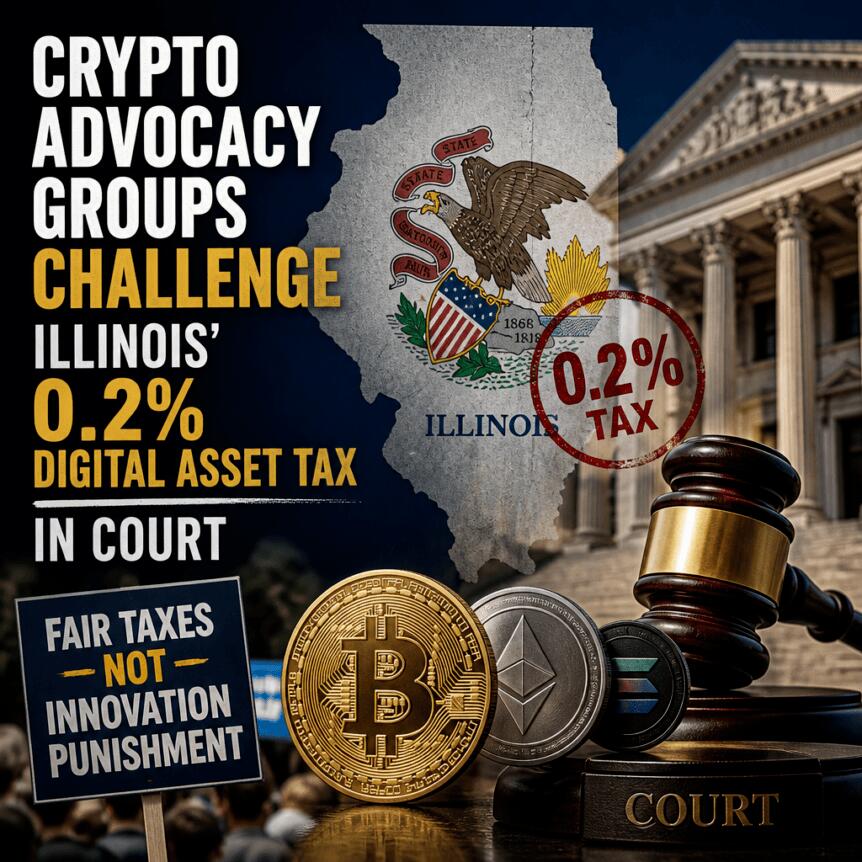
Two major crypto industry advocacy groups have taken legal action against Illinois over a newly enacted digital asset tax that is scheduled to take effect in January 2027. The Crypto Council for Innovation (CCI) and the Blockchain Association (BA) filed a lawsuit in Sangamon County, arguing that the measure runs afoul of the U.S. Constitution and other legal protections.
Illinois’ policy imposes a 0.2% tax on cryptocurrency based on transaction volume, which the state described as a “privilege tax.” The groups say the tax’s structure and administration create constitutional problems, including claims that the law is too vague and risks duplicative taxation for cross-border activity.
Key takeaways
- CCI and BA sued Illinois officials over a 0.2% cryptocurrency tax tied to transaction volume, effective January 2027.
- The complaint argues the tax violates multiple constitutional and legal provisions, including due process and the Commerce Clause.
- Opponents contend the rules are “unconstitutionally vague,” placing compliance burdens on residents and brokers under penalty threats.
- The lawsuit follows earlier Illinois crypto tax litigation from the Digital Chamber in July.
- Illinois’ broader regulatory posture also includes prediction market restrictions, alongside separate related legal challenges.
What Illinois’ crypto tax requires—and what challengers object to
The lawsuit was filed Friday in the Circuit Court of the Seventh Judicial Circuit for Sangamon County. According to the court filing, CCI and BA challenge Illinois’ digital asset tax on constitutional grounds, including claims involving due process and the Commerce Clause.
Illinois Governor JB Pritzker signed the measure into law in June as part of the state’s fiscal year 2027 budget. The tax is framed as a “privilege tax,” and it is designed to apply to transaction volume rather than income.
CCI and BA argue the tax creates uncertainty for market participants because it requires residents and brokers to determine what qualifies and how assets are taxed, while simultaneously exposing them to “serious civil and criminal penalties.” Their due process argument centers on alleged vagueness—essentially, that the law does not provide sufficiently clear guidance to comply safely.
Commerce Clause and the “risk of duplicative taxation” claim
Beyond due process, the complaint asserts that the Illinois tax implicates the U.S. Constitution’s Commerce Clause, which governs regulation of interstate commerce. In the filing, the groups contend the state tax creates a “specter of duplicative taxation,” a point aimed at the risk that crypto transactions spanning multiple jurisdictions could face overlapping tax obligations.
The core logic is that crypto activity is not confined to a single state boundary in the way traditional in-state commerce might be. If multiple jurisdictions try to levy comparable taxes based on transaction activity, the result—according to the lawsuit’s framing—could be inconsistent treatment and uncertainty for businesses and consumers operating across state lines.
“States have an important role in fostering innovation, but that authority has constitutional limits,” said Summer Mersinger, CEO of the Blockchain Association and a former commissioner at the U.S. Commodity Futures Trading Commission. She added that Illinois cannot impose a “novel tax regime” that discriminates against digital commerce, creates uncertainty for consumers and businesses, and threatens to fragment what she described as a rapidly growing national market.
How this fits into a wider pattern of Illinois crypto and prediction market scrutiny
The CCI/BA legal challenge is not the first court fight over Illinois’ approach. In July, the Digital Chamber filed a separate lawsuit against the same state crypto tax. That earlier case argued that the measure “discriminates against people who transact in digital assets,” aligning with the broader theme in the new complaint: that the tax places crypto users and related businesses under a regulatory burden not matched by other forms of commerce.
These lawsuits also arrive during an election year cycle in which crypto policy can become politically consequential. The filings and related actions point to how industry groups are mobilizing to challenge state laws that they say could reshape the compliance landscape well before the provisions take effect.
Illinois’ regulatory efforts extend beyond crypto taxation. The background includes Kalshi’s lawsuit against Illinois officials over legislation that took effect July 1 and, according to Kalshi, “expressly bans sports event contracts” in violation of federal law by requiring state licensing. Separately, Pritzker signed an executive order in April barring state employees from betting on prediction market platforms, explicitly aimed at preventing insider trading concerns amid the growth of event-based gambling contracts.
What to watch next
As the case moves forward, the key issue will likely be how courts evaluate the law’s clarity and enforcement mechanics—particularly the alleged vagueness and the constitutional concerns tied to interstate activity. With the tax slated for January 2027, businesses and brokers will be watching whether the litigation leads to court-ordered changes, delays, or a clearer interpretation of how Illinois intends to apply the 0.2% levy.
https://www.cryptobreaking.com/crypto-advocacy-groups-challenge-illinois-2/?utm_source=blogger%20&utm_medium=social_auto&utm_campaign=Crypto%20Advocacy%20Groups%20Challenge%20Illinois’%200.2%%20Digital%20Asset%20Tax%20in%20Court%20
Comments
Post a Comment