
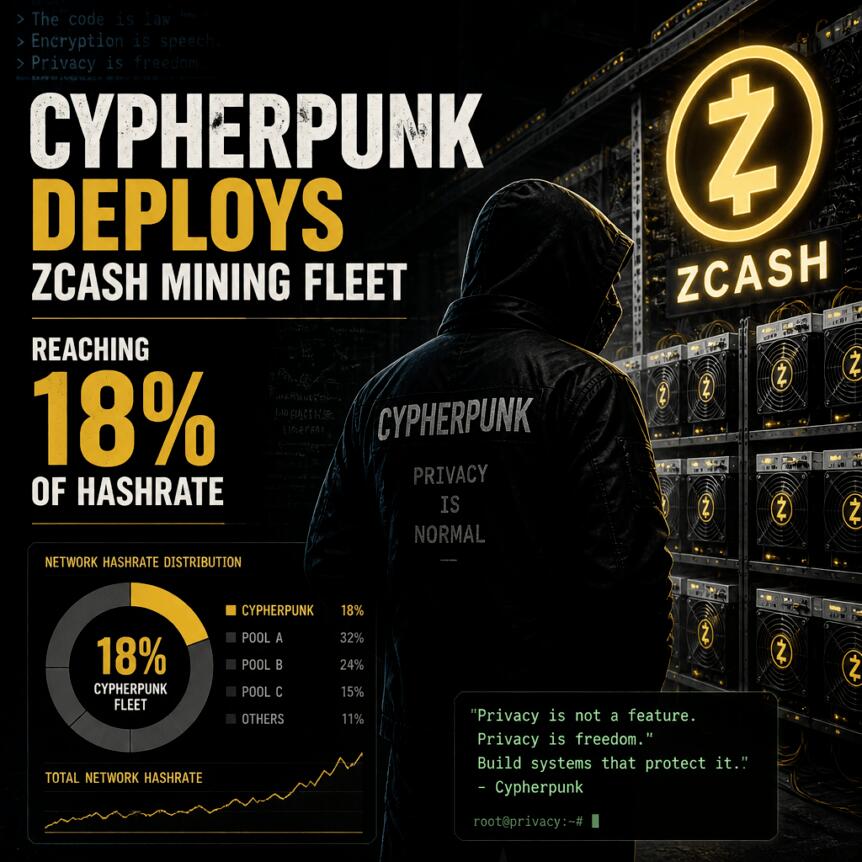
Cypherpunk Technologies says it has significantly boosted its presence in Zcash by launching what it describes as the world’s largest Zcash mining operation, following an acquisition of a mining fleet from Winklevoss Capital. The company framed the move as a bet on growing institutional attention to privacy-focused networks.
In a statement released Tuesday, Cypherpunk said it acquired the fleet via an equity-based transaction valued at $33.33 million. The new operation is already online across U.S. facilities and is producing about 4.2 GSol/s, which Cypherpunk estimates is roughly 18% of Zcash’s current network hashrate—if the figures are accurate, the arrangement would concentrate a notable slice of mining power under a single publicly traded company.
Key takeaways
- Cypherpunk Technologies reports acquiring a mining fleet from Winklevoss Capital for $33.33 million in an equity-based deal.
- The company says the fleet is live in the U.S. and is running at approximately 4.2 GSol/s, or about 18% of today’s Zcash hashrate.
- Cypherpunk’s existing ZEC holdings total 323,394 ZEC (about 1.9% of circulating supply), and it has set a longer-term goal of holding 5% of ZEC supply.
- Cypherpunk ties its mining push to improving economics relative to other workloads, though profitability depends on ZEC price, difficulty, and operating costs.
- The mining expansion comes after a strong rebound in ZEC’s price during the second half of 2025, coinciding with renewed interest in privacy coins.
Mining scale up and why it matters
Cypherpunk’s new mining operation adds capacity to the company’s existing involvement in Zcash. According to its disclosures, Cypherpunk already holds 323,394 ZEC, a stake it says is approximately 1.9% of Zcash’s circulating supply. The company also reiterated an ambition to increase that exposure over time, targeting eventually holding 5% of the token supply.
The capacity claim—4.2 GSol/s—goes beyond mere portfolio expansion. Mining on that scale could influence how investors and market observers think about Zcash’s network economics and security dynamics, especially given Cypherpunk’s estimate of roughly 18% of current hashrate. Such concentration can be a meaningful development for any proof-of-work network, because it can change the practical distribution of mining incentives and potentially alter how risk is managed across the mining ecosystem.
At the same time, the magnitude of the figure introduces a key point for readers: investors should treat the 18% estimate as dependent on Cypherpunk’s reported hashrate and on network conditions at the time of calculation. As with any mining metrics, real impact will vary as difficulty and hashrate shift.
From price momentum to institutional positioning
Cypherpunk’s move lands after a period when Zcash drew renewed attention, particularly during the second half of 2025. Cointelegraph previously reported on renewed interest in privacy-focused cryptocurrencies and linked that trend to a broader market push that helped push ZEC higher. As noted in that earlier coverage, the rally coincided with hedge fund activity that increased the asset’s visibility among larger investors.
While a higher token price can improve mining economics, mining profitability is not a simple function of price alone. Cypherpunk said it pitched Zcash mining as offering more attractive economics compared with Bitcoin mining or AI data center workloads under prevailing market conditions. However, the underlying variables remain critical: ZEC’s market price, the network’s hashrate, mining difficulty, and day-to-day operating costs all factor into whether a mining operation produces consistent returns.
That dependency matters for market participants. If the price-driven tailwind that supported ZEC in late 2025 fades, or if network difficulty rises faster than operating margins, the investment case for large-scale mining could tighten—regardless of the operational scale Cypherpunk is bringing online.
Zcash’s Ironwood upgrade and ongoing security work
The mining expansion is occurring alongside continued protocol evolution. Zcash completed its Ironwood upgrade on July 28, according to earlier reporting by Cointelegraph. The upgrade introduced a new shielded transaction protocol designed to replace the Orchard pool and strengthen the network’s security architecture.
The change followed the discovery of a flaw affecting Orchard. Under certain conditions, that issue could have allowed an attacker to create counterfeit ZEC within the shielded pool without immediate detection. While there was no evidence that the vulnerability had been exploited, the potential risk to the integrity of supply underscored a key challenge unique to privacy-preserving systems: transactions are designed to protect user data, but that same complexity can make security verification harder and the consequences of subtle bugs more serious.
For miners and token holders, protocol upgrades can indirectly affect operational considerations—especially if changes influence network behavior, transaction processing, or how nodes and related services perform. Even when a vulnerability is patched without confirmed exploitation, the narrative helps explain why Zcash continues to invest in iterative hardening, and why institutional interest may hinge not only on price performance but also on a visible security roadmap.
What to watch next
Cypherpunk’s fleet scale-up will be worth monitoring as Zcash network conditions change—particularly if hashrate and difficulty move in ways that alter the economics of such a concentrated operation. Readers should also watch how Zcash continues to maintain security momentum after Ironwood, because the long-term strength of the privacy narrative depends as much on resilient protocol design as on market cycles.
https://www.cryptobreaking.com/cypherpunk-deploys-zcash-mining-fleet/?utm_source=blogger%20&utm_medium=social_auto&utm_campaign=Cypherpunk%20Deploys%20Zcash%20Mining%20Fleet,%20Reaching%2018%%20of%20Hashrate%20
Comments
Post a Comment