
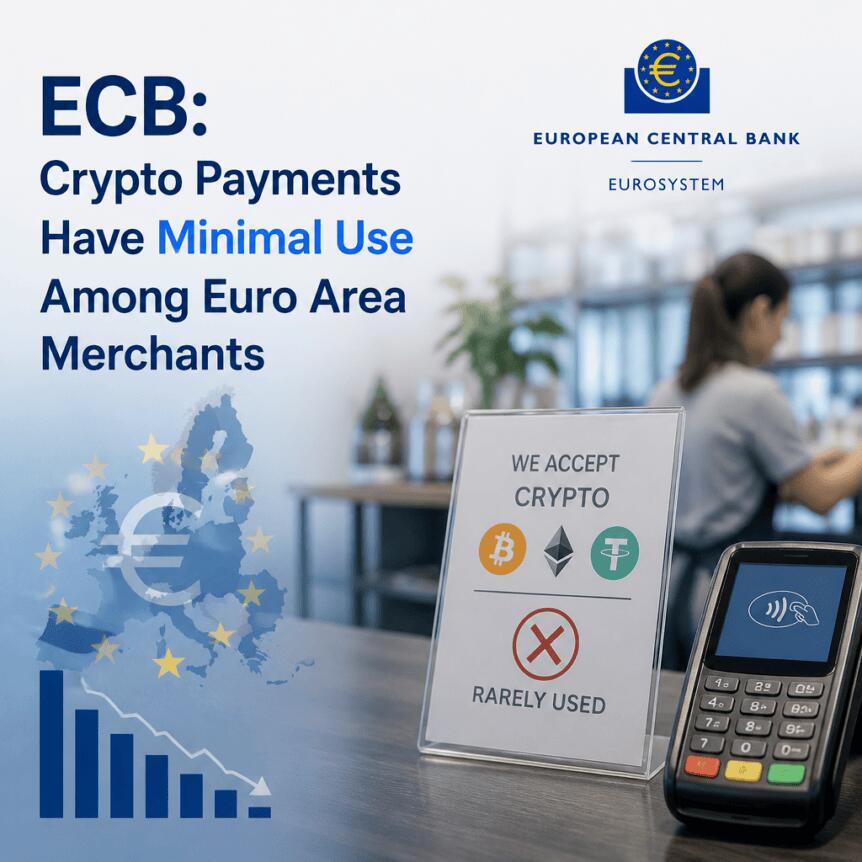
Crypto remains a niche option for payments across the euro area, according to a new survey by the European Central Bank (ECB) that tracks what businesses actually accept at the point of sale. Despite years of mainstream experimentation and the growth of digital payments more broadly, the ECB found that only a tiny share of merchants take crypto assets, including stablecoins.
In the ECB’s survey on companies’ cash use, just 0.2% of online merchants accepting goods and services online said they take crypto assets. Cash continues to dominate among businesses with physical sales locations, with 92% of companies accepting it, and mobile payment options continuing to expand quickly.
Key takeaways
- Crypto acceptance is extremely limited: the ECB reports 0.2% of euro area businesses accepting crypto for online purchases.
- Cash still leads at physical locations, accepted by 92% of businesses with point-of-sale outlets.
- Mobile payments are the main growth area for in-person transactions, rising to 68% acceptance in 2026 from 36% in 2024.
- Crypto and stablecoins show little traction at physical points of sale, staying below 1% in both 2024 and 2026.
- Merchants prioritize customer demand and security when choosing payment methods, with consumer preference cited as the top factor.
A euro area snapshot: cash holding firm while mobile rises
The ECB based the findings on interviews with 8,205 businesses across all 21 euro area countries. The sample includes retailers, restaurants and cafés, hotels, and arts, entertainment, and recreation venues. According to the ECB, Ipsos carried out telephone interviews from Feb. 23 to April 10.
While crypto remains close to the margins, other payment methods have moved meaningfully. At physical locations, mobile payments recorded the largest shift. The ECB’s figures show acceptance climbed to 68% in 2026 from 36% in 2024.
That rise is consistent with how customers increasingly transact in-store: the ECB notes that widely used mobile options include instant payments and digital wallets such as Apple Pay and Google Pay.
Where crypto sits: stablecoin and crypto acceptance stays under 1%
At physical points of sale, cash edged slightly higher—92% acceptance in 2026 compared with 90% in 2024. Physical card acceptance also increased modestly, moving to 88% from 87%.
By contrast, the ECB reported that crypto assets and stablecoins showed virtually no momentum. They remained below 1% acceptance at physical locations in both 2024 and 2026, suggesting that whatever progress the wider digital assets industry has seen has not translated into broad merchant adoption in euro area commerce.
The ECB also tracked other instruments. Acceptance of bank checks fell to 27% from 36%, underscoring that payments evolve unevenly across channels even as cash continues to retain the largest share of acceptance.
Why businesses choose payment methods—and why they don’t
The ECB survey highlights what drives merchants when deciding which payment options to support. Consumer preference was the most-cited factor, named by 26% of respondents. Security followed at 22%, while ease of handling came in at 15%.
The reasons for rejecting cash offer additional context for how businesses think about payment risk and practicality. Among companies that do not accept cash, weak customer demand was the most common explanation (36%), while the next-largest share pointed to difficulties related to depositing or withdrawing cash (35%). Security concerns were also mentioned by 29% of respondents.
While these responses relate specifically to cash, they help explain the broader merchant calculus: adoption tends to follow customer behavior and operational simplicity, with security and reliability shaping the risk assessment.
Country differences and the definition problem around “accepting crypto”
Merchant attitudes toward cash also vary widely across countries, and the same type of uneven adoption could be a challenge for crypto. The ECB reports that 51% of cash-accepting small and medium-sized enterprises in Cyprus said they may stop accepting cash, compared with 23% in Greece and 18% in Bulgaria.
For crypto, the ECB survey asked businesses whether they accept crypto assets or stablecoins. To anchor responses, it cited examples including Bitcoin, Ether, and Tether’s USDt (USDT).
However, there is a practical measurement issue. The ECB acknowledged indirectly that crypto payments can be structured so merchants receive settlement in traditional currency even when customers pay with crypto through certain services. The ECB’s survey, as described in the article coverage, does not clarify whether businesses should treat these arrangements as “accepting crypto.”
When Cointelegraph asked whether such conversions could affect reporting consistency and whether regulatory uncertainty could influence how firms answer, the ECB said it “prefer not to speculate.” In response to a question about whether euro area merchants are permitted to accept crypto under European Union rules, the ECB stated it does not set payment regulation and pointed to the European Commission and national lawmakers.
That distinction matters for readers interpreting the data: low acceptance rates could reflect both limited demand and constraints tied to how payments are operationalized and classified—especially in a regulatory environment where businesses may still be cautious about compliance or reporting.
Digital euro work continues, but merchant reality stays unchanged
The ECB’s crypto findings arrive as the institution continues its work on a digital euro—a central bank digital currency intended to complement cash while preserving the euro’s role in payments. Earlier coverage from Cointelegraph noted the ECB is advancing accessibility for payment providers as part of that broader CBDC effort.
Yet the merchant data in this survey points to a more immediate reality: even as mobile payments accelerate and digital channels expand, crypto and stablecoins have not crossed the threshold into mainstream acceptance for most euro area businesses—at least as measured by the ECB’s survey.
For investors, traders, and builders, the key question now is whether euro area crypto adoption can move from isolated use cases to meaningful merchant integration. The ECB survey provides a useful baseline; the next watch should be whether mobile payment growth continues to crowd out alternatives like crypto, and whether future regulatory clarity—or new payment rails using tokenized settlement—changes how businesses decide what to accept.
https://www.cryptobreaking.com/ecb-crypto-payments-have-minimal/?utm_source=blogger%20&utm_medium=social_auto&utm_campaign=ECB:%20Crypto%20Payments%20Have%20Minimal%20Use%20Among%20Euro%20Area%20Merchants%20
Comments
Post a Comment