
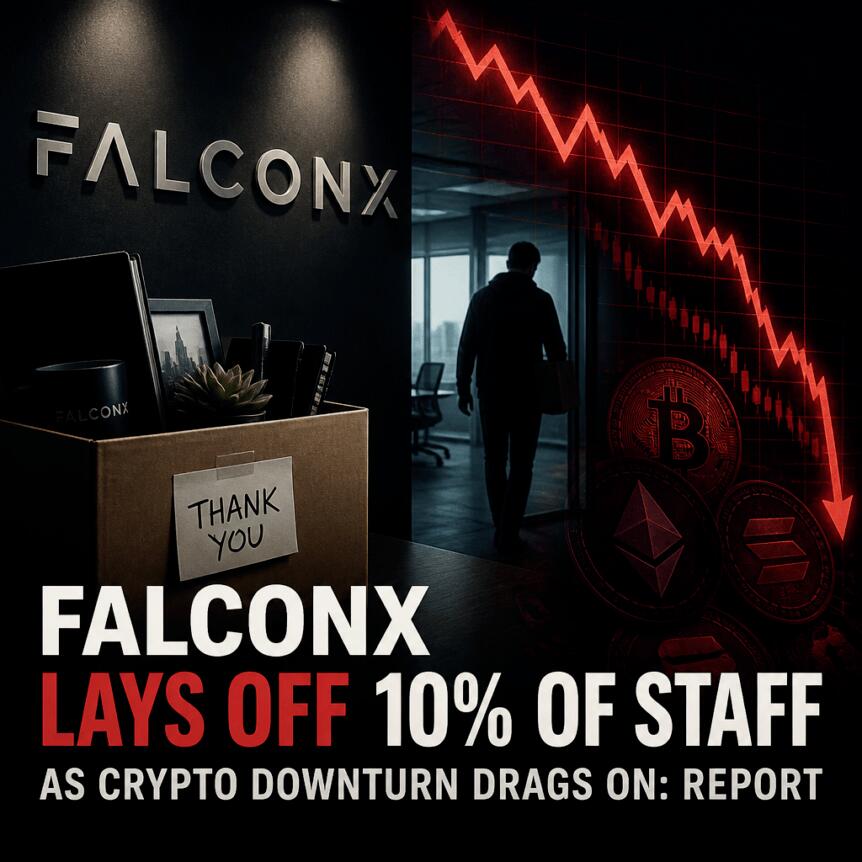
FalconX, the digital-asset prime brokerage that acquired crypto ETF issuer 21Shares in November, has laid off about 10% of its workforce as it braces for a longer crypto market downturn, Bloomberg reported Monday.
Bloomberg, citing people familiar with the matter, also said the firm is reshaping its Singapore approach—shifting emphasis toward crypto derivatives trading and planning to withdraw its license application with the Monetary Authority of Singapore. The company intends to keep a presence in Asia while expanding its business in Europe.
Key takeaways
- FalconX reportedly cut roughly 10% of staff amid expectations of an extended downturn, according to Bloomberg.
- The firm is reportedly pivoting its Singapore strategy toward crypto derivatives while preparing to withdraw its MAS license application.
- FalconX plans to maintain operations in Asia but is looking to grow its footprint in Europe, Bloomberg said.
- The move aligns FalconX with other crypto firms that have reduced headcount during the market slowdown.
- Broader exchange activity is shifting beyond spot trading toward derivatives and tokenized real-world assets, CoinGecko and Coinbase reporting suggest.
FalconX cuts staff as it plans a longer runway
Before the layoffs, FalconX employed about 350 people across the United States, the United Kingdom, Singapore, and Hong Kong, Bloomberg said. The report frames the cuts as part of a broader effort to operate through what it describes as a prolonged market slump.
Cointelegraph reached out to FalconX for comment but did not receive an immediate response.
Strategic pivot in Singapore, expansion in Europe
Beyond the workforce reduction, Bloomberg reported that FalconX is changing course in Singapore. The company is reportedly concentrating on crypto derivatives trading there, while planning to withdraw its license application with the Monetary Authority of Singapore.
While that withdrawal would mark a significant shift in its regulatory posture, Bloomberg also said FalconX expects to remain active in Asia. At the same time, the firm intends to expand its European operations—suggesting management is reallocating risk and resources toward regions it believes can better support its near- to mid-term growth plans.
Part of a wider wave of crypto downsizing
FalconX’s reported cuts add to a growing list of crypto companies scaling back operations during the downturn. Bloomberg’s report places FalconX alongside headcount reductions at exchanges and infrastructure providers mentioned by Cointelegraph, including Coinbase, Crypto.com, Luno, Gemini, and BitGo.
The shared theme is not just lower demand for trading products during a market cool-off, but also an industry-wide reassessment of costs, regulatory exposure, and product focus—particularly as volumes and retail participation tend to soften when asset prices pull back from prior peaks.
Exchanges broaden beyond spot as tokenized finance grows
Market pressure has been felt across trading venues. With Bitcoin and other digital assets retreating from last year’s highs, exchanges have seen trading volumes and retail engagement weigh on performance, and some analysts have argued that the market may still be finding its base rather than having fully bottomed.
Cointelegraph previously noted that some market participants believe Bitcoin has not yet reached a market bottom. At the time of the earlier reporting referenced in the source material, Bitcoin was trading below $64,000—about 50% under its October peak above $126,000.
In response, many exchanges are pushing into areas that can support activity even when spot momentum fades. CoinGecko, as cited in the source, reported that the “crypto TradFi” sector—which includes tokenized assets, derivatives, and other traditional finance products—grew fivefold to $6.6 billion between January 2025 and June 2026. That growth profile points to a strategic shift toward revenue streams less dependent on purely spot-driven cycles.
Coinbase’s latest earnings, cited in the source, also illustrate how some major platforms are positioning around products beyond spot Bitcoin trading. While Coinbase missed earnings expectations, it reported that 88% of second-quarter net revenue came from businesses other than spot Bitcoin trading, with derivatives, prediction markets, and tokenized assets cited as increasingly important contributors.
For FalconX, the reported emphasis on derivatives in Singapore fits this broader industry pattern: when spot trading slows, derivatives and structured products can help sustain engagement from more sophisticated participants and hedgers. However, the operational implications of withdrawing a license application—while still planning to operate in the region—will be something investors and clients may want to watch closely, since regulatory access can materially affect product availability and timelines.
Going forward, readers should monitor two things: whether FalconX’s European expansion accelerates in tandem with the Singapore changes, and how the firm’s reported shift toward derivatives aligns with the wider migration toward tokenized and TradFi-linked offerings as the market’s next phase remains uncertain.
https://www.cryptobreaking.com/falconx-lays-off-10-of/?utm_source=blogger%20&utm_medium=social_auto&utm_campaign=FalconX%20Lays%20Off%2010%%20of%20Staff%20as%20Crypto%20Downturn%20Drags%20On:%20Report%20
Comments
Post a Comment